You are currently browsing the monthly archive for April 2014.

I love dancing in dualities.
In the expressive movement classes I facilitate, I often ask my students to imagine dancing at one end of a sensory spectrum (“How does your body move if you imagine yourself in the middle of the Sahara, your bare feet in hot sand?”) and then during the next song ask them to switch to the opposite (“Suddenly we find ourselves in the middle of a blizzard. How does your body move to the cold, biting wind?”)
It’s an easy and fun experiment to see how many ways individuals can move, a chance for them to be creative and extend their movement beyond their “usual” dance. Ten bucks says the way your hands and feet respond to blistering desert heat is different from the way they are compelled to move during a mitten-less sleet storm.
My 5Rhythms teacher asked the same of us during a recent Waves class. During the final rhythm of Stillness, he proposed that we shift between movement that was open and that which was closed, our inhalation expanding us into one shape, and our exhalation leading the way into the next.
All he had used were the words “open” and “close,” but without much thought—more reflexive than mindful—I instantly translated these movements to “good” and “bad.”
So, for the first couple of minutes, my dance was a back-and-forth between shapes that looked like “Yes!” and “Halleljuah!” and “Here I Am!” to “Oh noooo” “Ow,” and “Woe Is Me.”
I even got a little upset. Before the teacher’s instruction, I had been feeling really alive. Now, he was asking us to be sad and withdrawn. How dare he…!
Fortunately, my Buddhist-in-training brain switched on before I got too far in the blame game, and it occurred to me that maybe these terms don’t need labels.
Why did I have to assign “good” and “bad” qualifiers to actions that were just that—actions?
It helped that earlier that day I had been listening to a talk from Buddhist nun Pema Chödrön, in which she was talking about the dangers of labeling mediation sits as “good” and “bad”:
“Say, for instance, you meditated and you felt a sort of settling and a sort of calmness, a sense of well-being. And maybe thoughts came and went, but they didn’t hook you, and you were able to come back, and there wasn’t a sense of struggle. Afterwards, [you think], ‘I did it right, I got it right, that’s how it should always be, that’s the model.’
Then you have the ‘bad’ one, which is not bad. It’s just that you sat there and you were very discursive and you were obsessing about someone at home, at work, something you have to do—you worried and you fretted, or you got into a fear or anger…. You just felt like it was a horrible meditation session. At the end of it you feel discouraged, and it was bad and you’re bad for the bad meditation. And you could feel hopeless.” (Source)
She goes on to explain how getting caught in this good-versus-bad tug-of-war causes a lot of angst and tension, always striving to attain the “good” and then almost always defeated when the good we were hoping for isn’t as good as the previous good, which means it is bad.
It feels as exhausting as it sounds. And this is what ultimately leads to suffering.
It’s kind of what was happening to me on the dance floor. I was getting pulled down into an abyss of “bad” because that is what I decided to equate with “closed.”
When Pema’s advice caught up to me, I decided to shift my thoughts.
I thought of all the ways “closed” movement can represent concepts beyond sadness and heartache and defensiveness.
Closed can mean shutting one’s eyes to daydream. Pressing hands together to pray. Curling up under a blanket to snuggle or watch a movie.
Closed can mean placing the hands palms down on the knees during meditation. Folding back into Child’s Pose during a strenuous yoga class. A baby in its mother’s womb, knees and arms tucked into chest—the original fetal position.
Closed can mean shutting down the office at noon for a siesta, wrapping arms around an injured animal or child and nursing it to health, withdrawing from the senses in order to tune inward in self-reflection.
In no time I was feeling alive again, no longer pulled down by this heavy anchor of “bad”-ness I had inflicted on myself.
Closing actually felt…beautiful!
Shifting my perspective in that one little way created big change, my dance of duality a moving lesson in being more open-minded about the notion of being closed.
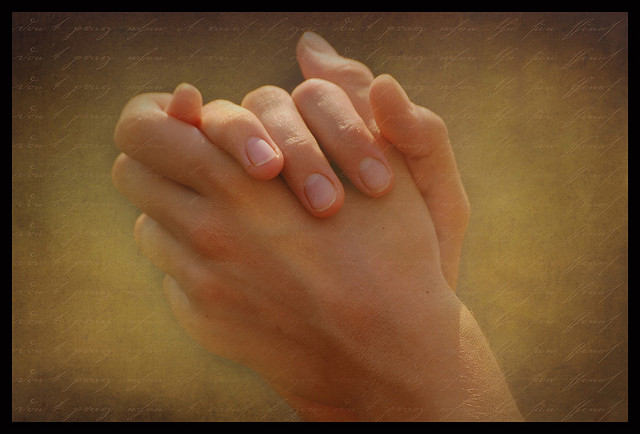
If you have any interpretations of “closed” you’d like to offer, please share in the comments below!
(This post is a continuation of my quest to reclaim my body through Rolfing®. Click here for my previous post detailing my history and decision to try this bodywork technique.)
When I entered my therapist’s office last week, the session started with a 30-minute consultation during which I described the most prominent and frustrating discomforts in my body, including postural/gait imbalances stemming from a small labral tear in my left hip, which leads to pain and locking in my sacrum and low back, as well as leg-length discrepancies that make me feel like I’m wobbling; a left shoulder that always feels sloped forward and contributes to neck and occasional jaw pain; and an incredibly tight psoas that constricts full diaphragmatic breathing.
The next step was for Laurie to examine my posture as I talked my way through how my body felt from the inside.
Standing fully clothed in front of her, I closed my eyes and described the way the soles of my feet pressed into the floor, how my knees balanced my weight, what the inside of my pelvis felt like as though it were a bucket carrying grains of sand. Was the sand evenly spread from femur to femur? Or did the sand feel heavier on one side? We used this kind of visualization up through my shoulders, and then I walked across the room a few times for her to assess my gait.
Some people may find this kind of description difficult to tap into, but as a very visual and sensory learner, I found it very natural and was happy to be with someone who worked in this manner.
I liked Laurie before I even stripped down to my underwear and got on the table!
The 60-minute bodywork session began ever-so-gently with Laurie pressing key acupressure points in my face, neck, and scalp and eventually working into my shoulders and arms, my ribcage and diaphragm, and then some work on my hips, buttocks, and upper legs. This is the traditional format of Session 1.
I was prepared for tightness in my left shoulder, and it was there. But it was never more than I could handle, and the most intense moments only lasted a few seconds. Laurie was constantly readjusting my arms, elbows, and hands like a puppet, and it felt good to move with the massage rather than lie passively and have someone dig in.
In that sense, my first Rolfing session felt like a combination of all my favorite bodywork/movement modalities—traditional massage, Thai yoga massage, chiropractic, yin yoga—all wrapped into one package, with a side of deep meditation.
I have a history of falling asleep during massage sessions, and although the Rolfing was at times surprisingly relaxing and comforting, I never felt the urge to drift off, mostly because I was taking great pleasure in the ways Laurie’s attentive work allowed me to feel my body in ways that had been locked off for so long.
For example, when Laurie worked on my perpetually tight psoas—which has been pulling on my diaphragm and sacrum for some time now—I experienced a wonderful opening in my sacrum, a sensation deep within the tailbone that I have only felt once before during a particularly intense A.R.T. session on that same area.
It was like smelling a marvelous new scent—imagine your nose suddenly inhaling something delicious—except it was my low back feeling something that had never been felt before.
I believe the words I said to Laurie were, “It feels like you’re tapping into a hidden repository of feeling in my sacrum!”, like Indiana Jones coming across a new, glimmering treasure buried deep in an ancient temple. It was there all along but just needed to be discovered!
I had a similar experience in my torso—after several minutes of her fingers smoothing out the tissue between my ribs, I had the sensation of my chest just opening and opening and opening like a blooming flower in fast forward.
My post-session description: “It was like a gynecological exam for my ribcage; she just spread me wide open!” It was a new sensation of expansiveness that I have not felt in a very long time.
Rolfing was no doubt more intimate that a traditional massage session in the way Laurie needed to work deep near my ribs and tailbone. That meant working near my breasts and close to my coccyx (i.e., at the top of my butt crack), but the sensation was more relieving than weird or uncomfortable. I am not modest when it comes to pain relief!
The work was also highly energetic and meditative for me. When she worked on my solar plexus, I felt a relaxing blue color spread through the area. Later, as she touched the same area as I lay on my side, I felt a wave of emotion swell from torso to throat, enough to make my eyes tickle with the beginnings of tears.
Midway through the session, I began to feel like a pot of water sitting on the stovetop, as though tiny happy bubbles were beginning a slow and steady rumble under my skin. I described the sensation to Laurie.
“What do you think that is?” I asked.
“That’s called good ol’ fashioned energy!” she replied.
By the end of the session, the bubbling had intensified to what I described as feeling jittery, giddy, and highly caffeinated. Laurie indicated that was a good sign, that we had worked deep enough to tap into the energetic body. Right on cue, it was time to wrap up the session before the energy got too intense.
Sure enough, as I lay on my back and Laurie did a few final touches on my scalp, something amazing happened.
She pulled her fingers off of my head, but I could still feel her. I knew she was no longer physically in contact with my head, but she was doing something above my scalp, and it felt like my facial skin was being pulling upward, a kind of energetic facelift. The sensation triggered an eruption of energy, which spilled forth in a burst of laughter.
It was not ha-ha funny laughter or nervous laughter but simply my body’s way of releasing the energy she had been coaxing. Almost instantly Laurie laughed back, saying she was keenly aware of the bubble of energy she was working with as well.
Stepping off the table, I felt amazingly aware of my bodies—yes, plural intended—my physical and energetic bodies. I felt like the planet Saturn, surrounded with rings of sensation that reached far beyond my corporeal surface.
Laurie encouraged me to use that sensation as a support, to learn to be comfortable being supported and carried by those rings of energy rather than using brute physical force to carry my body through space. I love this visualization, and I will probably write in greater detail about it later as I learn to incorporate it into my dance practice.
Before I left, I stood in front of Laurie again, feeling my way through my body from the bottoms of my feet up to my scalp. I was surprised at how firmly my feet were planted into the ground, when earlier I felt so wobbly and off-balance. The amazing thing is that Laurie didn’t do any work on my legs below my knees, which goes to show that everything is indeed connected.
Other immediate effects included a very acute tingling sensation in the big toe joint of my left foot, as though someone had spread Biofreeze on the area. This is the toe that has arthritis, and I couldn’t believe how vividly it was “speaking” to me after a session that included absolutely zero work on my feet.
It wasn’t pain, just an energetic “Hello, stuff has opened up in the rest of your body that is now trickling all the way down to me. This pesky arthritis has ‘locked’ me out for some time, but now I’m beginning to feel again!”

I felt strangely alert when I left Laurie’s office. Massages tend to make me super-sleepy and lethargic, but the feeling I had after Rolfing was more akin to how I feel after meditation or kundalini yoga—totally in tune with the world around me, grounded, radiant, and receptive.
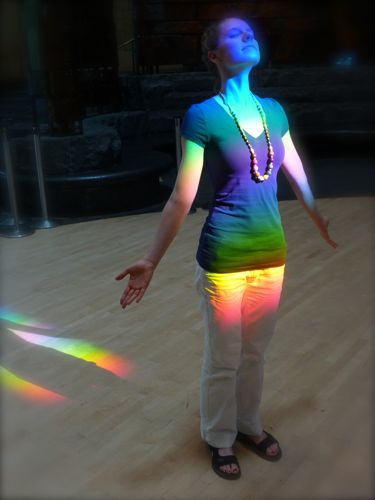
That evening, I attempted a simple backbend by pressing my hands into my sacrum, raising my chest, and tilting my spine back. Recently, my range of motion in this pose has been embarrassingly limited with my thoracic tightness, but that night I was able to see the wall behind me. I could not believe how far I was able to go back and the wonderful opening in my chest that allowed me to do so.
* * *
At the time I drafted this post, it had been exactly 1 week since my first session, and although I feel tugged by my old compensatory patterns, I am trying to be mindful of my movement and work on staying open and expansive.
I have noticed much more opening in my sacrum, chest, and shoulders during my warrior lunges in yoga and considerably more flexibility in my spine during backbends (but not as deep as that one the first evening). I can also bend forward into gorilla pose without feeling the usual psoas-sacrum-hamstring tug that so often limited my stretch.
I am staggering my 10 sessions every two to three weeks to help with the payments, and Laurie reassured me that I won’t “lose” what I’ve learned in-between sessions.
I return this week for Session 2, which involves the feet and lower legs. Watch out, Arthritic Toe!
Well, it’s official. I’ve been Rolfed.
Now that’s a phrase that may raise eyebrows, I’m sure. Is this something that requires filing a police report? Who did what to me, and am I OK? Is this a prank akin to getting Rickrolled?
In short, Rolfing® is a bodywork technique that aims to work out the kinks in the body’s fascia (connective tissue) that have accumulated over years of poor posture, compensatory patterns, and injury/overuse.
It’s different from massage, I learned, in that focal point of massage is muscle. Muscles have distinct attachment and insertion points in the bones, whereas fascia is an interconnected web of tissue that sheaths the entire body, “supporting and penetrating all of the muscles, bones, nerves, and organs” (Source).
Therefore, as the old saying goes, everything is connected. For example, a few years of sitting hunched over a laptop will not only affect your neck and spine but also your lungs, diaphragm, sacrum, hips, so on and so forth.
I’ve been getting deep-tissue massages regularly for several years, in addition to occasional chiropractic work that incorporates the Active Release Technique (A.R.T.). Both have served me very well and have aided in easing discomfort in my hips, sacrum, psoas, and scapula.
However, over the past year the relief provided by massage and chiropractic was short-lived. I’d have work done on my shoulders one day, swim laps a few days later, and feel out of alignment all over again.

Years of yoga and conscious dance have made me hyperaware of my body’s misalignments and imbalances, which has been both a blessing and a curse.
Being in tune with my body allows me to listen and respond precisely to what it needs (e.g., what shoes to wear on a bad hip day, what stretches to do in the morning), but being super-sensitive to every little notion of crookedness also makes yoga class an exhausting ordeal, my mind scrolling through a neverending checklist of all the body parts that feel “off” in each asana.
After a few recommendations from friends, I was ready to investigate this bodywork technique that they claimed changed their lives and introduced a whole new way of feeling.
Rolfing sometimes has an intimidating reputation of being torturous and painful, often likened to a deep-tissue massage from hell. Although some therapists take on that aggressive technique, the original form developed by Ida P. Rolf was not intended to be that way, and the therapist I eventually chose reassured me that her work was deep but not breathtakingly intense.
(In fact, my therapist trained directly with Ida Rolf and has been in practice for nearly 40 years, which was a significant selling point for me.)
The other factor I needed to consider before being Rolfed was cost. Rolfing is by nature more pricey than a regular massage session, and first-time Rolfing clients are encouraged to follow the “standardized ‘recipe’ known as the Ten-Series, the goal of which is to systematically balance and optimize both the structure (shape) and function (movement) of the entire body over the course of 10 Rolfing sessions” (Source).
So right off the bat, I knew I’d have to put out at least $1,000 for my treatment, should I go ahead with the full program.
It was a difficult decision, but after my annual contract at a so-so franchise massage spa ended and I was no longer shelling out monthly dues to another bodyworker, I felt confident going ahead with a plan to reclaim my body.
Stay tuned for a detailed recap of my first visit!





 Flowtation Devices