You are currently browsing the category archive for the ‘Class Reviews’ category.
Four weeks ago, I started taking a weekly tai chi class with my sister. The intention was for my grandmother to take class with us, but she just hasn’t felt up to it. Nevertheless, I’m enjoying having something permanent on my schedule every week, especially because I get to see my sister. We’ve been trying to do “after-class” socializing too, whether it’s going out to dinner at the local vegetarian restaurant, visiting my sister’s friends and their new baby girl, or getting salads to go and eating dinner at my grandparents.
And, oh yeah, the class itself is pretty good too. 🙂 The studio space is a bit “clinical” (bright overhead lights, a bit on the cool side), but I’m trying not to let those things bug me and focus entirely on the movement. Here’s what I’m digging so far about tai chi:
1. Attaining a clear and focused mind. After an hour of meditative movement and breathing (along with listening to my hypnotherapist teacher’s voice), my mind is in such a better place. I always enter the room a bit rushed and dizzied, having driven there right from work, but I’m in a totally different mindset once I leave. Any crazy guilt I have about not getting a “real workout” (i.e., sweat and breathlessness) on Thursday nights dissipates once class is over because I know that I have given my mind the workout it needs and deserves.
2. “Beach” feet. Yoga, tai chi, qi gong…whenever you’re doing an activity that requires absolute presence and mindfulness, you begin to feel very in touch with your surroundings, including the way your feet feel against the ground. Sometimes yoga makes me feel like I have tree roots growing from my soles into the earth, but tai chi makes me feel like I have “beach” feet, as though I’m standing barefoot by the ocean, my feet sinking softly into the wet sand.

3. Balance practice. Part of our warm-up is to shift from one foot to the other, balancing in place while “holding the ball” in front of our abdomen. Standing on one foot after a day of sitting at a desk or driving isn’t always easy, but it gives me a sense of attaining balance not just on my feet but in life in general.
4. The diversity. I’m 31, my sister is 26. The teacher’s assistant looks like she is in her 70s and wears orthopedic shoes throughout the class. There is a woman who has spinal issues and cannot twist and a “senior student” Asian man for whom tai chi looks second nature. The class brings in people of all different ages, abilities, and backgrounds, and there is something endearing about such a diverse group of students all learning the same thing together.
5. The flowing nature of the style. When all 24 postures of the Yang style are linked together, the result is a flowing work of choreography. We are still learning just the basic moves, but with time I hope to synchronize the arms and legs more; sink deep into the ground; and use the whole space available, not just one little spot on the floor. This woman is my inspiration:
Last Friday, I posted this message on Facebook and Twitter:
I’m getting my semi-annual “I’m losing control of my life” panicky feeling where a million things happen at once & I start to withdrawal 😦
Now, realistically, things aren’t that out of control. I have friends who are doing a ton more than me or who are going through some huge life issues, and I should just be counting my blessings that I’m not in grad school or caring for an insomniac toddler or having to approach HR about taking family medical leave (all real-life instances among my circle of friends). For the most part, the panic is just all in my head, and I’m letting stupid things get to me. I’m sweating the small stuff.
That’s why when I found out that Laughter Yoga leader Bob Pileggi was coming to town again, I knew I had to attend his class. I took one of his classes back in October, and the effects were immediate. It’s no secret that taking in more oxygen makes you feel good, and that’s the whole point of Laughter Yoga: to loosen up, open the lungs, work the diaphragm, and BREATHE! Suck in the air, let it out, and feel the ripple effects of all those sweet inhalations and exhalations. Everyone’s heard of a runner’s high, and it’s not that far off from the feeling one gets after Laughter Yoga. You get that same oxygen-induced buzz–almost a giddiness–minus the disgusting sweat and painful shinsplints.
I’m not going to go into too much detail about the class this time around; most of the exercises and my reaction to them are described here.
This particular class, however, had significantly more people, which certainly added to the experience. There were more eyes to connect with, more bellies to watch shaking. I even joked that one man had to have been the paid “decoy” because he was just so committed to the practice, his eyes twinkling, his laugh so hearty that every time I heard it I couldn’t help but double over myself.
We closed class by lying on our backs, our legs propped up comfortably on several folded yoga blankets, with just one instruction from Bob: “When I say ‘start,’ begin laughing and don’t stop until I say so.” What usually happens is that the first few seconds are a bit forced, simply a physical practice of vocalizing and pumping the belly. Then comes that tipping point, the moment at which something–usually someone’s cute little giggle or a bowl-full-of-jelly Santa Claus rumble–just sets everyone off, and the scale tips toward the truly authentic, gut-busting laughter. And I don’t mean a texting “LOL,” I’m talking about LOLFR–laughing out loud fer realz. Head thrown back/back arched/eyes crinkled laughing, the kind you get when it’s late at night, you’re a bit slap-happy, and you and a friend decide to apply Transformers tattoos on each other:


Bob always starts class by asking us to check in with our bodies and mind, to list on a scale of 0 to 10 how present and open we feel. I came into class as a 3 and just an hour and 15 minutes later was boosted to an 8. To tell you the truth, I’m always pretty resistant at the start of any kind of class, but I kind of see these endeavors as “therapy,” and know that by the end I will usually feel a million bucks better. Actually, even just a few minutes into class–after some simple deep-breathing exercises and a bit of meditation–I was already shedding my armor.
I used the lessons from the class later in the evening, when I was forced to park blocks away from the take-out restaurant where I was picking up my dinner. The walk I didn’t mind; it was the frigid wind chill that initially had me shouting expletives in the wind. I tried trading a f*** for a chuckle, and you know what? It made me feel better. Not warmer or less windblown, but just a little better.
Ever think of just laughing off a particularly annoying situation?
I could probably do this every morning on my drive to work, when I’m almost always stuck behind a slow-moving school bus/garbage truck/oil tanker.
Remember late last year when I took a Let Your Yoga Dance (LYYD) class with Nikki to help her fulfill her practice teach requirements?
One of the other students in the class was Suzie, who just so happened to be in the same LYYD training program at Kripalu. Suzie was a super-fun classmate, but I couldn’t wait to be one of her students. Like Nikki, she had a demeanor that just exuded Teacher. And, seriously, how cool is it to have not one but two LYYD teachers in my neighborhood?!
Friday night, in honor of the Go Red for Women campaign, Suzie held a heartwarming LYYD class where all proceeds went to the American Heart Association. It was a perfect tie-in: Raising money for charity by coming together and dancing our hearts out, getting our own cardiovascular workout through something as simple as dancing freely and openly.

I came into the class a bit tired and very cold. I felt like I was carrying weight of the work week on my shoulders, and I was afraid I would (a) just not have any energy; and (b) be a popsicle the entire time. When I am cold, I live with the fear that I will never warm up. Luckily, a few minutes of shaking around to Michael Franti’s “Say Hey (I Love You)” took care of that. 🙂
The thing about being a teacher is that you have to be ON, because you are the lighthouse for the rest of the class. If you begin to fade, the class energy fades with you. Suzie had some factors working against her: only a handful of students (one of whom [me] was sleepy and shivering) and the fact that we were dancing in the phys ed room of a small parochial school, surrounded by unflattering overhead florescent lighting, worn gray carpeting over a concrete floor, and hideous bright blue/yellow walls. She’d have to work extra hard to get us motivated!
Luckily, Suzie never let the conditions get to her and remained naturally ebullient throughout the entire class. It was hard to be grumpy when dancing with someone like this:

Those hats were used during our Broadway routine to “One” form A Chorus Line, when we strutted, shimmied, and kicked our way across the room. I have to say that was one of my favorite routines; props + musical theater = Happy Jen. It reminded me that as much as I love free-form dance, my past experiences on stage are still very much a part of me. (Maybe next time Suzie can play one of the songs from 42nd Street, with the tap-shoe sounds? Because how seriously fun would that be to pretend we’re tap dancers?!)
Our other props were scarves, which we moved fluidly and tenderly to RENT‘s “Seasons of Love” and then whipped around joyously to the Charlie Brown “Linus and Lucy” song. The colorful scarves were a great addition, and they helped add some vibrancy to the otherwise drab room. During the first song we were all inhaling and exhaling our scarves together like an opening and closing flower, and then when the Charlie Brown music came on, the scarves bobbed up and down with us as we shook around like cartoonish Peanuts characters.
And what’s a LYYD class without partner work? One of my favorite partner routines–not just of the class but, like, EVER–was standing in front of another person, eyes closed, and having their touch guide me into spontaneous movement. So the woman behind me tapped my right shoulder, and I moved from that touch. Then she touched my left knee, my right hip, the back of my head. Suzie instructed the “mover” to pretend as though we were in water, and that each touch from our partner created a kind of ripple effect. What made me love this practice so much was (a) the spontaneous factor, not knowing where I was going to be touched next; and (b) the “controlling” effect of being the toucher. It was like being a puppeteer in a way, me tapping my partner’s shoulder and watching her respond to that touch. I could control the speed I offered my touches and decide where my touch would go. And yet the movement she presented from that touch could never be predicted: Sometimes she rolled down over her knees, other times she reached up to the ceiling. What a seriously great practice in the dance between spontaneity and control, and also how one’s action can be so influential. The world continues to move via ripple effects.
I left class warm, both physically and emotionally. I wasn’t ready to be all Ya-Ya Sisterhood with my other three classmates, but I did feel more connected to them than when I first entered the room an hour earlier. I guess stuff like that happens when you roar like lions in each others’ faces and then later dance palm-to-palm, a la the Romeo and Juliet masquerade ball.
As much as I tried not to let the external environment get to me, I do wish the setting could have been a little more welcoming, maybe less harsh lighting and just a tad more visual warmth. I know the essence of yoga lives within us, but trying to cultivate it while standing under institutional lighting on a shabby gray carpet was a bit challenging. I joked that for her next class, Suzie should ask everyone to bring a small lamp or camping lanterns so we can shut off the overhead lights.
If not, though, I’ll just try to dive more into my practice and keep calm. 🙂

This past weekend marked the beginning of a tidal wave…of 5Rhythms, that is!
As I’ve written before, I’m a huge fan of the movement/dance practice called 5Rhythms. In a nutshell, 5Rhythms is the practice of movement through five different rhythms (duh)–Flowing, Staccato, Chaos, Lyrical, and Stillness–which collectively are called a “wave.” This weekend was the start of a monthly series dedicated to concentrating on one rhythm (although we did the other rhythms as well. My god, I would collapse if we did three hours of just Chaos!).
I think of myself as a very fluid and flow-y mover (um, hence the name of this blog), so I honestly thought that focusing on the first rhythm, FLOWING, would be easy and fun for me.
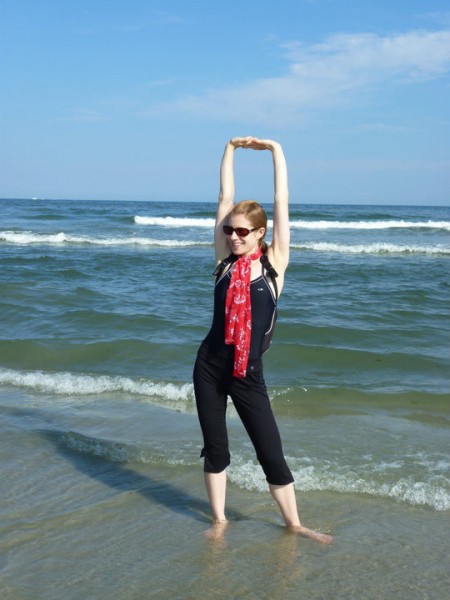 Surprise! It was not.
I DO like Flowing…but only to a point. There came a threshold when after so many swoops and sweeps and flutters and airy turns that I wanted some definition. Some pizzazz. Some oomph. I wanted Staccato.
Now, I’m not sure if it’s because I got tired of the Flowing movement itself…or whether it’s because I love structure, and my OCD brain was thinking, “OK, time’s up! The blueprints say we’re supposed to move onto Staccato now. Chop chop!”
Nevertheless, lingering in Flowing for longer than usual began to feel like an aerobics class that never progressed beyond the warm-up.
After class during our sharing circle, people commented that I am very much a Staccato dancer, which surprised me because in real life I am far from a Staccato personality (direct, forthright) and probably closer to Flowing (indecisive, experimental, constantly changing direction). I linger in the supermarket aisles because I cannot decide which yogurt to buy. I hem and haw over what to make for dinner, which restaurant to go to on Saturday night. I wanted to be a yoga teacher. And then I didn’t. Currently, I edit during the day…but dream of flying Southwest jets by night.
Environmentally speaking, another factor that inhibited my Flowing freedom was the floor (How many Fs can I get in that sentence?). We were dancing in a school auditorium, and certain spots were as slippery as ice. That was a HUGE factor in how I moved, and I had to be very cognizant of which areas were the danger zones and what moves I did if I found myself standing there. It’s kind of tough to fully let go when you have only three options: flow, fumble, or fall.
The instructor had some great tricks up his sleeve to help facilitate the notion of Flowing. For instance, we took a partner, placed our hands against the sides of her chest by the rib cage, and simply stood there with a gentle touch to receive the expanding and contracting of the partner’s inhalations and exhalations. It was soothing as both the passive holder and as the active breather–it is so much easier to take full, deep breaths when someone is physically encouraging you. It’s also a good reminder that breathing doesn’t just take place in the front of the chest and that it’s a 360-degree action.
Another great exercise was getting the whole class to stand in a circle, collectively inhaling our arms up toward the ceiling and then exhaling our arms and upper body down toward the floor, a bit like unstructured sun salutations. We did this several times until it began to sound like the ocean. It was so calming…and pretty cool to see the entire group do relatively the same motion (as usually we are all doing our own thing). We then began incorporating our hips into the breathing, then the feet. Soon, our entire body was part of the inhalations and exhalations, and the circle began to slowly break apart ever-so-calmly as we flowed into our own dance.

Flowing like the Disney Concert Hall
As I approach two years of dancing the 5Rhythms, I am learning some interesting things:
• I dance better at night. The monthly class I attend is on Friday nights, and it is there that I always feel my most free. I think there is something exotic about letting loose after work, as the sun sets, especially when there’s a full moon. This particular Flowing workshop started mid-afternoon (sunny) and ended at dinnertime (dark), and I definitely felt more “on” as the room grew darker and darker, until we were dancing only in candlelight and a small spotlight.
• I am more responsive to some people than I am to others. The notion of partnerwork can either make my heart leap or have me cringing. I generally love working with people who exhibit a heightened sense of musicality and rhythm, but even some people with those qualities just make me feel oogy. I am aware that I energetically block them off from me, and I often wonder/worry whether they can sense that.
• The simple act of looking someone straight in the eyes can be both terrifying and electrifying, like unlocking a door to a whole new realm of connection beyond movement. It takes A LOT for me to let my eyes dance. I can twirl and curl and shimmy and shake, but allowing my face to get involved is a huge feat. It’s why practices such as Biodanza are so important.
• There is still a lot of chatter going on in my head when I dance. Sadly, it is usually about other people in the room. I am somewhat of a storyteller and tend to develop these imaginative back stories of the people around me. I usually need to complete a full wave of dancing before this judgmental jibber-jabber dissipates and my brain is rid of unhelpful junk.
Barring any winter storms that prevent me from driving over the river and through the woods to February’s workshop, next month I’ll be focusing on my supposed dominant rhythm: STACCATO!

I didn’t realize it at the time, but when I came home from work last Wednesday utterly drained and so blah-diddy-blah, I was actually in the throes of PMS. Once a month, usually a few days before my period arrives, there is “Tired Day,” usually in the middle of “Rage [I Hate Everyone] Day” and “Hungry [Eat All the Things!] Day.” No matter how much coffee I consume or how many hours of sleep I get, if it’s Tired Day, I will be on zombie mode.
My first instinct when I came home that day was to immediately put on my pajamas and go to bed. Screw dinner. After all, Hungry Day wouldn’t arrive for another 12 hours! But something inside of me persisted, urged me to at least try to do something physical. I knew better than to push it, and I had no intention of even lifting a dumbbell or holding myself in a chaturanga. Then I remembered the CD I had purchased at Rudy Peirce’s yoga workshop last month, an 80-minute beginner-friendly gentle yoga class. I had yet to try it out, waiting for the perfect moment when such a practice would be appropriate.
That moment had arrived.

The practice is s-l-o-w. Circa-2004 Jennifer would probably hate the CD and throw it out the window in favor of a hot and sweaty ashtanga class. The postures are nothing new, nothing crazy. There are many moments of stillness to allow for integration. We bend to the right. We hold. We breathe. We release. Repeat on the left.
I don’t know if it’s because I know Rudy from Kripalu, whether it’s because I swear his voice alters your brainwaves into a meditative state, or (shocker!) maybe I just needed this type of practice, but man, I felt goood throughout the entire CD, like I was giving myself some kind of yogic massage. Each breath, each stretch, each hold seemed to release a “stickiness” in me, sometimes a physical stickiness in the back or shoulders or an emotional stickiness. The more I followed Rudy, the clearer my foggy head felt, as though each posture were plucking a cotton ball from my brain.
How could it be that I came into this practice so tired, and yet the more I moved the more full of energy I felt? Not an “I’m-gonna-dance-all-night energy,” but just a “Wow, I-feel-alive!” kind of energy? I was moving from zombie to human with each asana, and I loved the feeling so much that when the first 40-minute segment ended (my original self-imposed endpoint), I let the CD keep spinning and continued into the next 40 minutes to complete the entire practice. I even sat in meditation for a few minutes after the CD slowed to stillness, compelled to work with this newfound energy for as long as I could.
Slowing down is difficult for me, and most of my life I always feel like I’m running late to something. For example, last night I went into Philly with my friend to see a show. The second we got off the train in the city, I began booking it to the theater. Now, give me some credit, it was mighty chilly outside and walking fast helped keep me warm, but for some reason I felt like we were running late to the show. The performance started at 7; we walked through the theater doors at 5:58. The box office hadn’t even opened yet. Oops!
I just have a tendency to want to be fast. I drove past a girl running through the park yesterday morning, and for a split-second I really, really missed running. It was cold outside, and the girl was dressed in her black running tights, an Under Armor mock turtleneck, and her winter running hat. I recalled running in the cold-weather months, how I loved that feeling of warming up by running fast on a chilly December morning. Man, to be fast again, I thought.
However, as much as it sucks to have hip issues, maybe not running is some kind of life lesson for me, an invitation to just slow down. Maybe my walking practice is supposed to be the Rudy Peirce version of running, a meditative practice in enjoying the breaths between each step.
Actually, were it not for my long walks, I would never have the time to listen to some of my favorite iPod selections. Through walking, I am given the opportunity to listen to Christmas carols as I stroll through neighborhoods lit up for the holidays and some of the most intriguing/hilarious/inspiring podcasts. Right now, I’m addicted to NPR’s Radiolab, where each episode covers some mind-blowing aspect of science that leaves your jaw on the floor. For instance, the other day I listened to a story on the origin of AIDS and its spillover into the human race, a frightening account of a woman with transient global amnesia who couldn’t form new memories beyond 90 seconds, and a poignant story of a young man named Kohn whose voice was significantly altered after a childhood accident.
Coincidentally, the title of that last episode?
Slow.
I feel like I should have a little check-in with myself every month to review where I am with my yoga practice; in short, Am I doing it?
I rarely go to studio classes anymore, for many reasons: (a) I feel like I know enough to guide myself through a practice; (b) sometimes class times don’t jive well with my work/commute schedule; (c) I’m annoyingly picky about studio temperature/teachers’ voices/teachers’ word choices (i.e., “goddess,” “divine,” and any talk of angels will have me squirming in my savasana); and (d) I’m self-conscious about my hip and the fact that sometimes I have to stop what I’m doing and jostle my leg around to snap it back into place…and sometimes that takes quite a few jostles.
The one exception I made, starting back in October, was to sign up for a 5-week kundalini yoga series. I knew the teacher from a tai chi series I took two years ago, and she is very accommodating to injuries/limitations/modifications, as she herself has faced several physical challenges. I told her straight off about my hip and how I’d be using blankets to prop me up and may have to stop every so often for the jostling, all of which she was totally cool with. I was so happy when she guided us through frog squats but made a point to demonstrate that one doesn’t have to go all the way down to the floor and can simply hold onto their calves.
I was glad that I had registered and paid for the class beforehand, which kept me from bailing out. The class didn’t start until 7:30 p.m., and at times I struggled leaving the house after it was dark outside and I felt settled in for the night. Fortunately, the studio is less than 10 minutes from home, so I never felt like it was a burden to drive to class. Another plus: I always, always, ALWAYS left class feeling a million times better than when I started. I’m sure my husband noticed that the cool-as-a-cucumber woman who entered the front door at 9 p.m. was not the same as the one who trudged out at 7:15.
We started every class with an aura-strengthening kriya, which the teacher recommended doing every day, not only to keep our physical self healthy but our energetic body as well. I took her words to heart and have started every morning with the set, especially because I find there is a lot of negative energy floating around this time of year, with harried holiday shoppers, disgruntled cashiers, and many meet-ups with friends and family who may be energy vampires. Also, on a physical level, ’tis the season for unwanted germs!
Over the course of the 5 weeks, we also practiced the “Sa Ta Na Ma” meditation for 12 minutes; the “Breath to do when you don’t know what to do” (inhale thru nose, exhale thru nose; inhale thru mouth, exhale thru mouth; inhale thru nose, exhale thru mouth; inhale thru mouth, exhale thru nose); a Celtic energy clearing (while standing, wave hands above head, over heart, over stomach, in front of knees, behind knees); and a gong meditation, first to a recording of a gong, then later to an actual gong. I found that the gong meditation really stirred up some stuff inside of me, because at times it was really, really loud, maddening, almost. It was chaos in my mind, and I found myself wanting to scream along with the jarring sounds, not because it bothered me but because it was just stirring up some residual emotions. But then when the gong slowed and became soft, so did I. It was interesting to fluctuate between the two very different sounds.
I loved everything about the series and only wished it were a permanent class. I was really bummed when the 5 weeks were over, but I try to do a little kundalini every morning after waking up.
***
During the process of writing about my Kripalu experience, I began to crave more Kripalu-based classes. I wrote about finding a Kripalu class on YouTube, and then shortly after that I found the actual Kripalu-at-Home website, which offers videos of 7 different, full-length yoga classes.

I had done Devarshi’s moderate/vigorous one previously, and I’ve since tried Megha’s gentle class (a little too introductory for me, but probably great for beginners; also just wonderful to hear Megha’s voice again!); Jurian’s moderate class (her theatrical voice is perfect for leading class; fun practice, but so glad I was in my living room because there was a lot of hip-jostling going on); and Coby’s moderate vinyasa flow (REALLY loved this one, especially her utkatasana series). Others available but that I haven’t tried yet are Sudha’s restorative class and two vigorous classes, one from Danny and the other by Jovinna. Coby’s class is my go-to video when I’ve looking for a flowing practice, and if I crave a little more power, I just throw in my own chaturangas in between the planks and downdogs.
In fact, I practiced with Coby this morning, when, after waking up late and doing some stretching in the living room, out of nowhere I felt the urge to do a full practice. I actually put off from drinking my morning coffee for an hour so I could take class! That says something!
***
As I wrote previously, November also marked a yoga workshop with Rudy Peirce. I’ll admit, it was nice to be in a studio setting and work with others, especially a workshop setting where things are more hands-on and instructive. Even better was meditating with others, because otherwise it’s so hard to sit still! I bought one of Rudy’s gentle yoga CDs so I could take home the experience, and I also bought a new yoga mat to replace the Gaiam one that I keep slipping and sliding on. Several months ago I had posted about the quest for a new mat, and several people commented about the wonders of Jade. This studio happened to specialize in them, so I picked out my favorite color (red) and brought the new guy home with me.

The studio owner warned me that it would need to “air out” for a while to get rid of the rubbery (not chemical) smell. Boy, was he right! I’ve been airing it out for about 3 weeks and it finally seems ready to use. Not that I couldn’t have used it earlier, but the thing made the entire living room smell like new tires.
***
Finally, although this type of yoga doesn’t require a mat, I spent two Thursdays in November participating in the final two practice teach classes of YogaDance teacher-in-training, Nikki (who actually is now a full-fledged Let Your Yoga Dance teacher; she graduated this past Friday!). Nikki deviated from her prescribed class outline during the final class and taught something she created herself instead, and the authenticity showed! I didn’t realize that her previous classes were not her own (the outline was chosen for her), because she did so well leading them. However, when she taught a class full of music and choreography that was her own, her true spirit emerged, and it was so fun to be a part of this creative awakening. She has plans to eventually teach a weekly YogaDance class at a nearby studio, and I hope I can be a part of it. YogaDance reminds us that yoga doesn’t always have to be about sun salutations and downdogs; it’s about taking time to connect body and breath, movement and spirit.
…That said, I do like the way that hatha yoga stretches and strengthens, and I would like to incorporate that a little more into my life. We’ll see during the next yoga update if I managed to do that in December!
It feels like it was forever and a day ago, but last month I had the opportunity to take a 2-day yoga workshop with one of my main facilitators from my Kripalu yoga teacher training, Rudy Peirce.
During my month at Kripalu, we were introduced to a wide range of teachers and variations on the Kripalu style, but it was always after Rudy’s classes that I felt the most content, still, and focused. We meditated a lot during those 28 days, but I felt like I always sunk just a little deeper when Rudy was at the front of the room. Rudy is also a master at offering modifications and adjustments, and although I jotted them down in my notebook during my training, their importance was never a great as they are now, when I am constantly looking for ways to make certain postures accessible in light of my hip limitations.
Five years after my training, I consulted with the universe in perhaps meeting up again with Rudy, and the universe answered by bringing Rudy to a yoga studio 45 minutes from my house.
It was a Big Deal for me to attend the workshop, because it meant I’d have to drive–by myself–out of my comfort zone, on unfamiliar roads and highways that kind of scare me (for no reason). This is usually the dealbreaker for me and out-of-town events, but there was no way I could ignore this awesome act of synchronicity. I printed out directions from Google Maps, slapped my husband’s GPS on my dashboard, and set out on the road. My first commute on Saturday was a bit hairy, because my directions led me through a not-so-nice part of Philadelphia. Fortunately, before I went home that evening, the ever-so-gracious owner of The Yoga Garden studio sat down with me and mapped out a way-friendlier route, which I used the following day and arrived without a hitch. Thank you x 1,000,000, Mark!
(By the way? The Yoga Garden is such a fantastic place! I wish I lived closer because I would love to have it as my “home base” studio. Everything from the entranceway to the bathrooms to the lobby was so perfectly zen and aesthetically pleasing. It definitely helped to walk into such a pleasant environment after sweating through a nervewracking drive.)


I saw Rudy in the lobby before class, and he swore that he remembered me from back in 2006 (apparently my last name runs in his family as well). In case he forgot what cohort I was with, I brought along this photo of all the teachers/assistants from Fall 2006:

He kept the photo alongside his notes for the whole class, which I found so endearing!
I didn’t know it coming in, but Saturday’s class was a backbend workshop. I thought it was going to be a general yoga class, and when I found out I got nervous–but for all the reasons why such a class would benefit me: I feel stiffness in my thoracic region, standing backbends don’t come so easily to me anymore, my lumbar spine aches at times. But Rudy’s approach to exploring backbends is slow, simple, and mindful, meaning no Wheel or anything crazy within the first hour of class. We did a lot of warm-ups, several forward bends followed by rising to standing via a straight spine, rather than rolling up. Rudy’s instruction was to “bend the knees, take the curve out of the spine, and come up straight,” as he noted that “rolling up” and stacking the vertebrae can cause strain over time and sometimes is just plain old dangerous for older people with aging spines.
We rose up from every forward bend by either rising the arms overhead or elongating them in a T position out to our sides, palms up, lifting sternum, pressing pubic bone forward, and tilting the head back while gazing to the ceiling in a slight backbend. The first time I did this I felt so stiff, but after several rounds, this move felt delicious. I found myself wanting to hold the backbend for just a little longer, plus I was actually breathing in the bend, something that is usually difficult for me. No longer did my inhalations stop once I dropped the head back.
We did some work with Eagle arms too, which I think really helped work some kinks out of my trapezius and neck. Even though most of us could wrap the arms in Eagle without assistance, we used a yoga strap to hold the arms, which took away any excess strain and helped us focus on our backbends. Pressing the hands to forehead, we went from a backbend to a forward bend, while still holding the arms in Eagle. Have I ever done a forward bend with Eagle arms?? I don’t even know, but it felt great. (Side note: Since this workshop, I’ve incorporated some Eagle arm stretches into my post-swim workouts.)
I knew Camel was coming eventually. When I think of Camel, my mind goes back to Bikram class, when Camel kinda feels like sh*t. But here, we did a lot of prep work leading up to the full pose, including a “Camel dance” (bring right hand to right heel, rise, left hand to left heel, rocking back and forth with breath) and then a one-sided Camel during which the right hand comes to right heel, opposite arm extended up, pubic bone pressing forward, slight backbend. Repeat on opposite side, and continue side to side in your own flow. I tried some prop assistance during this pose, including placing a cushion on my calves instead of reaching all the way down to my heels and then placing a blanket under my feet to raise the heels closer to my hands. Of course, there’s also the option of placing blocks between your feet, but I really liked the cushion-on-the-calves modification. By the time we got to the full expression of the pose, I was fully alive. Gone are my visions of puke-inducing Camel!
Some other modification pointers I took home with me were really, really simple (like, Why didn’t I think of that on my own?!). One is placing a folded blanket under the hands during table pose. I’ve seen the folded-mat variation of this before, but I like this option because it doesn’t shorten your mat. Another was placing a rolled-up yoga mat long-ways across your knees during seated meditation to allow the hands to rest comfortably on the knees. I especially liked this one because I generally sit in hero pose for meditation, and I’ve found it difficult to find a comfortable/natural place for my hands to lie. The yoga-mat option allows my hands to rest beyond my knees as though I were sitting in sukhasana.
As expected with any Kripalu class, we ended with pranayama. I was so excited to be led through kapalabhati with retention, something I learned at Kripalu and never saw after that. Yet it is so invigorating! Rudy also led single-nostril kapalabhati, in which we did 20 expulsions on one side, 20 on the other, and then alternating-nostril kapalabhati. Yowzas! My brain felt cleared of any junk, and my body tingled with oxygenation.
Rudy closed class with his usual “Hari Om, shanti, shanti, peace, peace,” which brought a smile to my lips. I hadn’t heard his voice utter those words since 2006, and it reminded me of Kripalu and the time when one of my classmates asked him what “hari” meant, to which Rudy had replied, “It means Yay!” 🙂
After class, I hung around to talk with Rudy’s wife, Joyce, who had tagged along as his assistant/sidekick. She is a dancer herself, and we spent some time talking about the challenges of being trained in dance/flexibility yet never in strength, as well as the challenges of carrying the “teacher” label and finding a balance between being a student and leader. It was comforting to learn that Joyce also struggled in adapting to being a “teacher” and how it tarnished the innocent love and fascination of yoga that came along with just being a student. And why is there always a tug to become a teacher? Can’t one just be a lifelong student? Why is there a guilt that comes along with practicing yoga for oneself? My husband runs four times a week but is not going out to become a track coach or personal trainer. Is it something about being a woman that makes us feel guilty for being just a tad selfish? Or perhaps it’s the huge sense of responsibility that Kripalu places on its trainees, that Here is this gift. Now it’s your mission to spread it to others. It is something Joyce and I both still struggle with, but it was so reassuring to talk with someone who understands. (This all reminds me of a woman who led belly dance classes at my gym. She always said, “I don’t like to say that I ‘teach.’ I’m not a guru or anything. I prefer to say that I ‘share.’ I just take what I love to do and share it with others.” I love that mentality! It feels so much less burdensome to say “I’m going to share some yoga with others” rather than “teach.”)
Yogas Citta Vritti Nirodhah
(Yoga is the cessation of the modifications of the mind; yoga is the cessation of thought forms in the field on consciousness; yoga is to still the patterns of consciouness) ~Patanjali’s Yoga Sutras, 1.2
I returned to The Yoga Garden on Sunday for Rudy’s meditation workshop. The first half of class was a lot of yoga philosophy and talk, much of which I learned at Kripalu. However, Rudy has such a mellow voice that just listening to him induces a peaceful, meditative state. I swear, he could be talking about burgers and I could drift into a wonderful meditation.
Rudy summed up the act of meditation like this: The mind is a media center–movies, slides, songs, photos, memories, books–more channels than cable. Meditation is stepping back and seeing that it’s all just a movie, that you don’t have to be actively engaged in all these media swirling around your neural circuits.
We reviewed the three main components of meditation:
– Dharana: Concentration on one point.
– Dhyana: Witnessing (dropping preferences, evaluation, and identification with thoughts).
– Samadhi: No differentiation of pain and pleasure (non-dual awareness).
Unfortunately, Samadhi was nowhere to be found for me that afternoon. I made the mistake of starting my meditation sit in sukhasana, which my hips were not pleased with. By the time I made the effort to shift positions, my entire left leg from my sacrum down to the toes was asleep and tingling in pain. I tried to breathe through the discomfort, and by the time I settled into a space of ease, our time was up and we emerged out of meditation. Needless to say, my mind never really escaped the “media center” mentality; however, I did learn that just because everyone else in the class is sitting in one position does not mean I have to do the same, especially when I know that it will eventually cause pain! I totally, totally knew this going into the sit, but I succumbed to “peer pressure,” just wanting to be like everyone else.
So, not the best meditation ever, but I still left the studio feeling pretty mellow and chill, a perfect way to commemorate the anniversary of my training with Rudy on the same weekend I graduated from the program 5 years ago.

2006

2011, Super Serious

2011, Smiles!
(And yes, the head scarf I’m wearing in 2006 is the one I’m wearing around my neck in 2011. I bought it during my YTT, so I consider it my “Kripalu scarf”!)
Since undertaking the grand challenge of re-living my entire monthlong Kripalu yoga teacher training experience (Day 1 starts here in case you missed it), I’ve really begun to miss the warm and fuzzy things associated with Kripalu: smiles, breathless dancing, and instant connection with others. While it’s true that I attend a 5Rhythms class at least once per month and that that kind of dancing is no doubt full of healing and feeling, traveling back down this long road of Kripalu memories has made my heart yearn for Kripalu’s brand of free dance (termed DansKinetics while I was there and since updated to Kripalu YogaDance).
Whereas 5Rhythms is largely self-guided, YogaDance is structured enough so that people who have never danced before will have an idea of where to begin while at the same time is still open to interpretation enough that experienced dancers won’t feel restricted. In YogaDance, there is a time to have fun and be wild with the group but also a time for private reflection and personal movement. Most important, you have to come to YogaDance with a willingness to smile, make eye contact with others, and shake your booty (even if just a little).
As if the universe was listening to my thoughts and lending a sympathetic ear toward my desire to be re-acquainted with Kripalu, I recently found out that a woman who was in the Laughter Yoga class with me a few weeks ago is training to be a Kripalu YogaDance instructor and, as part of the certification process, must teach three practice classes in-between her two training sessions. A local yoga studio owner was kind enough to allow Nikki to conduct the classes at her studio, and—just like that—last week I found myself immersed in Kripalu all over again.
Anyone who has taken a “Let Your Yoga Dance” class at Kripalu knows that its founder, Megha, is the spark that sets the place on fire. Taking a class with Megha is akin to studying ballet with George Balanchine—you’re getting the real deal, a 10 gazillion mega-watt (pun intended) practice.
I admire all YogaDance instructors and at times wish I myself had done the training, but I gotta say, once you’ve taken class with Megha, the bar is set pretty high. I hate to step into a class with expectations, but my time dancing at Kripalu is so near and dear to my heart that I just can’t help making comparisons.
Which is why when Nikki stepped into the studio and began leading our class, I instantly felt at home, as though she had stepped straight off the bus from Kripalu, still brimming with that wonderful vibe passed down from Megha and everyone at Kripalu.
She was authentic, funny as hell, and just glowing. Her instruction was clear but conversational, giving class the lightheartedness it deserves, not a robotic, “This is what we’re going to do now. And now we do this next. Do this, now that.” We joined together as a group and took turns leading each other in movement like a flock of birds; we took time to ourselves to close our eyes and move in our own little prayer dance. We banged on our stomach as though it were a djembe; we took turns stepping into a circle with our interpretation of a “powerful” movement. A particularly poignant portion of class was the “healing” dance, in which we partnered up and exchanged what we thought of as a healing movement, whether for ourselves, for the planet, or for humanity. I happened to be partners with Nikki’s aunt, who confessed to never having done yoga or a structured dance class before but yet was still able to flow with grace and express herself through movement. It was easy to copy her moves, feel them in my own body, and find my own version of Nikki’s aunt’s healing dance. In YogaDance, the point isn’t necessarily to “copy” each other’s moves but to find inspiration in them and add your own flavor as it feels appropriate.
The healing dance was immediately followed by the familiar tune of C + C Music Factory’s “Everybody Dance Now,” a total juxtaposition but one that instantly made everyone smile, relax, and get their groove on. We stood in a circle again, showing off our best dance moves from the ’80s and ’90s, and then sweated even more as a swing dance number came on.
With 5 minutes to spare, we lay in savasana, the events, emotions, and energy from the past hour seeping into our system and spreading through our bodies. I emerged from relaxation totally revitalized, despite just having come from 8 hours of work. Most important, I felt alive, that kind of vitality I felt at Kripalu. I was amazed that Nikki still has another week of training before being certified; I told her she was ready to teach, right here, right now.
I’ve always had a fondness for Kripalu, but I’m feeling it especially strong now since I began doing my day-by-day documentation of my own teacher training experience. Nikki was able to fill that little space in my heart, and for that I am ever-so-thankful. In fact, when I got into my car to drive home, a song that I’ve always associated with Kripalu was on the radio as soon as I started the engine. Woah. Keep the energy flowing, Nikki!

I didn't even know it was flowing white sweater night!
Earlier this week, I re-connected with a dear old friend…kundalini yoga!
My relationship with kundalini has been a bit off and on, but my interest in this unique style of yoga began during my yoga teacher training at Kripalu, where we learned about the founder of Kripalu yoga, Swami Kripalu, referred to by his followers as Bapuji. Bapuji practiced kundalini yoga, the most ancient style of yoga (kind of how ballet is to the dance world), which incorporated very regimented sequences of breathing, movement, chanting, and meditation. The Kripalu style of yoga is derived from kundalini; hence, why Kripalu yoga is very heavy on the pranayama (breathwork)-asana (postures)-dhyana (meditation), and why I came home from yoga teacher training very interested in trying out this mysterious style.
The problem is that it’s pretty hard to find a kundalini teacher–let alone class–in Small Town, USA. Kundalini is totally different from “regular” yoga. There’s a ton of chanting, crazy-fast breathwork, and lots of repetitive movement, at times which can look very silly and feel somewhat awkward or weird (say, hopping on one foot with your eyes closed?). The objective is to unblock the energy from the base of the spine and allow it to rise through the chakras and all throughout the body.
Each session has a specific objective (e.g., heart opening, liver detox, mental clarity) with a prescribed set of “kriyas,” the postures/chants/movement. These kriyas are arranged in a specific order with designated time limits for each move or meditation; sometimes a set will call for the same move for 30 minutes; other times, the set will include several moves that last 2 or 3 minutes each.
I first started kundalini back in 2007, when a local studio offered an introduction series and then included it as a regular weekly class on the schedule. I was a kundalini junkie and experienced some pretty intense visualizations and post-class energy shifts. I was a regular student until the teacher stopped working at the studio, and then no more local kundalini classes existed. 😦
A different studio began offering the class last winter, and I immediately dove in. However, this teacher’s style was a bit different, and I felt like class was one third kundalini, one third the teacher talking about her life, and one third sitting (im)patiently on the floor post-start time, waiting for class to begin already. I couldn’t stand paying money for that and again had to depart from kundalini. 😦
But here we are in 2011, and to my delight, a teacher with whom I studied Tai Chi Chih last summer is offering a short kundalini series that began this past Tuesday. 🙂
I love this woman’s teaching style, with her soft, gentle voice; her attention to detail; and the way she can break down such a complex style of yoga to a hodge-podge group of students who are at all different levels and from different backgrounds. I mentally groaned to myself when she said that the first part of class would be more of a background of the practice but was surprised when I found myself eating up her words and really coming to understand the meaning of not just kundalini yoga, but yoga in general.
The physical practice that night was somewhat abbreviated but still powerful. We did all the basic warm-ups (lots of spinal rocking/twisting), the opening invocation, and worked our way into a short series for aura enhancement. I loved how she described our aura: the extension of our physical body, a kind of force-field surrounding our corporeal mass that we need to keep strong so we are able to block negative things (e.g., germs, bad energy) before they get to our physical bodies and cause sickness, disease, and mental negativity.

Strong aura, strong body!
We ended with Sat Kriya, which is usually included in every kundalini class. It’s a very simple but intense kriya in which you sit in hero pose (or rock pose, as it’s called in kundalini), with your heels under your rear; hold your arms above your head with hands clasped, pointer fingers extended and touching; and vocalize a sharp “sat” (pronounced more like “sut”) that draws in the belly, followed by a relaxed and soft “nam” during which the belly relaxes.

Hold the pose and repeat the sat-nam sequence for 3 to 30 minutes. Like most kundalini movements, this feels a bit tiring at first but then out of nowhere shifts into a very strong gesture and meditation. I’ve added 3 minutes of Sat Kriya to my morning routine and already feel the benefits: more alert, focused, and confident throughout most of my day.
The thing about kundalini is that sometimes its effects are not immediately evident; like, I didn’t leave class on Tuesday night feeling like my aura was all shiny and clean. However, the next morning, during my morning walk around the park, everything felt illuminated. The oxygen I breathed in, the sights I saw, the people I passed…I wasn’t necessarily labeling them as “brilliant” or “beautiful”; I simply felt like I was really noticing everything I passed, like my awareness was heightened. Especially with it being fall and the leaves changing color, the landscape around me felt like an artist’s easel with various shades of autumn pulsing from the canvas.
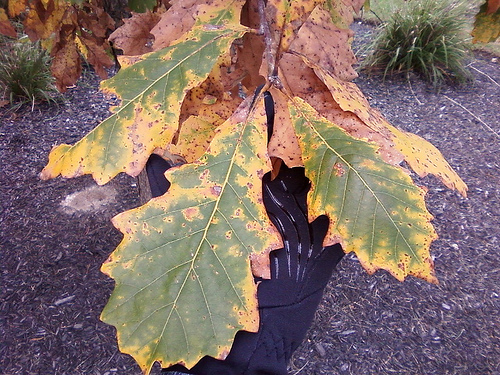
Crispy around the edges
Have you ever tried kundalini? If you ever have the chance, I recommend giving it a shot. It’s definitely different at times, but generally it makes me feel pretty darn good.
I had a lot to smile about yesterday–a fresh pumpkin raisin muffin from the farmers market, getting to pet a black pug, and a long mid-afternoon walk through town with Bryan–but the thing that got me smiling the most was an hour of Laughter Yoga!

Laughing with Buddha (Lhasa, Tibet)
A local yoga studio offered the hour-long class, led by Bob Pileggi. I was interested in the class because it seemed to be more about the physiological/psychological aspects of laughter and smiling, not about telling funny jokes or being silly for the sake of being silly. And just having written about the importance of breathing and opening up the lungs, I thought this would be a great way to experiment more with just that. Another reason I went was to figure out how to lighten up a bit. A lot of times when I’m doing the 5Rhythms, I feel like everything but my face dances, that there is so much emotion in my hands, my fingers, my torso…everything but my face. Even when I feel joy inside, my jaw clenches. It takes a lot of build-up for me to break out into a genuine smile or to laugh when I dance. I hoped that Laughter Yoga would teach me how to be more comfortable turning up those two corners of my lips. 🙂

I was a bit anxious when only three other students showed up for the class; would it be possible to bust a gut laughing with such a small group? (Answer: YES!) Bob instructed us to commit ourselves 100% to the exercises, like little children playing princesses or pirates. Immerse ourselves completely, don’t hold back. I vowed to do just that; I mean, I had paid for the class so I might as well dive right in.
We started standing with some simple warm-up exercises to loosen the spine and hips, then moved on to conscious breathing, very much like dirgha pranayama in yoga, raising the arms during inhale, lowering the arms during exhale. We picked up the pace by breathing as though we were blowing out a candle on a birthday cake, very sharp exhales, a bit like kapalabhati breath. Already, I could feel my lungs opening up, my cells dancing with oxygen.
Then came the vocalizations, which we used for much of the class: Ho, ho, ha-ha-ha, done while clapping to the rhythm. We did this standing in a circle, exchanging eye contact with others. This continued for a while, getting louder, softer, faster, slower. Bob encouraged us to change the pitch of our voices, the direction of our clapping. Soon, this exercise continued with us walking around the studio instead of standing in place, still making eye contact with those we passed. Things lightened up at this point, and we shifted in and out of different “characters,” maybe ha-ha-ha’ing haughtily like a snobby debutante or ha-ha-ha’ing demonically like a monster. Before we knew it, unconscious giggles slowly began to escape our lips.
Once the beginnings of true laughter began to appear, we got back in our circle and…laughed. It felt a bit forced at first, just a tad uneasy. But the longer we continued, the more real it became. Each person’s laughter took on a different tone; one woman had a cute giggly sound to hers, another had a spirited ebullience to hers. Hearing all the different kinds of laughter was, well, kind of funny and contagious, and eventually I felt the shift from “I’m doing this because the instructor said so” to “I’m doing this because it’s coming naturally to my body!” It was a bit like babies crying–when one starts, they all start.
Next, we connected laughter to emotions. Standing in the circle, we took turns shouting out things that brought joy to our lives. After each person made their exclamation, we all laughed. It went a bit like this: “My baby nephew falling asleep on my chest.” (::laughter::) “Walking down Main Street, USA in Disney World!” (::laughter::) “Little curly puppy dogs!” (::laughter::) Then came the trickier part: doing the same thing, but shouting out things that caused us stress: “Sitting in traffic!” (::laughter::) “Sallie Mae loans!” (::laughter::) “Getting into a fight with your boyfriend!” (::laughter::) As Bob explained, if something stressful has happened and there’s nothing you can do about it, why cause yourself more stress by stewing and steaming? By choosing to laugh at something, you’re guiding your body into a more optimistic response and not harming your health in the process.
One of my favorite exercises was the three-part’er: (a) Cover your mouth and give a small, polite, demure little giggle; (b) Relax and give a medium-sized chuckle; and (c) Let loose and give a full belly laugh. I found this to be a bit like 5Rhythms–a little wave of laughing–from flowing to staccato to chaos. By the time we got to chaos (full belly laugh), we were ready to erupt. For a while, it sounded like the five of us were old college chums meeting up for the first time in years, cracking up about the good ol’ days. The funny thing is that I only knew one person in the class.
Before a final savasana, we lay on our mats and went through a final breathing-to-laughter exercise. Maybe it was because we were all spread out across the room and couldn’t see each other, but I found my most authentic laughter during this part. I heard one woman’s delightful giggle and just lost it, the full back-arching, throaty laughter you get when someone tickles you mercilessly. It eventually winded down naturally, and soon I was sinking into my yoga mat for a very peaceful savasana.
Sure, the class felt a bit silly at times, but just an hour of ho, ho, ha-ha-ha’ing and laughing without reason opened me up from my core to my head. That area of my body that always feels so neglected during 5Rhythms had a chance to dance, and I felt all kinds of wonderful pops and cracks throughout my spine and neck as the muscles around them relaxed and warmed up. For someone so intrigued by pranayama practice, I was thrilled to work with the breath in such a unique way–standing and moving and laughing–not necessarily sitting in lotus pose and doing ujayii breath for 20 minutes straight.

Also, on a more biopsychosocial-spiritual level, the actions of laughing and vocalizing are centered around the chest (anahata chakra) and throat (vishuddha chakra). Since finding out I have hypothyroidism, I am especially interested in the vishuddha chakra, and that maybe perhaps I don’t give it enough attention. Maybe introducing more laughter and throat-opening exercises will help my thyroid?

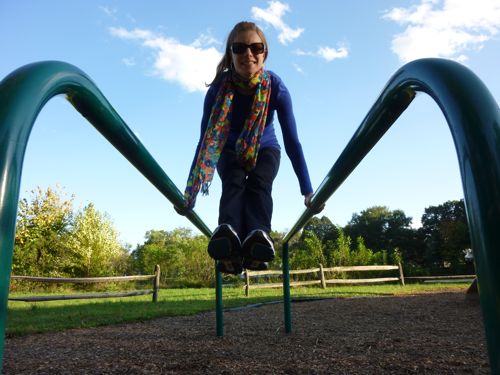
Playground version of simhasana (Lion's pose)
What did you laugh about this weekend?





 Flowtation Devices