You are currently browsing the category archive for the ‘Dancing’ category.
Like most children of my generation, I grew up watching Sesame Street. I loved Big Bird, I got pissed at Oscar the Grouch, and I caught on early to the fact that the cookies Cookie Monster shoved in his mouth just broke into pieces and spewed all over the place, never really being ingested and eaten.
I really loved Sesame Street. However, there were two recurring segments that actually scared me and sent me face-first into the couch cushions so I wouldn’t have to watch: (a) the “Yip Yip” martians; and (b) the shadow puppets.
I can see being disturbed by those slack-jawed martians with their hypermobile mouths and crooked antennae. They’re weird looking and speak in jibberish. But being frightened by the shadow of someone’s arm turning into an elephant or swan? I wish I could have a conversation with my 4-year-old self and figure out what exactly about that segment made me squeal in terror and cover my eyes. Why was I afraid of shadows?
Well, apparently adults are just as easily frightened by shadows as they were 20-something years ago, because when 5Rhythms teacher Douglas Drummond announced he was leading a “Light and Shadow” workshop in my area a few weeks ago, I instantly equated it with “good vs. bad,” “happy vs. sad.” I imagined us taking these five beautiful rhythms and plunging them into darkness, exposing their menacing, scary sides. I pictured my happy-go-lucky Ronald McDonald dancing transforming into Pennywise from Stephen King’s It, laughter morphing into screams. No thank you!
This wasn’t the case, of course. The workshop was called “Light and Shadow,” not “Light and Dark.” Two very different things! As Douglas explained: “The shadow should not be looked upon as a negative, rather an integral component of the bigger picture—a play with polarity.”
The five rhythms and their respective shadows are:
Flowing / Inertia
Staccato / Rigidity
Chaos / Confusion
Lyrical / Distraction
Stillness / Numbness
This wasn’t an exploration of opposites; more like an examination of our underbellies, those angles of our bodies that are difficult to see without a mirror. After all, the opposite of Stillness would probably be something more like Chaos, not numbness. We were learning to dance with the fraternal twin of each rhythm, not its evil cousin.

It’s true, the shadows listed above may, at first, seem “bad.” But Douglas was quick to explain the benefit in each of them, starting with the concept of physical shadows themselves. Ever been in the city on a hot and sunny 100-degree day? Stepping into the shadows cast by the towering buildings can be a welcome reprieve. Alternatively, stepping out of the shadows on a 30-degree day can be just as rewarding. Neither is bad; one complements the other.
Flowing / Inertia
Regarding inertia, Douglas used the metaphor of a garden hose with a kink in the tubing. What was once freely flowing is now blocked, perhaps only a trickle of water escaping from the mouth. I was reminded of the “squeeze-and-soak” concept of twisting yoga postures, where creating restriction in one area of the body will expel staleness and allow room for fresh blood to flow in once released, much like wringing out a dirty sponge.
Movement-wise, Douglas described inertia as trying to move while wearing a heavy backpack. This was a good exercise for me because I tend to be a dramatic upper-body mover, prone to always being one arm-flail away from dislocating my hyperflexible shoulders or elbows. Instilling that sense of heaviness in my upper body created a kinesthetic awareness that I would have never allowed myself to experience; inertia was a wise old sage reminding me to be cautious with flowing.
Staccato / Rigidity
It’s only appropriate that I had just watched The Hunger Games on Netflix before working with this shadow, because, as Douglas explained, rigidity is like the tension built up in a crossbow before an arrow is shot. Without tension, there is no directness and the target will never be hit.
Someone with a staccato personality will just come right out and say what’s on her mind: “Yes!” “No!” If that person becomes rigid, the staccato is brewing inside but is just never quite fully released, the way someone’s eyes will scream Yes or No but the words are stuck in her throat.
While dancing rigidity, I was reminded of my days studying ballet—specifically pointe—when my feet were jammed into tight block-like shoes, my ankles bound with satin ribbon, and my movement consisting of a series of straight lines. But that type of dance is also an art form, and at the time it meant a lot to me. My years of rigidity taught me discipline, direction, and poise. My current barefoot and dubstep-supported staccato is stronger because of my years in tights and a tutu.
Chaos / Confusion
Even in my wildest Chaos, I am usually able to maintain a sense of proprioception; whether I’m flailing, leaping, or spinning like a whirling dervish, I still have a keen sense of body awareness that keeps me from colliding with someone else or running into a wall.
Switch that to a confused state, and I may start to lose my footing. Step on another’s foot. Even with my eyes wide open, being confused will have me running into more obstacles than an eyes-closed chaos.
I think the difference lies in the role of the brain: In Chaos, there is minimal cerebral interference. Things are wild and loose and frenetic, but the body is intelligent and is rolling with the punches, so to speak. The body knows. In confusion, however, things are still wild and loose and frenetic, but the brain keeps trying to step in and control the situation. In confusion, the mind keeps questioning “Why? Why? Why?” instead of just letting things be, regardless of how messy or weird or unattractive they are.
Confusion can also be a gift, too. While walking in a bad neighborhood at night, switching the brain on to full-power and having a slight sense of panic may clue one into something amiss and save her life.
Lyrical / Distraction
So often I compare Lyrical to dessert, the sweetness that comes after supper, a sumptuous reward for making it through the rather strenuous and hearty rhythms preceding it. Lyrical is meant to be savored one spoonful at a time: licked, nibbled, sucked.
And then there’s dessert with distraction, devouring the slice of office birthday cake because it’s sitting on your desk, hurriedly shoving forkfuls of icing into your mouth while composing an e-mail in Outlook. Or excitedly finding the last strawberry-cream-filled chocolate in the Whitman’s sampler and popping the whole thing in your mouth at once, distracted by the object itself rather than focused on the sensory pleasure of taking it in.
I acknowledge that I have a tendency to slip into distraction (also described by Douglas as “spaced out”) more than I’d like, especially at the weekly farmers’ market. There’s usually a lot going on at once—cute dogs being walked, cooking demos being presented, plump vegetables and warm apple cider doughnuts being sold—and instead of taking a deep breath and becoming one with all this goodness, I tend to separate myself from it all, viewing it in a blurry haze. It feels a bit like walking around without my glasses, viewing things out of focus.
I was surprised, then, that the embodied version of distraction was not as “blurry” as I thought it would be. My fellow classmate described becoming captivated by his hands and all of their intricate movements during this portion of class; I too had a similar experience, becoming fascinated by the glowing red exit sign above the door. So, yes, we were “distracted” by these singular objects rather than surrendering our entire body to Lyrical; however, there was a notion of pointed, meditative focus involved in this distraction, which is certainly not a “bad” thing.
It reminds me of sitting in the church pew during my friends Erik and Anna’s wedding. Everyone around me was singing a hymn, eyes glued on the lyrics; I got distracted and decided instead to glance up at the two of them sitting at the front of the church. They exchanged cute smiles and expressions of love, probably not aware that anyone was looking up from their hymnals. My distraction gave me a few seconds of witnessing something very special.
Stillness / Numbness
Stillness is being open to mystery. Numbness is shutting down: Nothing in, nothing out.
There are moments for numbness, like receiving bad news at an office meeting. When you’re sitting around a conference table with the big-wigs and learn that the company is cutting employees’ salaries, it’s professionally wise to just hear the information and process it later, since it will most likely involve expletives or crying or fist pounding. Nothing in, nothing out (until after work, and probably at the bar with your colleagues).
Numbness makes me think of the chilly Decembers when my sister and I would crawl into a freezing car after Christmas dinner at my aunt and uncle’s house, screaming at the cold leather under our butts and impatiently waiting for the engine to warm up so we could too. Sometimes—instead of carrying on with all the “Brrrrrrs” and shivering and foot stomping—it was easier to just become limp inside our winter coats and go into silent hibernation mode. Nothing in, nothing out, just lifeless bodies in the backseat until the heat kicked in.
In those ways, numbness is protective, shutting down receptivity in an effort to save face or save energy.
Dance-wise, numbness was the most difficult shadow for me to embody. It felt like a “scary” place to me; not scary like Pennywise from It but scary like Robert De Niro in Awakenings, a catatonia that shut down my ability to express what I needed to express. I remember getting stuck in a shuffling kind of foot pattern—step forward, step back, step forward, step back—when all I really wanted to do was plow ahead. I remember wanting to extend my arm out but found it paralyzed next to my torso.
It was frustrating and sad. I’m glad we weren’t partnering at the time, because I can’t imagine standing in front of someone and being completely immune and indifferent to their movement. Alternatively, it would be equally as difficult to pour my heart out through movement and get nothing in return.
Impressions
The format of Douglas’ class worked perfectly with our environment: The light-centric portion of class coincided with daylight, and by the time the shadow-centric Wave had rolled around, the sun had set and we were dancing by candlelight. Not only were we dancing with our metaphorical shadows but our literal ones, too! Many times I could only identify someone by the outline of his or body. Even in those conditions, no one clashed or collided or ran into walls. Again, shadows aren’t necessarily “bad”!
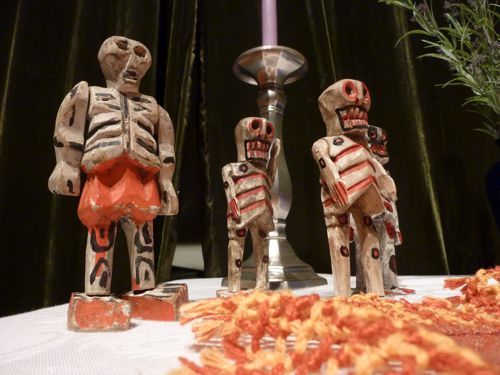
A fascinating coincidence was that our venue—a Friends school—still had its display up from Dia de los Muertos (Day of the Dead), a reminder about the importance of acknowledging and celebrating the shadow side of our physical existence on earth.

It brought me back to the 5Rhythms workshop I had done in October, the one Gabrielle Roth was supposed to lead. Our space was decorated in black and white, a celebration of living and dying and everything in-between.
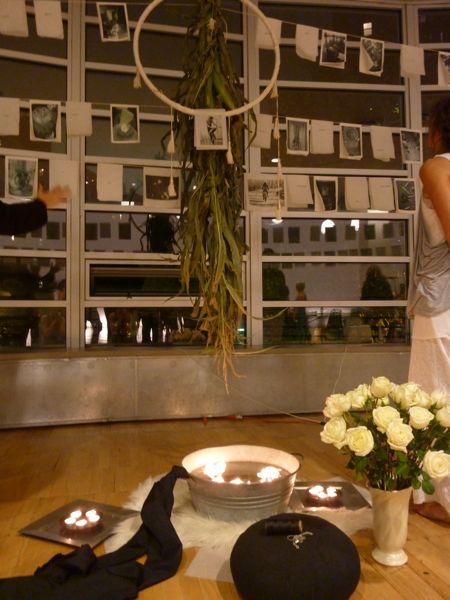
It was a poignant event, but never “dark.” Gabrielle’s son Jonathan and her husband Robert talked about the shadows, brought them to the forefront, but never thrust us into complete darkness or misery. We danced along the continuum, at times more heartbroken than others, sometimes going from crying to laughing to crying in a matter of minutes.
* * *
I don’t know what the Children’s Television Workshop was thinking when it introduced those freaky Yip-Yip martians to Sesame Street, but I have to say, those educational researchers must have been onto something with the shadow puppets. Even though I didn’t accept it at the time, I’ve come to realize that shadows aren’t bad or scary, whether we’re talking about a hand becoming a horse or Chaos becoming confusion.
Our shadows are always with us, even (and especially) on the brightest and lightest of days. It’s about time we become acquainted with our other half so we can better understand the full spectrum of our movement, and—more important—our existence.
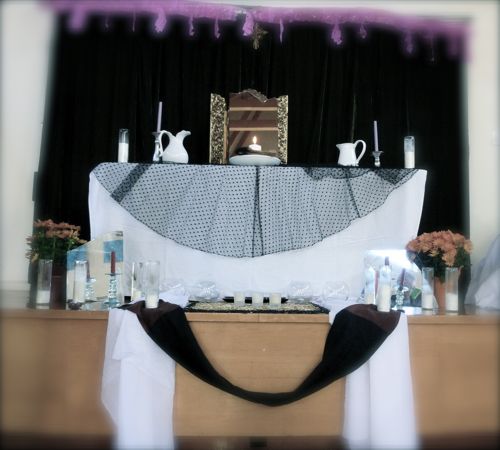
Light and Shadow installation
As much as I love to dance, there are in fact days (usually when I forget to drink my afternoon coffee) that I’m just not quite sure my limbs, torso, muscle, and bones are going to sync with my brain and produce some kind of coordinated movement. When I head off to a 5Rhythms or YogaDance class with a dull brain, I fear that even the most rockin’ tunes won’t get the engine going and I’ll end up wasting 2 hours sputtering in the driveway.
Most of the time, however, my inner Henry emerges.
Who is Henry, you ask?
Henry is that glorious moment when inertia suddenly switches to reaction. Henry is eyes lighting up. Henry is fingers snapping. Henry is the reminder that you can feel.
Henry also happens to be the poster child man for the nonprofit organization Music & Memory, whose goal is to bring the therapeutic benefits of personalized music to long-term care (LTC) settings nationally and globally. You may remember Henry from his spin around the social media circuit earlier this year, his wide-eyed and animated face plastered all over Facebook and Reddit video posts: “Man In Nursing Home Reacts To Hearing Music From His Era”:
What I recently found out was that Henry is just one of hundreds of older adults profoundly touched by the gift of music, and one of several featured in the up-and-coming documentary Alive Inside: The Story of Music & Memory. I had the privilege of attending an advanced screening of this documentary at my alma mater, coordinated by the Dean (who also happens to be a fellow blogger!) of my old stomping grounds, the College of Communication & Creative Arts. Both the executive director of Music & Memory, Dan Cohen, and the film’s producer/director, Michael Rossato-Bennett, were present to discuss their project.
Cohen, armed with volumes of evidence-based research on the connections between music, mind, and memory (including testimony from the renowned Oliver Sacks), is on a mission: to help all LTC residents and individuals with Alzheimer’s disease/related dementias reconnect with their joys, dreams, and passions of yesteryear using digital music players as the key to unlocking these deeply rooted memories.
The idea is simple and straightforward: Talk with LTC residents and their family members about what kind of music the residents enjoyed growing up; compile these songs in a personalized iPod playlist; place a pair of headphones on the resident’s ears; press Play.
Of course, the individuals featured in the documentary were ones with the most transformational reactions: Henry, described by his caregiver as “inert and unresponsive” suddenly began signing Cab Calloway, talking about his childhood, and waxing about love and God; Denise, who had been using a walker every day for the past two years, stood up, pushed it aside, and began dancing with the researcher; and Joe, a former performer, started singing like a Broadway star, his clearly trained voice stunning the other residents and staff. He cried afterward, stating that he was so happy to find that connection again.
Cohen pointed out that not everyone has the same reaction—for some residents, the response isn’t instantaneous; for others, it takes several attempts to narrow down just the right music that will spark something in their brains. Sometimes there is no change at all. Nevertheless, he said, there’s never been an adverse reaction to listening to some music. The video clip of Henry, in fact, was filmed 4 years ago. Today, Cohen said, Henry still has his music protocol. He’s declining physically yet remaining stable cognitively. Had it not been for the music, both domains instead of one would have most likely been on a downward slope.
This effect of music on the mind is nothing new, nor is the notion of bringing it into the lives of nursing home residents. The genius of Cohen’s vision, however, is (a) personalization and (b) high-quality stereophonic audio. With today’s technology, volunteers can easily create customized playlists for residents, adding and eliminating songs with the click of a mouse. This is one key difference in Cohen’s program versus, say, playing a record of Count Basie in the nursing home living room. Not everyone is going to appreciate Count Basie, and his music may not fire the neurons of someone who prefers bluegrass or the Beach Boys. The Music & Memory program also strives to personalize not just the music but a resident’s schedule as well. Maybe Jane likes to wake up to Broadway showtunes but functions better at bedtime with a soothing melody. With this program, residents’ music is tailored to their personal preferences, mood, and time of day.
In addition, the use of crystal-clear digital sound and the iPod headphones are crucial in a nursing home, where auditory distractions are commonplace. This way, residents get a “direct infusion of music,” said Cohen. Also, in the case of Alzheimer’s disease, one’s ability to filter out background noise diminishes, he pointed out. A stereo sitting on a nightstand may be useless for someone who is going to be distracted by a ticking clock or voices in the hallway.
While this is all very inspiring work, one of the challenges Cohen faces is convincing nursing home CEOs and potential donors that it is worth the money. It can be disheartening when facilities and insurance companies will pay millions of dollars for a treasure chest of antidepressant/antipsychotic drugs but can’t find value in spending $40 per person for a program that will rejuvenate hearts and souls, something no drug on the market can do. It is the lazy/ignorant route to point at patients slumped in the corner and claim that they are withdrawn and unresponsive, so if drugs can’t help them, how can an hour of Elvis?
As editor of two gerontological nursing publications for the past 5 years, I guess you could say I have a soft spot in my heart for the older adult population, and yes, that is partially why I attended the screening; however, I was more interested in witnessing just how magical music can be. Nearly everyone featured in the documentary had some kind of physical response to the music—tapping their feet, swaying, gesturing their arms like a conductor—a testament to how deeply music is stored and can be felt in our bodies. One woman—bedridden and catatonic—began rocking back and forth when the headphones were placed on her ears.
It’s reactions like this that make me even more appreciative of not only Cohen’s work but that of movement-based therapeutic modalities such as Let Your Yoga Dance (which has a separate teacher training for those who wish to work with special populations, including older adults), the 5Rhythms Reach Out for elders, and Wu Tao Dance for the dementia population. When the older adults in Cohen’s Music & Memory program start ditching their walkers and wheelchairs, these groups will be prepared to add safe movement to that oh-so-magic music.
Have you found your inner Henry yet? Put on some music and see if it does to you what it does to Henry:
“It gives me the feeling of love, of romance. I figure right now the world needs to come into music, singing. You’ve got beautiful music here.”

Sometimes the most inspiring component of a 5Rhythms class is not the music or the environment or the people but rather the guidance or encouragement the instructor shares mid-dance via microphone, a phrase that touches you just the right way, a combination of nouns, verbs, or adjectives composed and delivered in such a manner that words become energy in mere milliseconds.
For example, during Amara Pagano’s workshop last month, a simple, emphatic “There you go” would sometimes launch me from minimally energized to borderline explosive.
However, one phrase I never imagined would (a) ever be uttered during class, and (b) be such a catalyst for me is the following, courtesy of Douglas Drummond:
“Bust out your inner blacksmith.”
Now, I have imagined myself to take on several identifies and forms during a 5Rhythms class—a high priestess, a tiger, a lady in red, a collection of vibrating atoms—but never a dirty-faced dude wearing safety goggles and a leather apron, forging iron over an open flame.
But the command made sense at the time, as me and about 15 other dancers were in the middle of Douglas’ “Embodying the Elemental” workshop, and our Staccato—the element of fire—was getting hotter by the minute. We had just dug up the earth with our feet (my metaphor for Flowing; we were on a wooden floor the whole time), and now the music was picking up tempo and busting some bass, and it was our duty to transform this collection of dirt-speckled minerals with the fire churning from our bellies.

Even though I was physically dancing inside a church auditorium in Pennsylvania and a primary school in New Jersey, the two-day experience ended up being a journey into the center of the earth and on edge of the cosmos. Each class consisted of two standard Waves, but we approached each rhythm as an element:
Flowing: Earth
Staccato: Fire
Chaos: Water
Lyrical: Air/Wind
Stillness: Ether

The same elements are represented by prayer flags, like those hanging in the kitchen.
Connecting the 5Rhythms with the natural world brought a new level of understanding to this often complex dance. As much as I loved Amara’s Fire of Love workshop, associating the dance with heavy-duty and abstract concepts such as fear, love, and loss brought a certain degree of difficulty to the process. But water, sand, wind…how tangible these objects are, how primal.
We all know how pliable earth feels under our toes and how the threat of fire causes us to jump and react. Douglas acknowledged that everyone has had an experience with these elements, some positive and others not so much. While it is easy to associate earth with a flourishing garden or sandy beach, Douglas is from New Zealand, an area on fault lines where the constant threat of seismic activity makes this element a bit frightening. And yes, how refreshing it is to open the windows on a spring day and allow the breeze to rustle your curtains, but this same element of air and wind can also take the shape of a funnel cloud and wipe out entire towns.
At first I was perplexed about the element of water representing Chaos—Isn’t water always associated with flowing?—but the more it was explained, the more it made sense. Water is temperamental, unpredictable. I mean, heck, water can freeze, water can boil, water can turn to a solid or evaporate into steam. A heavy rainfall can turn into a flash flood in a matter of minutes, and a steady flow of water underground can turn into this the moment its container breaks:

Water main break in Center City, Philadelphia, the same day as the workshop.
To be able to actually visualize the rhythms was something relatively new to me. I loved Douglas’ example of how dancing in Staccato requires being aware of your environment: If you’re standing in tightly packed group, are you going to bust out a raging bonfire that’s going to burn others around you, or can you achieve the same heat with a simple and sharp strike of a match?
I’ll tell you, it was hard at times not to let Staccato become the blazing bonfire. Douglas’ playlist was heavy on the dubstep/psy-trance/electronica, music I seldom listen to but when I do—WATCH OUT! That genre already has that little electric “buzz” built it; my veins and arteries basically became live wires. And I love the brief moments of pause/suspension in the music—it reminded me of trick candles being blown out and then coming back to life, stopping for a breath (…) and then launching right back into the movement (!!!).
By the time Stillness rolled around, my mind was definitely in the ether; I was in a whole new dimension. Maybe it’s because I had just played with fire and water and been electrocuted, that the Four Winds had just resuscitated me with their breath of life, but during Stillness I hovered in a state of acute awareness and deep meditation, a bit scared by this near-possession but allowing it to move through me, because as Douglas had stated earlier, the element of ether is the deepest mystery, the enigmatic.
In Tibetan Buddhism, ether is defined as the regions of space beyond the earth’s atmosphere; the heavens. For me, Stillness is like looking in a mirror and seeing nothing but knowing and feeling that something is there. It is vibrating wildly like the smallest speck of matter, moments away from bursting and expanding into a vast universe, the Big Bang of my consciousness. It is also ending class with my limbs feeling like magnets being drawn down into the earth’s magma, barely able to rise from the floor and shuffle over to the center of the room for the final sharing circle.
And just as we have to share this planet, Douglas also gave us plenty of time to share our thoughts with each other. In pairs, we answered the question, “In the element of ___ (fill in the blank with the given element), I feel ___.” Douglas emphasized that this was an exercise in conscious listening—while the speaker spoke, the listener was simply to listen—no nodding in agreement, frowning, prompting the speaker in any way. Doing both workshops, what a gift it was to hear 10 different descriptions of these elements. I don’t recall everything that I stated, but I do remember snippets:
In the element of earth, I feel sludge, resistance.
In the element of fire, I feel electricity.
In the element of water, I feel like I am submerged, having no oxygen but hearing every little breath and sound my body makes.
In the element of air, I feel like a dolphin coming to the surface, the breath that connects me with the rest of the world.
In the element of ether, I feel a spiritual hypnosis, grasping for something that is always just out of reach, the beauty you feel but cannot see.
Honor and respect these elements, Douglas reminded us. They were here long before us and will exist well beyond our lifetime. Recognize their beauty, acknowledge their power, and feel the rhythms they hum, crackle, churn, whisper, and vibrate.
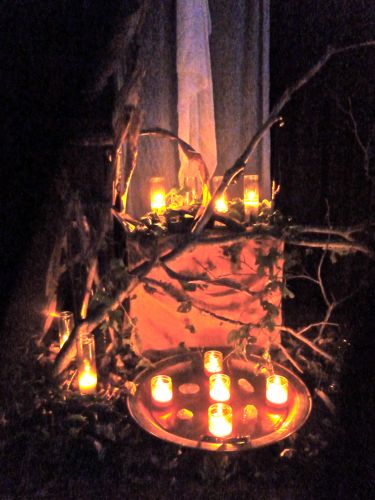
Element-inspired installation, Day 2.
I’ve sat down at my computer so many times over the past week in an attempt to document the three-day “Fire of Love” 5Rhythms workshop with Amara Pagano I attended in late September, and each time my fingers try to translate movement into words, I get discouraged. The hard, clickety-clack sensation of my metallic keyboard feels so unnatural and sterile, a device more fit for writing about a tap-dancing or clogging class, not about a program created to explore the inner workings of the body’s most fragile organ.

Opening night installation
“I wish I were a ballet blogger,” I say. “It would be so much easier.”
If I blogged strictly about ballet, I’d write about combinations we learned, steps that challenged me, the way I wobbled during my fouette turns or how I think my grand jete needs more height. I wouldn’t have to write about the experience of delving deep into the next level of 5Rhythms after Waves—Heartbeat—an act akin to going out for a run with a twisted ankle. I’ve already gleaned so much about myself during Waves practice, have faced questions that only present themselves through movement. My dance has already transitioned from mind to body to heart; dear god, did I really need to take it a step further?
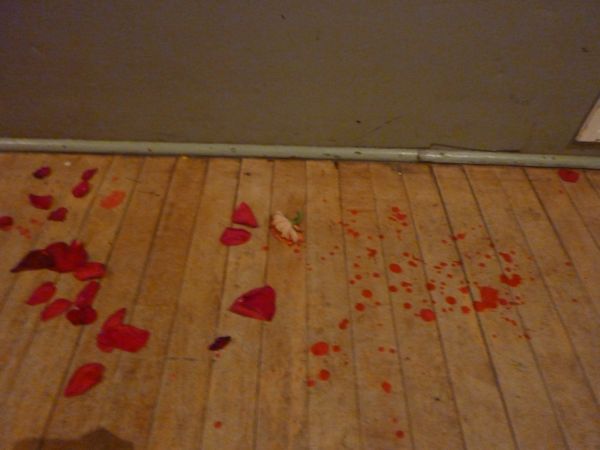
Love is messy
If I blogged strictly about ballet, I’d describe the teacher by how tightly her hair was pulled back, the commands she barked, the feedback she offered on my lines and execution. I wouldn’t have to write about the way Amara Pagano could speak without uttering a word, how her fluid body conveyed more information than any encyclopedia, how her eyes connected with each and every student. I wouldn’t have to explain that when I danced because Amara said so, I was dancing for myself, not because I was trying to impress a superior. I threw myself into the movement because Amara was serious about self-realization; she didn’t care about appearance or rhythm or lines—all she pressed us for was authenticity and the courage to “let it go.”
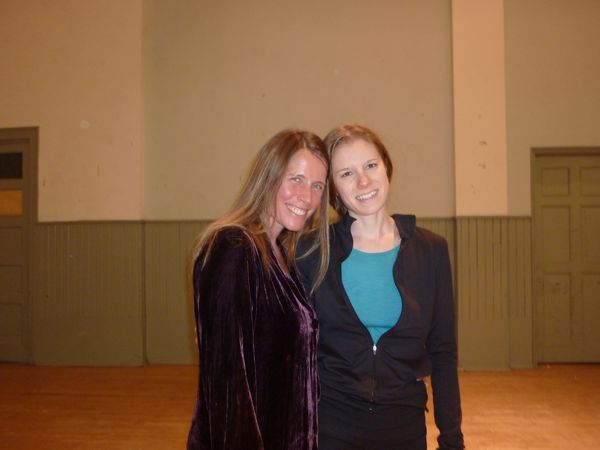
Amara Pagano and me
If I blogged strictly about ballet, I’d post pictures of my bloodied toes, the result of being packed too tightly into pointe shoes. I wouldn’t have to explain how the purplish-brown bruise on my elbow was from throwing myself into a dance depicting grief, how the skin on the top of my foot was torn after dragging my lower body across the floor, my arms propelling my lifeless legs behind me in an exercise exploring our fear.

A ballet blogger’s description of “center work” would involve small jumps, turns, combinations of 8, 16, 24, and 32. I wouldn’t have to write about a group exercise in which we were told to trust no one but ourselves, to move as though you are suspicious of everyone. I wouldn’t have to describe how fear built up so intensely that when Amara told us to switch the fear to excitement, the outburst exploding from my body was manic, a throaty laughter I didn’t even recognize, wild, wicked, and somewhat lascivious. Back and forth we went—fear, excitement, fear, excitement—continuing the dichotomies with a partner, screaming, baring teeth, grinding pelvises, alternating from witches to whores, criminals to cat-nipped kittens. A ballet blogger wouldn’t have to explain how such “center work” pushed us into the concept of fearlessness, finding the euphoric midpoint between fear and excitement.
“I wish I were a language instruction blogger,” I say. “It would be so much easier.”
If I blogged strictly about language, every day I’d present a new word and translate it into Italian or Swahili, maybe use it in a sentence as well. I wouldn’t have to write about the surprise I felt after hearing a French-Canadian accent emerge from the mouth of a young woman with whom I engaged in an intense responder/revealer partner dance. Our movement was such a rich conversation of fear, empathy, support, and encouragement; I never once thought of her as a “foreigner.” If I blogged about nouns and adjectives, I wouldn’t have to write about how dance is a universal language; when one dances fear, you will understand it and respond to it, no matter what country you’re from or what accent you carry. I wouldn’t have to explain how when one dances love, it translates both as a whisper in the ear and a scream in your face—so subtle and personal, yet so loud and clear and public.

If I blogged about language, I’d describe how X means Y, how A means B, clear definitions for words, proper ways of constructing sentences. I wouldn’t have to write about the language of love, defined by Amara as awareness, being available. I wouldn’t have to write about allowing a partner to touch me, being instructed to just take in the touch, be receptive, before moving and responding to the touch. I wouldn’t have to go into detail about using the floor as a partner and then returning to my human partner to extend this “conversation,” or the disappointment I experienced when my partner’s movement felt tired and distant.
If I were a language instruction blogger, my post on pronouns would discuss nosotros versus vosotros, tu versus Usted, you, me, I, we. I wouldn’t have to write about the difficulties of retaining my “I” movement when dancing with a partner, the pitfalls of too quickly abandoning “I” for “you,” the connection that develops when the right amount of “I” (authentic movement) and “you” (a partner’s movement) equals “we” (a dance of revelation, response, and mutuality). If I were a language blogger, “we” would be just a two-letter word, not a concept involving a group of people ending a three-day workshop as an interconnected mass, limbs linked, hands touching, someone’s cheek resting atop my thigh, my fingers running through a woman’s saturated hair, a circuit of energy looping through our intertwined arms and legs, a current so strong that I swear I could feel the pulse of even those I wasn’t physically touching.

“I wish I were a dream blogger,” I say. “It would be so much easier.”
If I blogged strictly about dreams, I’d describe and interpret the fantastical images that play through my brain at night. I wouldn’t have to write about the stirring visions I experience on the dance floor, like when I closed my eyes and saw not just my classmates’ faces but felt their movement talk through my body, as though everyone had been squeezed into me and I into them, until we were simply a giant concoction of universal movement, no skin, bones, or muscle separating us. I wouldn’t have to write about how that experience felt like I was serving as a kind of medium for my classmates’ stories, experiencing not just their dance but the emotion behind it as well. I wouldn’t have to describe how the experience comforted me, a metaphorical experience for the realization I am not alone, that even after just a few hours of being introduced to these people, they now live inside of me.

“I wish I were a fashion blogger,” I say. “It would be so much easier.”
If I blogged strictly about fashion, a post about evening wear would discuss necklines and fabrics and hems. I wouldn’t have to write about how a little red dress serving as our installation’s centerpiece was the catalyst for my dance of fearlessness. I wouldn’t have to explain that, after dancing out “fear” across the floor—my movements heavy, reluctant, dragging, having to tug at my pant leg to propel me forward—I had no idea how I was going to follow Amara’s instruction to turn around and return down the floor with fearlessness. The resistance was overwhelming, and I stopped at the floor’s edge with no idea of how I was going to turn around and face fear in the eyes. I couldn’t. I was stuck. Expletives ran through my head, and I felt like a failure as my dancemates’ grimaces turned to smiles. If I were a fashion blogger, I wouldn’t have to explain how I stood against the auditorium stage in a panic, looked up, and saw that red dress before me—that was my cue. I want to be that lady in red, a voice inside of me said. I will wear that dress. Like that—BOOM!—fearlessness! I whipped around and returned down the floor in seconds with intensity, boldness, espresso in my cup. My speed down the floor wasn’t an attempt to evade the exercise but rather was me listening to the authentic voice that boomed forth. This fearlessness didn’t want to waste time, it wanted action. NOW.

If I were a fashion blogger, I’d write about which celebrity looks best in that little red dress. I wouldn’t have to write about metaphorically wearing that dress myself for the rest of the workshop, embracing fearlessness, stepping forward and dancing with someone who intimidated the hell out of me, being surprised at how much I gave myself to her, observing my emotions shift from fear to excitement to fearlessness in a cycle. I loved it, I hated it, I was scared, I was joyful. I was.
If I were a fashion blogger, the little red dress would be just a little red dress, not a symbol of sensuality and womanhood. I wouldn’t have to write about the way it touched me to my core, how when I observed two women in the throes of a throbbing, shaking voodoo dance, I stood beside them with my palms open, soaking up their energy, a gnawing, gripping, pounding desire to be in their bodies, feel the way that red dress enveloped their flesh, share their rawness, maturity, and wisdom.
“I wish I were anything but an overly sensitive dance/movement meditation blogger,” I say. “It would be so much easier.”
Wouldn’t it? But I am, and so I dance, and so I feel, and so I write.


I think there’s some kind of universal phenomenon that when you’re by yourself, wearily and contemplatively driving down an empty road in the middle of the night, whenever you decide to click on the radio, the song that comes to life will be speaking EXACTLY to you. Even if it’s Nickelback or Carly Rae Jepsen or some awful modern-day remix of a song from the ’60s you used to love…somehow, in your vulnerable and delirious state of mind, that song is suddenly the most significant ballad of your current life. You nod along, yelling an emotional “Yeah!” to the deserted road, alternating between laughing giddily at the appropriateness of every word and sobbing between the bridge and the final verse.
I’m really bad at following modern music, so I didn’t know anything about “my” song the other night/morning, except that I had heard it played a lot during the Olympics. Google has since informed me that the song was “Home,” by Phillip Phillips:
Hold on to me as we go
As we roll down this unfamiliar road
And although this wave is stringing us along
Just know you’re not alone
Cause I’m going to make this place your home
OK, so, in all honestly, these lyrics are nothing amazing. Road metaphors? “You’re not alone”? Song Clichés 101. But again, at eleventy-baglock in the morning, Phillip Phillips had become my personal troubadour. Clearly, he had worked with the universe to get his song to play on my car stereo the very moment my desperate hand reached for the radio button.
A 5Rhythms class with Peter Fodera earlier in the day (a Waves class, too. See line 3 of the song. THE RADIO GODS KNOW.) had put me in this state. Peter had spent some time using new direction with us, material from a “Threshold/Gateway” workshop he’s recently developed.
His description:
Every journey begins with the first step, and often taking that first step through the threshold is the most difficult part of the journey. Gateways are often guarded by challenges or difficulties that we have to overcome in order to continue down the path. Beginnings take a great deal of faith and surrender.
As a way of getting us to take these first steps into each rhythm mindfully and with clarity, Peter abandoned the traditional 5Rhythms structure of transitioning seamlessly from one rhythm into another and instead stopped and started the music for each rhythm, giving us specific instruction for beginning each one. With his use of the word “threshold,” I kept thinking of a house, each room being one of the rhythms. What Peter was having us do was enter each room with a new perspective, maybe opening the front door with gratitude and appreciation instead of flinging it open in a mad rush.
- For Flowing, Peter scattered rubber snakes all over the floor as a reminder of staying grounded, the way snakes are. We were to dance only with our feet—no arms—with instruction to be aware of the snakes but not to pay attention to them.
- For Staccato, Peter cranked up a thumping, throbbing, bass-filled song and instructed us not to move. When we were allowed to move, it was only briefly, before we were asked to come to stillness again. It was torture! However, the lesson was clear: True Staccato emerges only when you give it time to speak, when its message is fully developed and ready to scream out to the world. As much as I wanted to shift into Staccato the second I heard that music, being still and giving things time to stir inside made the eventual hip-centric dance more intensely powerful than anything I would’ve done straight out of Flowing.
- In Chaos, we were encouraged to let go of our heads, maybe even positioning ourselves on hands and knees and just letting the head go wild. I was at first resistant to this instruction, but when the wild music started, I had a vision of me standing in front of an out-of-control train, headlight blinding me, the engine roar growing louder and louder. It was so vivid that it dropped me to my knees, and then there I was, on my hands and knees, giving in to Chaos.
- Lyrical, a rhythm for which I tend to use my whole body, was initiated with instruction to dance from the fingers and hands. Any other day, I wouldn’t have liked this specificity, but given that Chaos had rendered me a sweaty, sprawled out mess on the gritty wood floor, I was OK with letting my torso and legs remain dead weight and my fingers do all the work. I eventually got off the ground and found myself engaged in a wonderfully lighthearted ballet guided by my hands.
- In Stillness, the focus is on the breath. Peter instructed us to be mindful of our inhales and exhales, maybe only moving on one or the other. This was a good lesson for me, because sometimes my Stillnesses are so poignant that I hold all the emotion in my throat and forget to breathe.
So here we were, crossing these thresholds in an attempt to come home in our bodies. However, even in a house/practice you are so familiar with, sometimes entering the room/rhythm in a new way or different manner throws things askew. How refreshing it is to step into your kitchen on a Sunday morning, coffee in hand, breakfast on the table? But what if you enter that same kitchen in a distracted tizzy, grocery bags flying everywhere as you attempt to put everything away in 5 seconds before you have to rush out the door again?
Changing up the manner in which you approach a rhythm can make the whole house feel like it’s falling down. I’ve always seen Stillness as the sturdy foundation of my dance but during Saturday’s class I felt more like I had descended into the heart of my home, the basement, without a flashlight. I was still in the same place—the deepest spot of my home, an earthen room of quietness where heat and electricity originate—but without that flashlight I felt lost in my own home. I got scared. The breath didn’t flow as easily, and I could feel my body tighten and tremble. I tried to feel my way around and remind myself where I was; every now and then I got glimpses of daylight, but I allowed the fear to overcome me. My Stillness shifted into uncontrollable shaking and sweating, an unnerving vibration coursing through my center like a furnace ready to blow.
It was one of the few times during a class that I wanted to exit the floor. I was facing so much resistance; emotions and thoughts were getting the best of me. However, two things kept me planted:
1. Like the song lyrics from above, I knew that everyone there with me was on an unfamiliar road. None of was alone; we were all there for each other. It was a safe place, a space for openness and exploration, a metaphorical group home for our souls and spirits to grow, heal, and learn.
2. As a Kripalu yoga teacher, I am very familiar with the practice’s philosophy of “BRFWA“: Breathe, Relax, Feel, Watch, Allow, the five steps to handling any kind of strong emotions or physical sensations. I dealt with a very similar situation during a yoga class in 2006; the recommendation is to simply ride the wave.
So I stayed in the basement that Saturday afternoon in Stillness, BRFWAing through the unease rather than running out the cellar door. If I ran away, my dance—my home—wouldn’t be complete, despite its internal tremblings and instability. I simply wanted to be there to the end.

Even though the sun has been rising later and later, I’ve been pretty good at sticking to my early-morning walk routine all through the summer. In June, I’d need my sunglasses at 6 a.m.; nowadays, not so much. Still, most days I am able to catch the rising sun gleaming off the underside of airplanes descending into Philadelphia, making all jets look like red-bellied Southwest planes, metallic birds with torsos aglow.
However, not all mornings are ideal for the outdoors, including today. With the remnants of Hurricane Isaac drifting toward the Northeast, today started drizzly and gray, a reasonable and seasonable temperature of 70° but the suffocating humidity ruining any notion of comfort (or straight hair). Mother Nature had decided my morning workout: Today I would dance.
Leaving my sneakers in the porch and remaining barefoot, I lit an orange pumpkin-scented candle, bowed my head to the flame, and began to flow.
It’s hard for me to dance first thing in the morning without some kind of guidance, so I made sure to compile a playlist before diving in. One might think that starting with a high-energy techno or rock beat would help shake off the sleepies, but I always prefer to follow 5Rhythms’ gradual build-up structure of Flowing, Staccato, Chaos, Lyrical, and Stillness.
The 5Rhythms structure is kind on the body, the way an opulent meal is to the senses: Flowing is a bit like a glass of wine before the appetizer of Staccato, which is then followed by the hearty and chow-down main meaty course of Chaos. Finally, there is dessert, sweet-like-blueberries Lyrical, the prelude to the final course of Stillness, that moment at the table when you’re sipping coffee with eyes half-closed, smacking your lips, and inhaling the memory of your fulfilling meal.
Here’s the music I chose to represent those sensations:
- Warm-Up: “Damascus,” Conjure One, featuring Chemda
- Flowing: “To Zion,” Trevor Hall
- Flowing: “La Guitarra,” B-Tribe
- Staccato: “Black Velvet,” Bonnie Raitt
- Staccato/Chaos: “Drumming Song,” Florence and The Machine
- Chaos: “Greg Didge,” Music Mosaic (from the album Didgeridoo Trance Dance 2)
- Lyrical: “While My Guitar Gently Weeps,” Carlos Santana, featuring India.Arie
- Lyrical: “Pequeño Vals,” Marlango
- Stillness: “Singapore (….),” The Candle Thieves
- Stillness: “Swelling,” Sarah Jaffe
Most of these are songs I’ve danced to in other classes; I find that once I’ve experienced the music in a class setting, it has more weight, the same way hearing a song in a movie soundtrack makes it 10 times more intriguing. For example, every time I hear “To Zion,” I imagine gliding around the wheat-colored carpet in Kripalu’s Main Hall during Dan Leven’s Shake Your Soul class; the frenetic didgeridoo song brought me to the floor, the wall, my feet, and back on the floor again during a mid-summer night’s Dance from the Inside Out class. I remember waltzing around the spacious floor of Studio 34 with an imaginary dance partner to “Pequeño Vals,” and well, hell, I just love Florence. She had to be in there somewhere.
The sweetest thing about the practice was that after an hour of dancing, the flickering flame of the candle I had lit at the start of the dance was being upstaged by something greater: the sun!
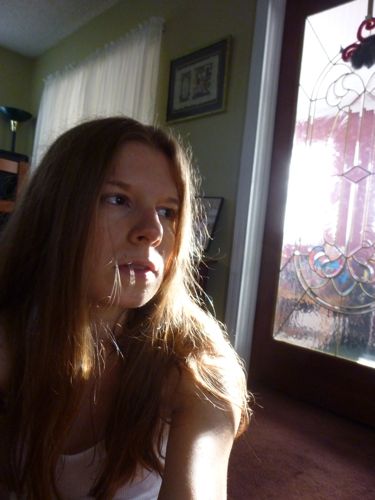
This day—filled with thunderstorms, flash floods, and tornado warnings—had about 60 minutes total of scattered sunlight; I am happy to have experienced at least 5 of them as a sweaty, satisfied mess of a body sprawled out on the living room carpet.

”Dance is important…. It can be a reason for a person to get up in the morning”
~ Jeanguy Saintus
When I am dancing by myself, I tend to find “partners” in various inanimate objects around the house, throwing my body against the carpet during an episode of chaos, draping my leg over the back of a chair, grasping onto a door frame as though it’s two arms on either side of me, pressing my back against the wall like there’s another human being supporting my weight, or engaging in a pas de deux with a set of curtains during a moment of stillness.

The aftermath of clawing on the carpet during Chaos
Recently, I even discovered that I can balance my arms on the kitchen counter while walking my feet seductively up the back of one of our wrought-iron chairs. It’s my sexy dance that I do while waiting for my corn to heat up in the microwave.
While I enjoy my creative ways of turning the whole downstairs into a jungle gym, there is one big thing missing from my dances with furniture and flooring: connection. No matter how hard I press my hands into the archway dividing the living room from the dining room, I won’t feel a pulse in return. My skin makes contact with paint and drywall; any energy radiating through my palms stops where the wall begins.
Even the curtains, so wispy and balletic in nature, are unable to cradle me like human arms. They make for a beautiful prop but not a true partner.
Many times during a 5Rhythms class, we are asked to take a partner. Sometimes the instruction is to do nothing other than dance your dance while simply being aware of the other’s movement. Sometimes, especially during workshops, the instruction is more specific and requires some level of trust, such as the time I had to dance while blindfolded, depending on my partner’s energetic cues to prevent me from colliding with other dancers.
The beauty in this work is that–unlike dancing with a wall or a kitchen chair–there is now some level of connection. The energy/prana/chi emanating from my hands and feet has found a safe place to flow, and in return, my partner’s energy mingles with mine. It’s a dance of mutuality.
For example, during last week’s 5Rhythms class, I happened to be partnered with the studio owner, Rhonda, for the last 10 minutes of Stillness. Our connection has been growing stronger by the month, but this time it truly came through during the dance: We linked hands and arms, leaned on each other for support, rolled on the floor together, held the weight of the other’s skulls in our hands, ran fingers through hair. It required a lot of trust and a huge opening of the heart. It’s not something everyone can do right off the bat, but that night it felt like we were conversing on an emotionally deep level that words would never be able to justify.
To end class, we stayed with this partner for an eye-gazing meditation, in which each person stares into the other’s left eye. This was the Stillness to end all Stillnesses, because, really, what act is simultaneously so still yet so moving? On the outside we may have been motionless, but it’s darn near impossible to look someone straight in the eye for 5 minutes and not feel things stirring inside. After class, we were both a bit weepy.
In this type of work, you may not know your partner’s stories or have an answers to their questions, but you can offer your unbiased presence. Likewise, the mere acknowledgement of your existence by another can be so comforting, a silent yet powerful dance that surpasses any exchange between human and home furnishings.

A couple of weeks ago I wrote about how my summertime dancing has pretty much worn me down to the bone, so I guess it was a blessing that there were no 5Rhythms events on the calendar this past weekend. Instead, I was able to attend something much lighter and less intense—an ’80s-themed YogaDance class led by Nikki, who admitted to being sick and feverish but still managed to be her usual firecracker self.
To be honest, at first, the ’80s theme almost scared me away. I was born in 1980, so I never felt particularly connected to the songs that made the decade. I mean, for most of that time period, I was listening to Rainbow Brite books on tape, Jem and the Holograms cassettes, or music that came along with my Barbie and the Rockers doll. It wasn’t until the ’90s when I started to fully understand the music of my times; you know, classics like Kris Kross’ “Jump,” Bryan Adams’ “Everything I Do (I Do it For You)” (which can make 12-year-old girls in love with their classroom D.A.R.E. officer weep…true story), and, of course, “Ice, Ice Baby.”
The tipping point that got me to go to the ’80s class was the fact that a decent number of people had already RSVP’d, and, well, I’m beginning to understand and appreciate the power of a group. I’d get to dance, sneak in a “doesn’t-feel-like-exercising” workout, and be around some fun people. I realized that I genuinely wanted to be part of the party!
…And a party it was! There were scarves! We “Vogue”d! Heck, we even re-created the chair/water scene from Flashdance‘s “Maniac”!

However, it took me a while to get into the groove. The premise of YogaDance is to move through the chakra system; most classes start with the lower “feeling” chakras and work their way up into the “speaking” and “thinking” chakras. I was so much in my head at the start of class that diving first thing into the muladhara and swadhisthana chakras just didn’t feel natural. I struggled to find my sultry cat during “Stray Cat Strut” and may have let George Michael down with my half-assed rendition of “I Want Your Sex.” I’m curious how my movement may have been different had these numbers come later in class, after I worked through the mental chatter.
The disconnection I was feeling was unsettling, so I thought back to the reason I came to the class: The power of a group! I shifted my attention to everyone else, being aware of not just my own movement but of everyone around me—fully acknowledging their smiles, exuberance, and connection to the music. I loved seeing YogaDance newbies just let it all loose, watching fellow dancer Suzie rock out like Cyndi Lauper, witnessing women belt out the lyrics to “Tainted Love.” Before I knew it, I had been infected (with love!). People frequently tell me that my passionate movement inspires them to dance deeper, but that Friday night I really needed others to be my lighthouse.
Even with the ’80s theme, Nikki constructed appropriate ways to dance into the more sentimental upper chakras. She used a beautiful ballad version of “Time After Time” (by Cassandra Wilson) as music for an Irish circle dance that may have brought tears to my eyes. (OK, it did.) For our last song, Joe Cocker’s “Up Where We Belong” was the soundtrack to our individual prayer dance. I loved how some people bust out into a full-blown lyrical dance (me) and others sat in stillness but yet bursting with gratitude. Everyone’s prayer was one of love, but they were expressed so uniquely.
I didn’t even realize it at the time, but Nikki sneakily led her class for an additional 30 minutes. The hour-long class I was originally reluctant to take had grown into 90 minutes without my knowing, and I have to thank not just Nikki but every other person in that studio for showing me just how fun an evening of INXS, Michael Jackson, and The Cure can be.

During a 5Rhythms class this past weekend, guest teacher Daniella Peltekova ended our first Wave by playing the closing song from the movie Babel, Ryuichi Sakamoto’s “Bibo no Aozora,” a simple and sweet piano-and-strings melody that accompanies what is perhaps the film’s most powerful and achingly sad moments. In this final scene, the deaf Japanese teenager Chieko, her handicap a giant wall hindering her ability to connect emotionally and physically with others, is so desperate to experience human connection and touch that she invites a police officer over to her apartment and stands nude in front him. After he rejects her, she moves outside to the balcony of her high-rise apartment, standing naked against the railing—perhaps contemplating suicide—until her father finds her and embraces her clothes-less body.
Even if Daniella chose this song simply for its melody, I found the connection so appropriate for the practice of 5Rhythms, where every class is a metaphorical shedding of clothes until we are standing in Stillness, so exposed, so vulnerable, so naked.
I think back to the days I used to go clubbing every Friday, when I’d be surrounded by women in halter tops and mini-skirts, my body packed tightly against others’ breasts and bare arms. There was a lot of partial nudity going on there under that disco ball and dry ice machine, but bumping and grinding to Beyonce in a tube top and jeggings is nothing compared to throwing yourself head-first into a 5Rhythms Wave, putting it all out there on the dance floor: screams, cries, laughter—everything–good, bad, beautiful, ugly.
Even in the winter, when my standard 5Rhythms dance attire consists of a long skirt, leggings, a hoodie, toe socks, and perhaps even a scarf, I am more naked than I am when changing in the gym locker room.
When I say naked, I mean vulnerable, being radically open to any and all possibilities and realizations. Reaching for another’s arm. Allowing another’s arm to touch yours. Making eye contact with that stranger with the tears in his eyes. Unleashing the angels and demons inside of you during Chaos and then caressing this new (and sometimes scary) sense of self during Stillness, exploring this new you with precision and awe, like an archaeologist tracing a magnifying glass over the walls of an Egyptian king’s tomb.
Emotions crop up. Hearts expand. Curiosity grows. Mysteries unfold. The naked soul is exposed.
A very good friend of mine is undergoing major surgery (read: 14 hours) tomorrow morning, and so I shall sweat my prayers for her.
May the long time sun
Shine upon you,
All love surround you,
And the pure light within you
Guide your way on.
May you wake up on Friday morning filled with love, light, and happiness!





 Flowtation Devices