You are currently browsing the category archive for the ‘Yoga’ category.
Five years ago on this day, I packed a month’s worth of black yoga pants, long-sleeved tees, and sports bras and headed to the Berkshires in Massachusetts for the Kripalu Center for Yoga & Health’s 200-hour yoga teacher training monthlong intensive.
I had been counting down the days until Bryan and I took off for the 4.5-hour car ride from New Jersey, eager to spend my mornings and nights om’ing and downdogging. I sat nervously in the car as we headed north, the trees along the highway getting thinner and more bare, the bright and fiery red, orange, and yellow leaves gradually shifting into more browns and naked branches as approached the Massachusetts state line. Every time we stopped the car to stretch our legs, the air that hit our face felt cooler than it did at the last stop.
When we finally pulled into the parking lot in front of Kripalu’s main building, I burst into tears and sob into Bryan’s sweatshirt, feeling like a youngster being dropped off for her first day of kindergarten.

When I check in, I get a nametag that has a star on it. I later find out the star designates me as a “newbie,” someone who’s never been to Kripalu before. Those without stars are like the 6th graders of elementary school. The do not cry when they walk into the lobby for the first time, and they walk around campus with their heads high, secure, smiling. They are adjusted. I only know one other person here, but not very closely. When Bryan leaves to head back home, I feel utterly and completely alone and begin to regret my decision to stay here for a month.
***
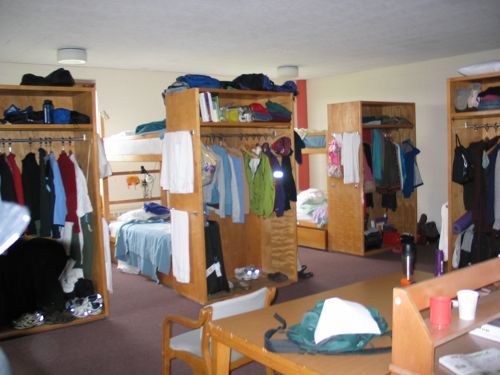
It’s a bit like college at Kripalu, I notice. People walk around in slippers, barefoot, wearing robes, shawls, dreadlocks, bandanas, do-rags. Our dorm door does not lock, everything is Open. People leave their yoga mat, shoes, whatever outside the rooms and alongside their bed without fear of it being stolen. It’s safe here.
At 4:15, I take a gentle yoga class with Evelyn. She reiterates the obvious, in a good way. I am speaking. There is noise below us. The heat is coming out of the vents. The soft music is playing. You are here.
You.Are.Here.
I come in and out of crying. I close my eyes for the first half of class and realize I am trying to hide the fact that I’m here, away from home. When I first open my eyes and see the ceiling, the giant stained glass Om symbol, I am lost, scared. By the end of savasana, however, the lost feeling is slowly fading.
***
Cell phones are not permitted in Kripalu’s common areas, and I must use the luggage room to call Bryan. I am told there is a lights-out rule in the dorm rooms by 10 p.m. Crazy rules that would seem absurd at home are completely reasonable here.
***
Tension. I am still scared, even after gentle yoga and talking with Bryan. My jaw is tight, my eyes burn with residual tears, I cannot relax. Every moment is awkward, from figuring out when I should shower, where to get coffee, when to use the gym.
Dinner that night is warm and nourishing. Country fried tofu, salad, mashed potatoes, peas and carrots, organic bread, soup, orange juice.
***
The training program officially begins that night, after dinner. Our facilitators are Megha (vibrant! energetic! bold!) and Rudy (soft, subtle, gentle). We sit in a circle, say our names, where we’re from, and three words. Jennifer, New Jersey, Breathe, Dance, Release.
We got to a personal altar that has been set up for us, where there is a candle, training manual, mala beads, and a card with a yoga posture on it. I am parighasana (gate). We reflect on what yoga means to us. We write it down:
Light! I am illuminated from the inside out–I can dance without inhibition. An energy that was once dormant is able to run through my blood, my veins, and out through my heart, arms, and legs. Peace! I don’t get angry so quickly. I respect others’ feelings and opinions. I am drawn to the human race. I feel we are one.
And then we chant, about inquiry. Atha Yoga Nushasanam. We do this in three circles, gradually. Walking in closer and closer. The sound is amazing. We are a choir. It gets louder and stronger as we come closer. I feel like crying, it’s so beautiful! We Om three times, stronger each time. Some people harmonize. Instant peace. I find myself smiling like a goofball, so awe-inspired, filled, in love with everyone around me. We make eye contact with our classmates and there is joy in everyone’s eyes.
We flow from goddess, warrior I, warrior II, reverse warrior, extended side angle, back to warrior I to music of chanting. The flow is alive. I am smiling!

Our assistants are Jurian, Roger, Leila, and Helga. They tell us over and over again that they are here for us, the wind beneath our wings. I feel so encouraged. No one is trying to trick us, play with our minds. Honest, caring, open, trusting.
***
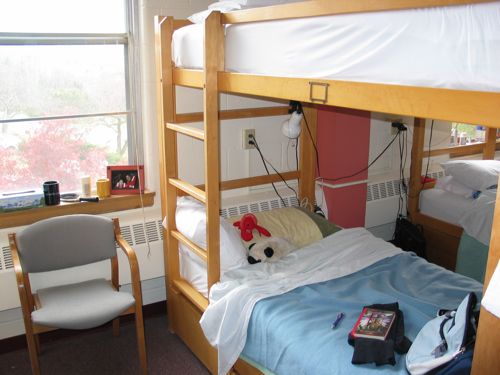
It’s nearly 10 p.m., and I am emotionally drained. This is my bed for the next month:
Earlier this week, I re-connected with a dear old friend…kundalini yoga!
My relationship with kundalini has been a bit off and on, but my interest in this unique style of yoga began during my yoga teacher training at Kripalu, where we learned about the founder of Kripalu yoga, Swami Kripalu, referred to by his followers as Bapuji. Bapuji practiced kundalini yoga, the most ancient style of yoga (kind of how ballet is to the dance world), which incorporated very regimented sequences of breathing, movement, chanting, and meditation. The Kripalu style of yoga is derived from kundalini; hence, why Kripalu yoga is very heavy on the pranayama (breathwork)-asana (postures)-dhyana (meditation), and why I came home from yoga teacher training very interested in trying out this mysterious style.
The problem is that it’s pretty hard to find a kundalini teacher–let alone class–in Small Town, USA. Kundalini is totally different from “regular” yoga. There’s a ton of chanting, crazy-fast breathwork, and lots of repetitive movement, at times which can look very silly and feel somewhat awkward or weird (say, hopping on one foot with your eyes closed?). The objective is to unblock the energy from the base of the spine and allow it to rise through the chakras and all throughout the body.
Each session has a specific objective (e.g., heart opening, liver detox, mental clarity) with a prescribed set of “kriyas,” the postures/chants/movement. These kriyas are arranged in a specific order with designated time limits for each move or meditation; sometimes a set will call for the same move for 30 minutes; other times, the set will include several moves that last 2 or 3 minutes each.
I first started kundalini back in 2007, when a local studio offered an introduction series and then included it as a regular weekly class on the schedule. I was a kundalini junkie and experienced some pretty intense visualizations and post-class energy shifts. I was a regular student until the teacher stopped working at the studio, and then no more local kundalini classes existed. 😦
A different studio began offering the class last winter, and I immediately dove in. However, this teacher’s style was a bit different, and I felt like class was one third kundalini, one third the teacher talking about her life, and one third sitting (im)patiently on the floor post-start time, waiting for class to begin already. I couldn’t stand paying money for that and again had to depart from kundalini. 😦
But here we are in 2011, and to my delight, a teacher with whom I studied Tai Chi Chih last summer is offering a short kundalini series that began this past Tuesday. 🙂
I love this woman’s teaching style, with her soft, gentle voice; her attention to detail; and the way she can break down such a complex style of yoga to a hodge-podge group of students who are at all different levels and from different backgrounds. I mentally groaned to myself when she said that the first part of class would be more of a background of the practice but was surprised when I found myself eating up her words and really coming to understand the meaning of not just kundalini yoga, but yoga in general.
The physical practice that night was somewhat abbreviated but still powerful. We did all the basic warm-ups (lots of spinal rocking/twisting), the opening invocation, and worked our way into a short series for aura enhancement. I loved how she described our aura: the extension of our physical body, a kind of force-field surrounding our corporeal mass that we need to keep strong so we are able to block negative things (e.g., germs, bad energy) before they get to our physical bodies and cause sickness, disease, and mental negativity.

Strong aura, strong body!
We ended with Sat Kriya, which is usually included in every kundalini class. It’s a very simple but intense kriya in which you sit in hero pose (or rock pose, as it’s called in kundalini), with your heels under your rear; hold your arms above your head with hands clasped, pointer fingers extended and touching; and vocalize a sharp “sat” (pronounced more like “sut”) that draws in the belly, followed by a relaxed and soft “nam” during which the belly relaxes.

Hold the pose and repeat the sat-nam sequence for 3 to 30 minutes. Like most kundalini movements, this feels a bit tiring at first but then out of nowhere shifts into a very strong gesture and meditation. I’ve added 3 minutes of Sat Kriya to my morning routine and already feel the benefits: more alert, focused, and confident throughout most of my day.
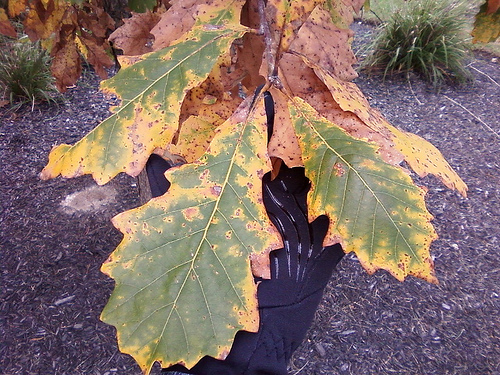
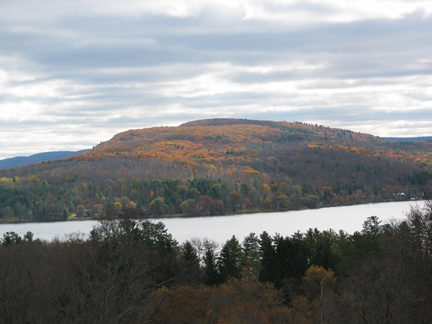
The thing about kundalini is that sometimes its effects are not immediately evident; like, I didn’t leave class on Tuesday night feeling like my aura was all shiny and clean. However, the next morning, during my morning walk around the park, everything felt illuminated. The oxygen I breathed in, the sights I saw, the people I passed…I wasn’t necessarily labeling them as “brilliant” or “beautiful”; I simply felt like I was really noticing everything I passed, like my awareness was heightened. Especially with it being fall and the leaves changing color, the landscape around me felt like an artist’s easel with various shades of autumn pulsing from the canvas.
Crispy around the edges
Have you ever tried kundalini? If you ever have the chance, I recommend giving it a shot. It’s definitely different at times, but generally it makes me feel pretty darn good.
I had a lot to smile about yesterday–a fresh pumpkin raisin muffin from the farmers market, getting to pet a black pug, and a long mid-afternoon walk through town with Bryan–but the thing that got me smiling the most was an hour of Laughter Yoga!

Laughing with Buddha (Lhasa, Tibet)
A local yoga studio offered the hour-long class, led by Bob Pileggi. I was interested in the class because it seemed to be more about the physiological/psychological aspects of laughter and smiling, not about telling funny jokes or being silly for the sake of being silly. And just having written about the importance of breathing and opening up the lungs, I thought this would be a great way to experiment more with just that. Another reason I went was to figure out how to lighten up a bit. A lot of times when I’m doing the 5Rhythms, I feel like everything but my face dances, that there is so much emotion in my hands, my fingers, my torso…everything but my face. Even when I feel joy inside, my jaw clenches. It takes a lot of build-up for me to break out into a genuine smile or to laugh when I dance. I hoped that Laughter Yoga would teach me how to be more comfortable turning up those two corners of my lips. 🙂

I was a bit anxious when only three other students showed up for the class; would it be possible to bust a gut laughing with such a small group? (Answer: YES!) Bob instructed us to commit ourselves 100% to the exercises, like little children playing princesses or pirates. Immerse ourselves completely, don’t hold back. I vowed to do just that; I mean, I had paid for the class so I might as well dive right in.
We started standing with some simple warm-up exercises to loosen the spine and hips, then moved on to conscious breathing, very much like dirgha pranayama in yoga, raising the arms during inhale, lowering the arms during exhale. We picked up the pace by breathing as though we were blowing out a candle on a birthday cake, very sharp exhales, a bit like kapalabhati breath. Already, I could feel my lungs opening up, my cells dancing with oxygen.
Then came the vocalizations, which we used for much of the class: Ho, ho, ha-ha-ha, done while clapping to the rhythm. We did this standing in a circle, exchanging eye contact with others. This continued for a while, getting louder, softer, faster, slower. Bob encouraged us to change the pitch of our voices, the direction of our clapping. Soon, this exercise continued with us walking around the studio instead of standing in place, still making eye contact with those we passed. Things lightened up at this point, and we shifted in and out of different “characters,” maybe ha-ha-ha’ing haughtily like a snobby debutante or ha-ha-ha’ing demonically like a monster. Before we knew it, unconscious giggles slowly began to escape our lips.
Once the beginnings of true laughter began to appear, we got back in our circle and…laughed. It felt a bit forced at first, just a tad uneasy. But the longer we continued, the more real it became. Each person’s laughter took on a different tone; one woman had a cute giggly sound to hers, another had a spirited ebullience to hers. Hearing all the different kinds of laughter was, well, kind of funny and contagious, and eventually I felt the shift from “I’m doing this because the instructor said so” to “I’m doing this because it’s coming naturally to my body!” It was a bit like babies crying–when one starts, they all start.
Next, we connected laughter to emotions. Standing in the circle, we took turns shouting out things that brought joy to our lives. After each person made their exclamation, we all laughed. It went a bit like this: “My baby nephew falling asleep on my chest.” (::laughter::) “Walking down Main Street, USA in Disney World!” (::laughter::) “Little curly puppy dogs!” (::laughter::) Then came the trickier part: doing the same thing, but shouting out things that caused us stress: “Sitting in traffic!” (::laughter::) “Sallie Mae loans!” (::laughter::) “Getting into a fight with your boyfriend!” (::laughter::) As Bob explained, if something stressful has happened and there’s nothing you can do about it, why cause yourself more stress by stewing and steaming? By choosing to laugh at something, you’re guiding your body into a more optimistic response and not harming your health in the process.
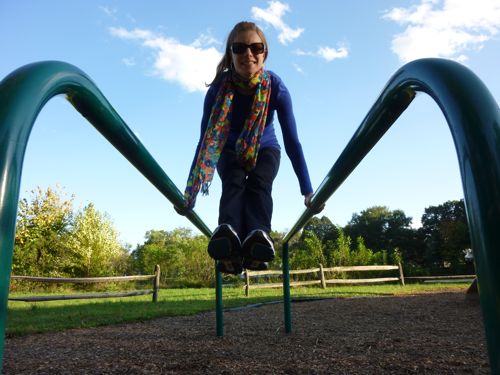
One of my favorite exercises was the three-part’er: (a) Cover your mouth and give a small, polite, demure little giggle; (b) Relax and give a medium-sized chuckle; and (c) Let loose and give a full belly laugh. I found this to be a bit like 5Rhythms–a little wave of laughing–from flowing to staccato to chaos. By the time we got to chaos (full belly laugh), we were ready to erupt. For a while, it sounded like the five of us were old college chums meeting up for the first time in years, cracking up about the good ol’ days. The funny thing is that I only knew one person in the class.
Before a final savasana, we lay on our mats and went through a final breathing-to-laughter exercise. Maybe it was because we were all spread out across the room and couldn’t see each other, but I found my most authentic laughter during this part. I heard one woman’s delightful giggle and just lost it, the full back-arching, throaty laughter you get when someone tickles you mercilessly. It eventually winded down naturally, and soon I was sinking into my yoga mat for a very peaceful savasana.
Sure, the class felt a bit silly at times, but just an hour of ho, ho, ha-ha-ha’ing and laughing without reason opened me up from my core to my head. That area of my body that always feels so neglected during 5Rhythms had a chance to dance, and I felt all kinds of wonderful pops and cracks throughout my spine and neck as the muscles around them relaxed and warmed up. For someone so intrigued by pranayama practice, I was thrilled to work with the breath in such a unique way–standing and moving and laughing–not necessarily sitting in lotus pose and doing ujayii breath for 20 minutes straight.

Also, on a more biopsychosocial-spiritual level, the actions of laughing and vocalizing are centered around the chest (anahata chakra) and throat (vishuddha chakra). Since finding out I have hypothyroidism, I am especially interested in the vishuddha chakra, and that maybe perhaps I don’t give it enough attention. Maybe introducing more laughter and throat-opening exercises will help my thyroid?

Playground version of simhasana (Lion's pose)
What did you laugh about this weekend?
OK, so it’s become evident that my morning routine is a bit extensive. As my husband noted the other night as I set my alarm clock:
Me: I’m sleeping in tomorrow!
Bryan: So, you’re getting up at what, 5:45?
Me: 6!
Bryan: Well, I guess you won’t be able to do all 17 of your morning exercises then.
And I didn’t. That morning, I had time for one set of the 6 movements of the spine, a downdog or two, and finally–pranayama.
Pranayama is the practice of breathwork. It’s breathing but with control, focus, and mindfulness. Yes, we breathe involuntarily all day, but when you take a few moments to do nothing but concentrate on your inhalations and exhalations, the benefits can be felt almost immediately. A greater sense of calm. More energy. Vitality. Like you’re really alive, that you are not numb to the world around you. You feel. After all, inhalations increase sensation.
During my yoga teacher training at Kripalu, we did A LOT of pranayama. It was one of foundations of the style and was incorporated into every class. I think I breathed more during that month than I did the 26 years of my life leading up to the program. The results were intense, especially after one session where we did nothing but different styles of pranayama for an hour and a half. I’m 99% sure I floated out of the classroom that day. I left Kripalu with a new appreciation for the practice and a fondness for oxygen.
One of my favorite pranayama techniques is nadi shodhana, or alternate nostril breathing (also called “anulom vilom” at Kripalu). I try to do it every morning, because it focuses my mind and helps clear both nasal passages.
Most people sit cross-legged; I sit in hero with a blanket between my butt and feet.

The right hand (active hand) goes into Vishnu mudra: index and middle fingers tucked into palm; thumb will close off right nostril; ring finger and pinky, acting as a unit, will close off the left nostril. The left hand (resting hand) can rest gently on your knee or lap.
1. Gently press right nostril shut with thumb. Inhale slowly through left nostril.
2. Close off left nostril with ring/pinky fingers and exhale slowly through right nostril.
3. Keep right nostril open, inhaling slowly.
4. Shut off right nostril and exhale through left.
5. Keep left nostril open, inhaling.
6. Close off left nostril and exhale through right.
So on and so forth. There are several variations of this technique, including adjusting the ratio of inhalation/exhalation counts, retaining your breath at the top of every inhale and bottom of every exhale for a few moments, breathing only through one nostril, so on and so forth. I usually stick to the basics for about 5 minutes. One thing I’ve heard in kundalini classes is that finishing your last exhalation through the left nostril (lunar side) will promote peace and calmness, whereas ending with an exhale through the right nostril (solar side) will promote increased energy; hence, the side I finish on in the mornings!
Another note: You don’t need to be sitting peacefully on a yoga mat or blanket to reap the benefits of nadi shodhana. Sitting in bumper-to-bumper traffic is a great time and place to do this, and you may arrive at your destination with blood pressure that’s not off the charts!
My final pranayama of the morning is kapalabhati breath. This is very intense, rapid breathing that involves a quick, involuntary inhalation through the nose followed by a sharp exhalation through the nose while simultaneously contracting the belly. It’s also called “Breath of Fire,” and rightfully so. It will warm you up in seconds! It’s a bit tricky to teach through words and it usually takes people a few tries to get it right. When executed properly, you won’t even be aware of your inhalations, and during your exhalations, your belly will look like it’s being punched by an invisible hand.
Here’s one of my favorite add-ons to kapalabhati, which I learned at Kripalu. It makes a juicer practice even juicier!
After your final exhalation, continue drawing out the exhale as you bend your upper half over your legs. Open your mouth and expel as much air as possible, like you’re vomiting oxygen/carbon dioxide.

Keeping the body empty of air, roll up through the spine and retain the exhale while sitting peacefully. When done correctly (and it takes a few tries), you’ll feel a “vacuum” effect from the belly up through the throat. Keep your pelvic floor engaged and lifted, the belly pulled in, and a slight lock in the throat (this throat lock is called jalandhara bandha).

Stay in this exhalation retention for as long as you can, concentrating on the belly as your mental focal point. Learn how to respond, not react to the desire to inhale. Panic mode will set in quickly, but the lesson is to work beyond the initial “OMG I’m gonna diiiie!” reaction. You will not die, and you may even find that moving beyond that initial fear will feel quite empowering and peaceful.
When the time is right, take a deep inhale through the nose…but only inhale to 2/3 of your capacity, so you’re not stuffed to the brim with air. At this time, shift your focus to the third eye (the space between your eyes, but just a hair higher) and retain the partial inhalation, allowing the oxygen to swirl throughout your body, feeling it dance from your head to your toes. I always feel a gentle, warm “hum” in my head at this point and a faint golden glowing sensation between my eyes, like all the rest of the world has shut off and I am just here. I tend to hold my hands out, palms up during this part, because I feel open to receiving energy.

Again, hold this inhalation until it’s absolutely necessary to finish the other 1/3 and then exhale into normal breathing. I do this sequence about three times and then finally–FINALLY!–end my 47538923893-step morning routine with a big, fat Om!
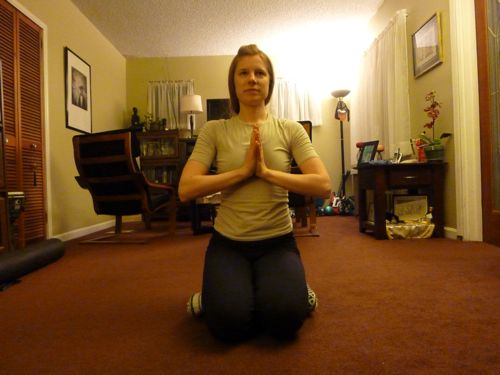
As I wrote in this post, my morning routine starts with the 6 movements of the spine…but it doesn’t end there!
What I’m finding is that starting my day with those movements really gets me in touch with my body and gently coaxes me into other movement, such as yoga, dance, pranayama, or meditation. When I’m pressed for time, I stick with the “Big 6”; when I have more flexibility in the mornings (which I usually do, because I wake up early specifically to do these kinds of things), I listen to my body and see what it wants to do next.
Time and time again, I return to the good ol’ seated sun salutation sequence, introduced to me by one of my very first yoga teachers. I love traditional sun salutes as well, but sometimes in the morning my hamstrings and hips just aren’t ready to bend down from a standing position.
Here, you start in dandasana and raise your arms on an inhalation, just as you would in a traditional sun salute.
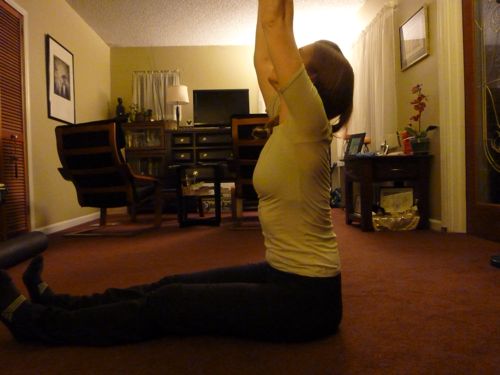
Next, leading with your heart, fold your upper body over the legs into a simplified paschimottanasana as you exhale. Don’t feel the need to grip your toes or ankles or whatever. Just let the hands fall naturally, without hunching the back. Stay here for 2 or 3 deep breaths.

These photos were taken in the evening, hence the greater flexibility; in the morning, my hands are usually somewhere on my shins.
Inhale, and come up the way you came, arms overhead. Place hands in prayer position and draw them down to heart. Repeat this modified sun salutation 2 more times.
After the third set, proceed as though you are going into a fourth salute, but when you lower down–instead of resting in paschimottanasana–take hold of your right foot, drag it up near your knee, and cross it over the left leg into matsyendrasana. Place your right arm behind you, raise left arm overhead on inhale, and on exhale cross left arm over right knee into a gentle twist.

Take several breaths here, making micro-movements into the twist. Be sure to start the twist from your core and work your up; don’t just crank your head and neck to one side!
After exhaling out of the twist, uncross leg and slide right foot to a spot on the floor between your foot and knee. Place both arms behind you, fingers facing toward body, and, pressing into the floor with both your hands and feet, lift up into a modified upward plank pose, purvottanasana.
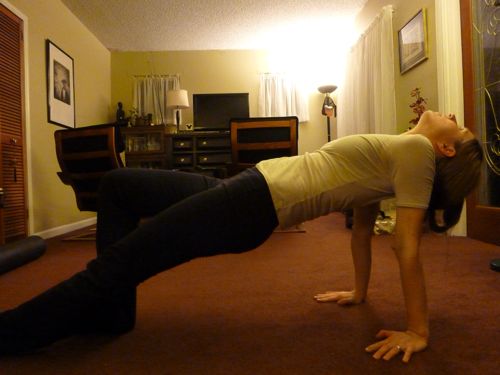
Not the best form; my neck and shoulders were very creaky the day I did this! (Also, again with the obvious hypermobile elbow. Ewwww.)
Drop you head back slightly if you wish and let your mouth fall open to release any tension. Take a deep inhale, and on exhalation, bend arms and lower yourself back to the ground, extending right foot out to meet the left, both legs straight.
Now, repeat the matsyendrasana/purvottanasana sequence on the other side.
When complete, return to Step 1 and do one last seated sun salute into paschimottanasana.
Do you feel any different in this pose than when you first started? Do you sense slightly more flexibility or more warmth?
I almost always sink just a little deeper at the end of this sequence and feel a little looser in my hamstrings. The focus on inhalations and exhalations calms my mind and primes me for some breathwork.
Stay tuned for a description of the final part of my morning movement–pranayama!
This past year I’ve really struggled with establishing a solid morning routine. Between waking up and leaving the house for work–with a shower/hair/makeup routine somewhere in the middle–I’ve experimented with doing hip-strengthening PT exercises, practicing therapeutic yoga DVDs, sitting in meditation for at least 10 minutes, committing to 10 sun salutations (5 A, 5 B), reading books while walking around the park, meditating with alternating mudras, and dancing around the living room in my pajamas.
Regardless of which activity I choose, the key is that I warm up as soon as I wake up. Even on my wedding day more than 7 years ago, I woke up at 6 a.m. and, before I headed off to the hairdresser, rolled around in my underwear, stretching and loosening up my limbs. I don’t consider myself “creaky” yet, but as I move into my 30s I am more aware of that car-in-the-winter feel that sets in overnight. Starting a day without stretching is like heading off to work without brushing my teeth–terribly icky and not recommended.
After doing the Kripalu yoga video the other day and being reacquainted with pratapana (Kripalu’s version of “warming up”), I was also reminded about the importance of going through the 6 movements of the spine before engaging in any other movement. The spine is that what holds us all together, and giving it the proper warm up will enable all other limbs to kick in gear.
The great thing about these movements is that they can be adapted for people comfortable being on the floor, those who wish to stay seated, and for others who prefer standing. Whatever variation I choose, I do about 5 to 10 of each movement.
Seated variation (can be done in easy/hero pose or in a sturdy chair)
Part A. Extension/flexion
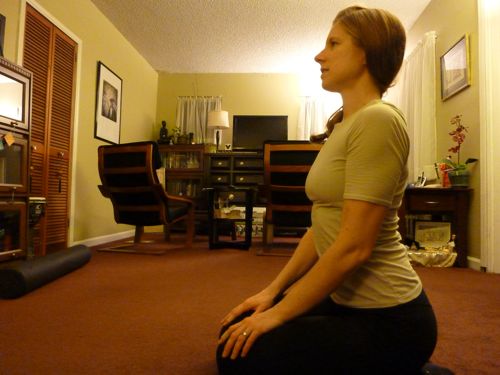
Spinal extension

Spinal flexion
Part B. Lateral (side-to-side) movement

A beautiful C to one side...
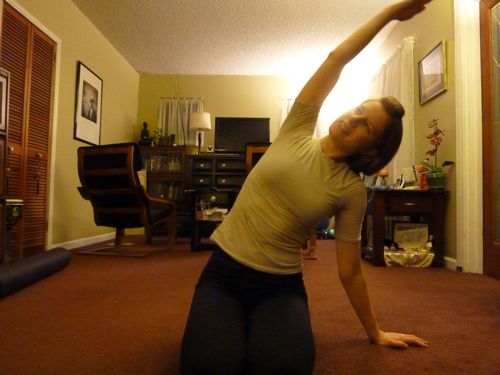
...and on the other.
Part C. Twists

Wring it out, like a wet sponge!
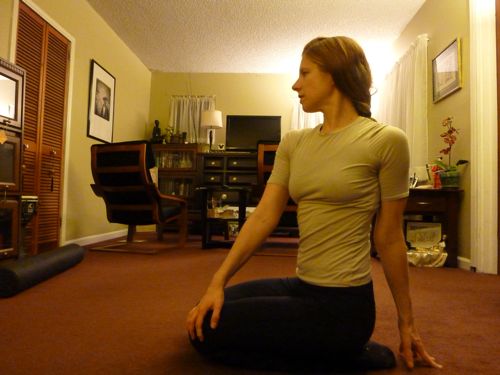
Other side, different angle (from which you can see the severity of my hypermobile elbow joints).
Floor variation (for those comfortable on hands and knees)
Part A. Extension/flexion
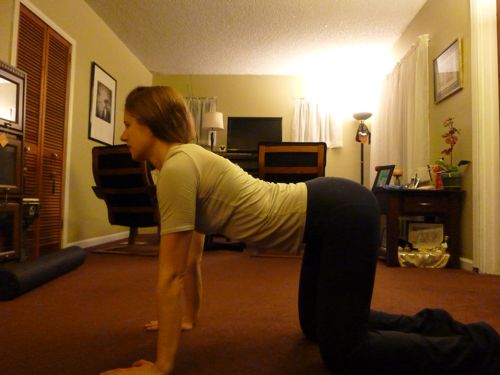
The well-known "cat" pose

...followed by dog/cow pose.
Part B. Lateral movement

Keeping the spine in one plane, curve head, shoulders, spine, and hips into a "C" on one side
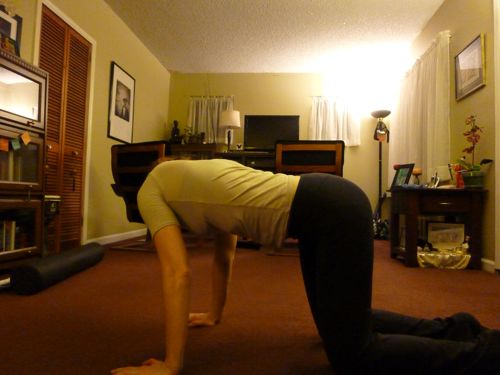
...and then the other. Try not to raise the head to look back at hips.
Part C. Twists

Slide arm under chest while turning head in that direction. No need to settle in this warm-up; I just let my head tap the floor and draw up to move to other side.

Be sure to keep hips over knees!
Standing variation (great for adding hara breaths)
Part A. Extension/flexion
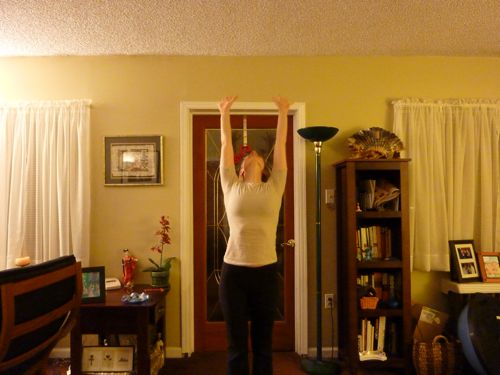
Extend up to sky, slight backbend, chest lifted. (inhale)
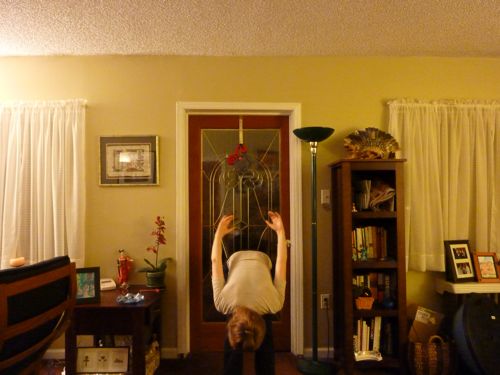
Drop down, swinging arms behind hips. Give a big sigh on the descent! (exhale-HA!)
Part B. Lateral movement
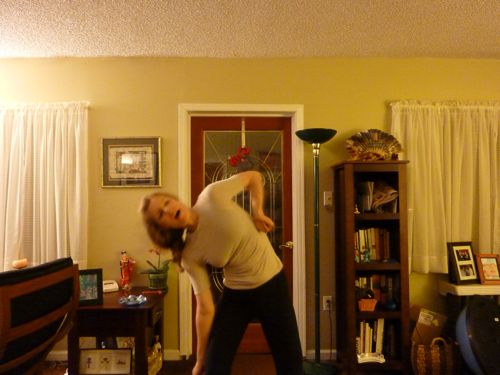
Bend to one side, letting that arms slide down leg. Draw other arm up to armpit, like a monkey. Hara breath can be done during the drop; inhale while drawing back up to center.
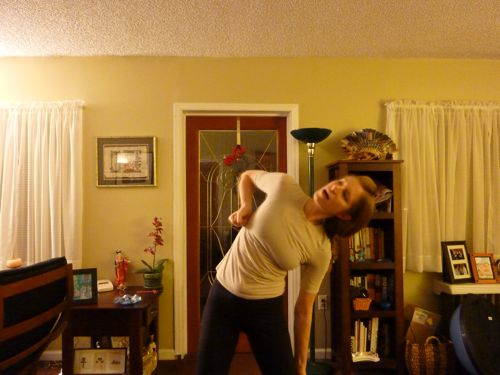
Increase the speed/breath to create more heat.
Part C. Twists

Imagine your arms are empty coatsleeves. Gently swing them back and forth as you twist side to side, one wrapping in front of body, the other behind. Exhale HA! at final point of twist; inhale while swinging back through center.

I always picture myself as a washing machine agitator during this movement.
Since last week, I’ve been mindful of starting each morning with those 6 movements, and the end results feel pretty darn good. Most mornings I do all three sets, starting with the floor exercises and working my way up to standing. Incorporating the deep hara breaths really gets things warmed up and opens up my chest, throat, nose, and mouth, clearing the path for the pranayama practice that follows. The spinal movements open up the space between each vertabra, thus opening the pathways for greater energy/prana flow.
I’ll show you the remainder of my morning routine in a future post. Until then, remember to brush your teeth, wash your face, and move your spine!
My coworker/5Rhythms classmate left yesterday for a yoga nidra workshop at Kripalu. A whole week of savasana…now that’s a relaxing retreat!
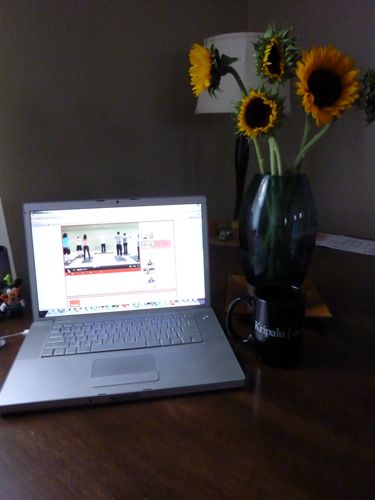
Instead of being insanely jealous about her vacation, I decided to bring a little bit of Kripalu into my own Sunday morning. About a week ago, Kripalu uploaded a video of a full-length moderate yoga class to its YouTube channel. This was a wonderful surprise, because up until then most of the videos were just short yoga breaks or interviews with staff/experts. This class was an hour long; led by one of Kripalu’s leading men, Devarshi (Steven Hartman); and had all the elements of an authentic Kripalu yoga class offered at the actual center. I spread out my yoga mat on the living room floor, opened the blinds to let in the sunlight, and began.

The class started with one of my favorite pranayama exercises: alternate nostril breath. Sadly, not many classes I attend at home dedicate time solely to breathwork, so I was thrilled to sit and focus on my inhalations and exhalations. I honestly believe that starting practice with focused breathing brings everything to center and really gets the mind, body, and spirit connected before moving on. I don’t think I’ve ever attended a Kripalu yoga class that doesn’t start with pranayama, and some end with it as well!
Many of the pratapana (warm-up) movements involved hara breaths, which means taking deep inhalations through the nose and strong, forceful exhalations through the mouth, while saying “Ha!” We did this during the “empty coat sleeves” twist, monkey arms side bends, and while sweeping the arms overhead (inhale) and then collapsing down (Ha!). The breath, the vocals, and the invigorating movement warmed me up instantaneously, and I felt a nice, warm juiced-up vibe flowing within me. At one point, I even remember thinking, “Man, I feel good!”
Another Kripalu trademark is long posture holds, which made its appearance during a simple standing position. Devarshi instructed us to hold our arms to the side in a T, palms facing out. Sounds simple, right? But then we held it. And held it. And continued holding our arms out. We made small circles going one way. Small circle in the other direction. Devarshi encouraged us to think positive thoughts (“My arms are strong!”) rather than the negative thoughts that first come to mind (“This is haarrrrddd!”). We breathed through it, relaxing and smiling into the stretch. There is such a fine line between wanting to give up and finally getting over that mental block of a hump and being OK with the warm sensations running through the chest, shoulders, arms, and hands, maybe actually enjoying it.
One of my favorite postures of the practice turned out to be one of most dreaded poses: utkatasana, chair pose. But the way Devarshi eased us into it–first just a slight bend at the knee, add a little bounce, arms loose, wrists relaxed–felt natural and tolerable. The best part was when he adding a little “snap” to the pose, guiding us to snap our fingers and sway our hips side to side, like a number in a Bob Fosse show. Holy crap, was I actually enjoying this rather long hold of utkatasana?!
There were no fancy poses, not even a single downdog, but the sequencing, languaging, and contemplative/meditative nature of the Kripalu practice made me remember why I trained in this style in the first place and that a yoga practice doesn’t need 25 sun salutations to feel “real.” After savasana, an om, and a triple shanti, Devarshi closed the class with a “jai bhagwan,” which totally brought a smile to my lips because it reminded me of every single yoga class at Kripalu, where “jai bhagwan” totally trumps “namaste.”
So if you’re ever stuck at home and don’t have time for a studio class, I wholeheartedly recommended this little gem of a YouTube video, especially if you’re familiar with the Kripalu style or curious about what a typical Kripalu class is like. The only thing missing was being able to roll up my mat; step outside for a deep breath of that cool, crisp Berkshire Mountain air; and enjoy my silent breakfast surrounded by other blissed-out yogis.
Instead, I poured my morning coffee in the black Kripalu mug that got me through all 28 days of training and enjoyed my breakfast next to the sunflowers from this weekend’s farmers market. Not quite a mountain retreat but I felt just a little closer to home.
I’m in Disney World right now, but as I mentioned in this post, I wanted to share with you the yamas of a yoga practice and how they can be applied to all of life’s experiences, even a weeklong trip to the Mouse House. Read on for a breakdown of the final three!
Yama #3: Asteya
“Asteya, or ‘not stealing,’ refers to the stealing that grows from believing we cannot create what we need. We steal because we misperceive the universe as lacking abundance or we think that there is not enough for everyone and that we will not receive in proportion to our giving.”
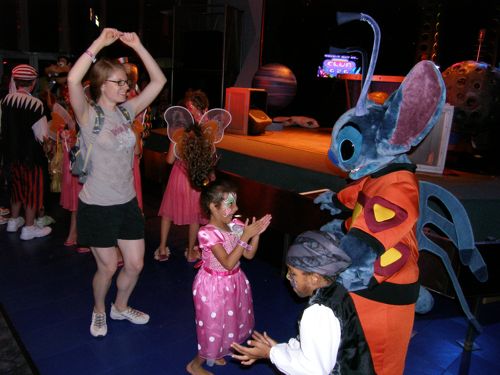
Even though you want Stitch all to yourself at the Club 626 dance party, remember to share him with the kiddies.
Chip and Dale need a lesson in asteya: It’s not very nice to steal your fellow chipmunk’s gal.

Although it is flattering to be part of this disagreement!
Fun fact: Stitch is WDW’s the biggest asteya offender. Watch all loose objects; Stitch WILL steal!
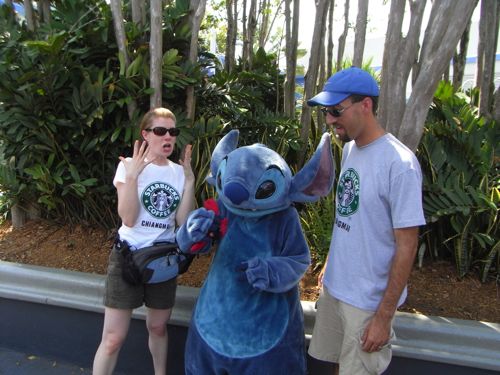

Yama #4: Brahmacharya
This is a tough one to grasp, so I’m posting a slightly longer explanation: “Brahmacharya reminds us that our life force is both limited and precious, and sexual activity is one of the quickest ways to deplete it…. We can teach brahmacharya by helping our students learn to use the minimum energy to achieve the maximum result. Teach them not to use small muscles to do the work of large muscles, and to bring their minds into the poses so that their bodies do not become fatigued.”
The concept of brahmacharya is sexually rooted, but, as noted above, it can also mean not letting your body loose control in an effort to enjoy something.
Ever go on a roller coaster and scream your brains out just to be silly? With all that yelling, waving, hooting, and hollering, you may lose out on the true experience of the ride, and it will all go by in a flash.

Stay in the moment and feel the experience of loosing control, while keeping your mind and senses engaged. Enjoy every second of that lift up the hill and breathe in the joy of the final descent.


Yama #5: Aparigraha
“Aparigraha means not coveting what isn’t ours. It is different from asteya, which asks us to avoid stealing that is motivated by a greed springing from a perceived lack of abundance. Aparigraha is the greed that is rooted in jealousy…. Rather than finding who we are, we look at someone else and say, ‘I want to be that.’ Aparigraha, in its essence, helps us discover our own selves so that we no longer feel the need to covet what someone else has, or be what someone else is.”
Don’t compare yourself to others, even if you think Walt Disney should have picked a lobster for his sidekick instead of a freakin’ mouse.
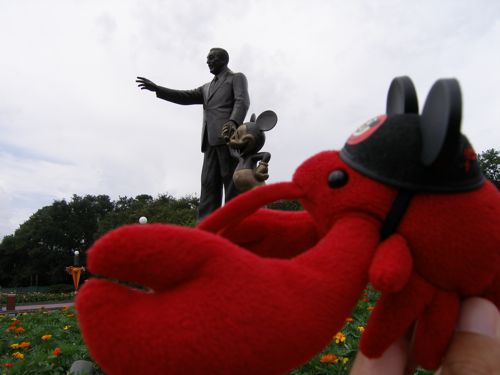
"Man, that darn mouse has it ALL..."
Remember to enjoy the entertainment at Disney World, rather than dwell on the fact that you will never, ever be a Disney dancer, despite your lifelong dream of wanting to be THAT girl.
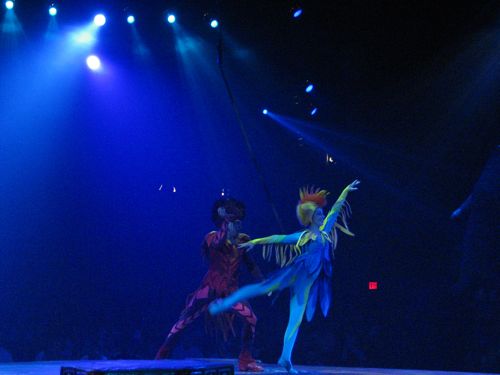
Remember your own accomplishments instead of trying to stand in someone else’s shoes.

Note: I had every intention of writing up a similar post on the five niyamas before I left, but then I forgot that I needed a proper rain jacket for what looks to be a mildly damp week in Florida, so my jaunt out to L.L. Bean totally sucked up my blogging time!
On that note, I have to remember the niyama of samtosha (contentment) and accept that I’ve done all that I can physically do before heading out. Namaste!

Contentment.

I’m in Disney World right now, but I was sure to pack my yamas. (It’s cool, the TSA allows a maximum of five.)
As I wrote about in my previous post, it’s very possible to practice yoga without stepping on a mat. The physical form of yoga we all know and love–asana–is just one limb of eight that comprise the complete practice. Yamas is one of those other limbs, and it refers to measures of self-restraint. As Aadil Palkhivala states in his wonderfully written article, “the five yamas–kindness, truthfulness, abundance, continence, and self-reliance–are oriented toward our public behavior and allow us to coexist harmoniously with others.” Paired with the niyamas (another limb that includes five elements), the yamas are very much like a Ten Commandments for the yoga world.
Palkhivala’s article (which I’ll quote throughout this post) is very well written for those who are curious how to incorporate the yamas into their physical practice and puts these esoteric Sanskrit terms into everyday context. But how does one appreciate and practice the yamas while standing in line for 30 minutes to ride Space Mountain, like I’m doing now?
Yama #1: Ahimsa
“Ahimsa traditionally meant ‘do not kill or hurt people.’ This can be extrapolated to mean that we should not be violent in feelings, thoughts, words, or actions. At root, ahimsa means maintaining compassion towards yourself and others. It means being kind and treating all things with care.”
Ahimsa means keeping your cool, even when this kid throws a temper tantrum for 45 minutes straight while waiting for the afternoon parade to begin at Hollywood Studios. Ahimsa is what keeps us from flipping out on the parents, who look the other way and laugh as their boy wails loud enough to be heard over at Epcot.

Thou shalt not kill.
Forcing your spouse into drinking the “Beverly” soft drink over at Epcot’s Coca-Cola Club Cool strays from ahimsa. We all know it tastes like sh*t, and it’s not very nice to torture each other for the sake of a funny photo.


On a more serious note, it’s easy to get overwhelmed at Disney World and want to cram everything into the day. When the body asks for some rest, accept it. Besides, that’s what the Tomorrowland Transit Authority PeopleMover, railroad, monorail, and the train to Rafiki’s Planet Watch are for.

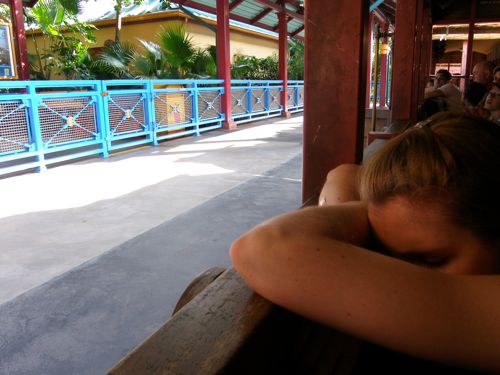
Take a break!
Lastly, no matter how much fun a ride is, don’t overdo it. Remember self-compassion–ahimsa–and stick to no more than three consecutive rides on the teacups. Two if you’ve just eaten.

Yama #2: Satya
“Satya means ‘truth,’ or ‘not lying.’ Practicing satya means being truthful in our feelings, thoughts, and words, and deeds. It means being honest with ourselves and with others.”
Satya means withholding from telling your mate that the Beverly drink tastes “Awesome! You gotta try it!” (see above).
Satya means it’s OK to not really like the Hall of Presidents, to think Mission: Space is eh, or ::gasp:: to admit that the Carousel of Progress should be next on the chopping block. (The latter was really hard to write, but that’s the point of satya–be true to your feelings, despite the discomfort it may cause.)

Satya: Don't lie. It's OK to admit that Mission: Space doesn't really do anything for you. (And yes, I go on the orange side!)
Satya is being truthful about one’s obsession with Stitch and never playing down her love of the big blue alien, despite being a grown-up.
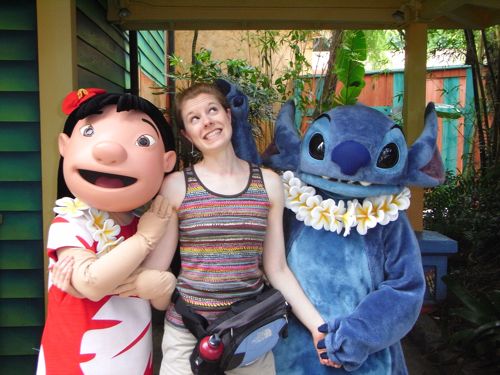
Don't lie and deny your most rewarding pleasures!
There are three more yamas that should be in your carry-on before any vacation, but you’ll have to wait until Thursday for the full Disney-fied breakdown. Stay tuned, and see ya real soon!
Ahhh, September. The start of National Yoga Month. Yet as all my fellow downward dawgs unfurl their mats to begin a month of celebration, contemplation, and meditation, I’m leaving my asana behind in New Jersey and heading to a land of not one but FOUR mountain poses: Space, Big Thunder, Splash, and Everest.

As the old saying goes, “I’m going to Disney World!”
Although I’ll still do a few hotel room sun salutations in the morning and most likely prop my achy legs up into Viparita Karani after a long day walking around World Showcase, the truth is that–for me–this first week of National Yoga Month will probably include very little yoga.
Well…let me rephrase that. It will probably include very little PHYSICAL yoga.
Unless you’re a yoga teacher, long-time student, or someone very devoted to the tenets of yoga philosophy, your vision of yoga is most likely the ol’ headstand-in-the-middle-of-the-room, foot-behind-the-head variety. The vision of yoga that makes you say, “I’m not flexible; I can’t do yoga.” The kind of yoga that requires a sticky mat, some kind of Lycra wardrobe, and either an instructional DVD or a gym membership.
But here’s the thing: That kind of yoga is only 1/8 of the practice.
The physical postures of yoga that we’re all most familiar with–termed asana in Sanskrit–is just one serving of a multiple-course meal. I didn’t know this myself until I had been taking yoga classes for about a year and was interested enough to pick up an issue of Yoga Journal, but it made sense. What had started as me taking some classes at my gym to improve my balance and flexibility gradually turned into something bigger. I felt kinder toward others after doing yoga. I developed a deeper appreciation of my body after doing yoga. I felt compelled to sit in silence and meditate and breathe after doing yoga.
Asana was the key into this wide world of yoga, a practice of not only physical postures but seven other “limbs”:
• Yamas (ethical restraints).
• Niyamas (personal observances).
• Pranayama (breath control).
• Pratyahara (sense withdrawal/control).
• Dharana (concentration/inner perceptual awareness).
• Dhyana (devotion, meditation).
• Samadhi (union with the divine).
So, as you can see, asana is just a sliver of lunchmeat in this extra-long hoagie we call yoga, which means it is very possible to still do yoga while walking the dog, doing the dishes, grocery shopping, or traveling.
I’ll never forget the way yoga became my best friend during my 3-week trip to China and Tibet in 2006. I didn’t touch a yoga mat for 21 days and never once had the floor space to even get into Downdog, but the emotional aspect of yoga, pranayama, and lovingkindness meditation completely enriched the adventure. There were so many times I could’ve gone ape sh*t, cried hysterically, or lost it completely, but I’m certain that the mental clarity and focus I cultivated from my then 2 years of asana yoga practice got me through it all and let me go with the flow–even our three days on the pirate ship garbage barge Chinese cruise ship, where stowaways, cockroaches, and the residue of an uncleaned communal squat toilet punctuated our sweaty 72 hours out on the Yangtze.

Stowaways in the hall
Will I be doing Bakasana in the middle of Main Street, USA next week? Probably not. (Although man, that would make an awesome photo…!) Will I be doing yoga? You bet! In fact, I’m pretty sure I can apply all of the 10 yamas and niyamas to life inside the Magic Kingdom, and, as part of YIOM’s observance of National Yoga Month, I hope to blog about it. See what others have to say about the 8 limbs of yoga here…and then go out on a limb and see how you can incorporate a little slice of yoga lunchmeat into your life. 🙂





 Flowtation Devices