During the 10-week tai chi series I participated in earlier this year, there were times in between practicing the previous week’s moves and learning the next one that I would ever-so-briefly slip into ballerina mode and turn the form into a dance, secretly wishing the instructor would dim the lights a bit, turn up the volume on the pan flute music, and not care that I was giving these martial arts moves a bit of rhythm and sensuality.

Tai chi is a practice of stillness, and yet the movements moved me: The extreme attention to detail, the microscopic focus, and the repetitive nature of the practice brought my mind to such a stillpoint that it became keenly aware of all the chi (energy) moving within. At times it was difficult to contain this flow of energy. It simply wanted to dance!

That’s why when I heard about a relatively new “dance meditation system” called Wu Tao—a blend of Chinese medicine, dance, and music—I agreed to go to the introductory workshop before I even really investigated what the practice was all about. A brief video on YouTube showed a medley of free-form movement and tai chi-like choreography, and that’s all I needed.

I felt very fortunate to be a part of the class, as it was one of the first offerings of Wu Tao in the United States; the practice originated in Australia, the brainchild of former ballerina Michelle Locke, who, after a back injury, went on to study Chinese medicine and healing. Wu Tao is the marriage of her two strongest passions, complemented by a third element: music to accompany the movement, composed by her husband.

Michelle described Wu Tao as a way to restore inner peace, balance, and energy (qi) in the body, and clearly the practice has had an effect on her: She came into the studio late after being gridlocked in horrendous turnpike traffic, yet somehow remained remarkably cool, calm, and collected. I couldn’t believe how such a soft and soothing voice could emerge from someone stuck behind a steering wheel for 2+ hours.

Michelle, me, and a move from the “Wood” element dance.

What makes Wu Tao stand out from other dance meditation practices is its connection to the visceral body, specifically the body’s meridian channels, pathways that run through our bodies bringing energy—qi—to our internal organs. (These meridians are the basis of acupuncture; you know, how a needle in your back can heal pain in your toe.) Each set of movements stimulates specific meridians, but in a subtle way, so you’re never really consciously thinking “large intestine, large intestine, large intestine.” You move, you breathe, and the energy transforms naturally.

Wu Tao’s movements are based on the five elements: Air, Water, Wood, Fire, and Earth; what a magic number in dance, as it reminded me so much of the energy behind 5Rhythms. The major difference, though, is that in Wu Tao each element has choreography—a “routine” so to speak—to learn, practice, and then execute with the music. It really was like a dance version of tai chi (or qi gong)—specific moves designed to keep the life force flowing, all while adding the element of music and personality.

Because it was our first time experiencing Wu Tao, we spent a lot of time learning the moves and practicing them, but experienced practitioners can complete a series in about 30 minutes, much like going through a tai chi form or surya namaskars. During the workshop, we learned and practiced the elements of:

Air: Several upward sweeping arm movements to stimulate the lungs and large intestine, all with a theme of letting go, casting away grief, shedding fear.
Water: Performed on the floor, mostly side-to-side rocking, rolling, and forward bends, all meant to stimulate the bladder and kidneys, as well as to honor our energy, rest, and allow the natural current of the water to carry us.
Wood: A dynamic set of movements to stimulate the liver and gall bladder, starting from grounding the body like tree roots to growing tall, a feeling of moving forward, direction, and purpose.

We didn’t have time to learn the final elements of Fire and Earth, but I imagine them to be very much like the rhythms of Lyrical and Stillness, respectively: Fire, a chance to come home to the heart; and Earth, a moment of being still, receptive, and finding grace.

We ended class with a guided “river” meditation, Michelle playing soothing music in the background as she encouraged us to imagine ourselves floating down a river. I have to say, this was the most vivid portion of class for me, probably because of all the work going on inside of my body after such a powerful practice. I envisioned myself dressed all in white, a kind of water-based angel flowing effortlessly down a river that twisted through snow-capped mountains and luscious green landscapes. I saw this from both a bird’s-eye view and a first-person perspective, changing focus with each bend of the waterway. It was absolutely stunning, like I was watching a painting unfold in my mind and body.

I realized after I sat up that the essence of Wu Tao emerges after the practice. Although I enjoyed doing the moves in the moment, I didn’t actually feel their full effect until I had given the newly transformed energy time to circuit through my body during the relaxation/meditation portion. It’s very much like how I feel during tai chi: sometimes not fully appreciating what I’m doing until it’s done, and then WHOOSH. A sudden feeling of inner peace.

The practice is accessible for all skill levels; moves can be modified, and Michelle even offers special classes for adults with dementia and a chair-based class for those with physical limitations. Wu Tao for Two is a specialized practice designed for couples as a way of deepening connection and spirit:

In fact, Michelle and her husband will be offering a Wu Tao for Two class this weekend at Jaya Healing Arts in Lambertville, New Jersey. It’s a sweet spot above an antiques store in a super-cutesy central Jersey town, right across the Delaware River from New Hope, Pennsylvania. (The coffee shop a few doors down offers almondmilk for your lattes…HUGE selling point, in my book!) She’s also teaching regular Wu Tao classes Monday and Wednesday July 23 and 25 at Lucky Lotus Yoga Studio in Brooklyn before heading back to Australia.

Would I do Wu Tao again? Absolutely. It requires the attention of tai chi/qi gong but with the added element of freedom to flow and infuse your own individuality, a perfect blend of healing and moving arts. And anything that can allow me to sink into such a blissful state of relaxation afterward is definitely worth pursuing.

Several months ago, one of my Kripalu yoga teacher training classmates, Kristen, asked me if I’d like to write an article about yoga dance/expressive movement for the local magazine she edits.

Asking a writer/dancer if she’d like to write a piece about dance? Um, yesplease!!

Here’s the link: Yoga Living, Summer 2012. (My article is on page 22.)

In the article, I give a brief description of some of the more well-known styles of yoga dance/moving meditation/conscious dancing/insert-your-descriptor here, a general primer for someone curious about becoming a real-life Nataraja but not sure exactly what goes on when the yoga mats are rolled up and the music thump-thump-thumps.

Three of the styles I am very familiar with and have written extensively about them on this blog: 5Rhythms, Let Your Yoga Dance, and Nia.

The fourth one, Journey Dance, I’ve only done a handful of times. I feel very fortunate to have danced with Journey Dance’s founder, Toni Bergins, while at Kripalu, but other experiences closer to home have been…different. Like the time we started class on our hands and knees, instructed to crawl around like cats, purring and everything, even guided so far as to brush up sensually against our fellow felines.

Getting people to do yoga is hard. Getting people to try some form of yoga dance is even harder. Instructing students right off the bat to drop to all fours and coo and purr and crawl like cats and tigers and lions (oh my!) may not be the most appealing selling point, in my opinion.

So it’s been a while since I’ve Journey Danced.

But that has all changed, because last weekend a new class started in my neck of the woods!

We started the class with sounds, but fortunately not those of animals. I used to be afraid of making noise but have grown accustomed to it over the years, especially after studying Kripalu yoga (which is ALL about audible expressions like sighs and ahhs and ooohs and haaaaa), and even more so now after taking Bobbie Ellis’ workshop, in which we rolled around on the floor whispering sa-sa-sa-sa-sa.

Wendy, this class’ instructor, started with three distinct sounds: Oooo, Sthhhh, and one that kind of sounded like J-zhow-J-zhow. The first, which sounded a bit like Om, was all about grounding. Finding that base, the foundation. The second, very snake-like, we did while lying on the floor, and I felt like it was filling me with air and breath and the beginnings of light movement. The third was the start of movement exploration, and Wendy encouraged us to move our bodies along to this somewhat unusual sound. I’m so used to music being the movement instigator; this time, using the breath inside of me, the vibrations from my throat, and the facial expressions on my lips and cheeks and eyes gave my first “dance” a more authentic, from-the-inside-out feel.

Once I was on my feet…well, it’s hard to remember the rest. There was a great group of women dancing, from fellow 5Rhythms dancers to someone who stuck to very private, internal movement to a girl who was off the hook with happiness and exhilaration; the smile on her face was something everyone should see every day, because there would never be any wars if people saw that expression. Her movement was pure joy, and I was amazed to learn that this was her first time dancing in public like that.

Wendy admitted that a lot of her music revolved around a “praise” theme; not about praising a specific god or spirit, but just praising our time together right then and there, praising the freedom to dance and express and be. We moved across the floor with our expressions of praise, sometimes grand (jumping to the ceiling! spinning in circles!) or very introspective and reverent.

The studio was decorated with a sky/cloud photo mosaic…perfect setting for all that praisework!

Midway during class, the props were pulled out—this time, scarves. I selected a silky one with a summertime color combination of reds, oranges, and yellows. Wendy instructed us to dance as though the scarves were our hearts, and I was surprised to find my movement incredibly subtle at times, caressing and stroking the fabric so delicately as though I were a lab student in the middle of a dissection. Precise, exact, utmost attention, so careful with this fine piece of imaginary muscle. It surprised me because, well, give me a scarf and I am usually all over the place with the thing, flying it from corner to corner like it’s a kite.

But I didn’t want to be whimsical and ethereal in that dance; no, I wanted to treat that scarf like a beating organ on the operating table—chest open—veins, arteries, and, blood vessels expanding and contracting; me, the surgeon who needs to find the dance of life, the pattern of movement that will keep this thing beating. I felt like both a curious anatomic investigator—exploring this mysterious muscle in front of me—and a very dedicated surgeon, instinctually knowing all the right moves but just needing to build up the bravery to take the scalpel to the tissue.

During the post-class sharing, I mentioned this observation, the fact that this time my “heart dance” was very introspective and internally intense, not the usual “Put it all out there! Spread the love!” that I normally feel.

After class, another 5Rhythms classmate echoed my observation, noting herself that she noticed a difference in my movement. “You’ve grown a lot,” she told me. I think the last time we danced together was in April, yet even since then, she said, “It shows. Your dance has grown.”

This meant a lot to me, because emotionally I know I am growing; for that growth to be projecting through my movement and interaction on the dance floor is reassurance that my mind, heart, and dancing body are all the same thing. Tug on one, and they all follow along.

Journey Dance will be a monthly event at this particular studio, but my dance is a daily journey that is constantly in flux, an ink spot baptized by a splash of water: branching out, oozing toward the edges, growing.

More studio artwork.

(In late June, I spent 5 days at Kripalu Center for Yoga & Health in Massachusetts. This is another installment in a series of posts documenting the experience.)

My older friend Carrol shared with me the other day that she feels her purpose in life right now is to be in the moment when someone else needs her help, assistance, or general presence. She doesn’t have grand plans to travel to India or Africa to volunteer; in fact, she finds comfort in being of aid in the smaller moments of need.

For instance, she said, she was sitting next to an elderly woman at the farmers market, who, without warning, leaned on Carrol’s shoulder to prop herself up to standing when trying to rise from a chair. Later, a parent left a small child all alone out in the middle of the bustling market, and Carrol gently ushered the child to the shade, in a chair, where the child wouldn’t be in such an open, vulnerable position. When I first met Carrol several years ago, I was impressed when she came to work one day with a giant black-and-blue welt on her arm; she had gotten slammed by a foul ball during a baseball game but said she was happy to take the hit because sitting next to her had been an older woman on one side and a child on the other, both who could have been much more seriously injured had Carrol not been there.

“I just try to live in the moment,” Carrol said, “And by doing so, I feel that I am there when I am needed.”

Our discussion reminded me of the children’s book The Three Questions by Jon J. Muth, an eloquent, watercolor-illustrated, Zen-inspired story about compassion and living in the moment. Throughout the book, the central character, a young boy named Nikolai, continues to ask the three questions for which he so desperately seeks the right answers:

When is the best time to do things?
Who is the most important one?
What is the right thing to do?

That morning, as I sat in her living room, Carrol was once again following her philosophy and in a way answering those three questions: The best time was now; I—the person she was with—was the most important one; and the right thing for her to do was that which I needed: listen, hold the space, and offer gentle wisdom…not to mention chocolate avocado muffins and then, later in the day, a few beers. 🙂

Me ‘n’ Carrol

While I was away at Kripalu, there were times I got way too lost in thought in an effort to answer those three questions. Sometimes, instead of just allowing myself to sit outside and admire the mountains, I instead became a disengaged analyzer and interpreter, shuffling through the thoughts and words and images stored in my brain and trying to make sense of them, not really being aware of the landscape around me but more so using it as some kind of pretty, two-dimensional backdrop for my mental games.

It’s amazing how hard it really is to live in the moment, even at a place like Kripalu, where being present in the core of the experience!

Despite my fumbles, I did open myself to several moments of pure mindfulness and attention, and I have found those times when I dropped all the effort and just let things be are the ones that I remember most about my experience.

* * *

During a wild, trancey Let Your Yoga Dance (LYYD) class with live drumming, I peel off my saturated shirt and dance in my sports bra. So many smiles! Glow! Unfolding! Celebration! Joy! When I partner up with others, I sense something new emerge from me that I don’t remember possessing when I was here last: Uninhibited connection, a longing to share this experience with others, the drive to make this a mutual experience and not just MY dance. I can feel how I’ve grown, I can feel it in my feet, my hips, my face. My face, I let it shine, I don’t hold back. Sullen eyes don’t attract energy; radiate, shine, and the rest of the world will light up with you.

As the class wraps up, I sit with the large group in a circle, my sweaty calves and thighs plastered to the bamboo floor, the soles of my feet peppered with bits of sand and dirt, remnants from the few minutes we took our dance outdoors and paraded around the parking lot, everyone’s dance quickly becoming a “walking on hot coals” routine as the hot asphalt scorched our skin. Megha guides us in a series of cool-down motions, everyone’s arms floating to the center of the room, then away. Flowing in, flowing out. I think to myself, “This feels like a painting,” and when I turn my head to one side, I happen to notice that the executive director of the LYYD program, Irena, is taking a picture of the group.

(Those are my pale legs cut off on the upper right side.)

After class, I make my way over to see to Megha, who recognizes my name and remembers me and a letter I wrote her in 2006. In that moment, she is the most important one, and the right thing to do is give her a big hug and let her know that her energy and the influence she has on other teachers (Nikki! Suzie!) is omnipresent. We embrace, and our sweat mingles.

So sweaty, so perfect!

* * *

I sit in the dining hall during silent breakfast, refraining from pulling out a book or my BlackBerry because all I really want to do is feel the crunch of my nutty flax cereal in my mouth and watch the way my hard-boiled egg wobbles around my plate any time I move my tray. In silence and without distraction, I am able to witness so much. The slight bow of the attendant’s head as she greets people into the cafeteria. The musical clink and clank of silverware brushing against each other. A couple sitting across from each other, outstretched arms, hands holding, a silent welcoming into their shared meal. A young man pausing before he eats, eyes closed, slight smile stretched across his lips, utmost and sincere appreciation for his food. Shawls, do-rags, Lululemon, Target, sweaters, tank tops, freshly showered, damp with perspiration, so many people to witness.

At my table sits a young girl in a tie-dye shirt and messy dreadlocks in her hair. It is obvious she is part of the yoga teacher training program; her manual is open, notecards spread across the table. I get a sense that today is the final practice teach day. She stands up to return her food tray; I pull an old page out of my notebook and place it atop her materials. It is a letter I wrote when I was last at Kripalu in 2008; also at a time when a YTT was taking place. I remember feeling so honored to be at Kripalu in the middle of YTT, feeling the ebullient energy emanating from their program room, throughout the halls. I had penned the letter as a fellow former YTT student, giving them my well-wishes, respect, and understanding of the monumental experience they were currently going through. But…I never did anything with the note in 2008. It sat in my notebook for four years. So that morning, in 2012, that young girl in the tie-dye shirt was the most important one, and the right thing to do was to pass the letter along to her.

When she returns to her belongings, she looks at the letter with a quizzical expression; I nod, permission for her to take the note. She reads it at the table, her face filling with emotion as the writing unfolds. Her hand comes up to her mouth, her eyes. We exchange word-less namastes, a slight bow of the head, hands on heart. With that, she turns to go about her day. We never once use our voices, but the silent exchange is one of the most profound conversations of the day.

* * *

I am outside, sitting at a picnic table, watching the way the breeze makes the canopy above me flutter, a gentle whooshing sound. The trees lean slightly with each whisper of wind. There is so much green, and above that, so much blue. Tea mug in my hand.

At the table next to me, a chipmunk comes across a left-behind plate and bowl. Jackpot! The chipmunk nibbles on a cantaloupe rind. Pauses. Nibble. Looks around. Contemplating. Plunges its little furry head right into the bowl and drinks up whatever is left.

The chipmunk show causes me to linger. Someone else joins me at the table, a woman named Radiah who has just arrived for a 5-day qi gong program. “I’m so happy to be here!” she exclaims, before we even exchange hellos. She asks what I am there for, and I tell her about the Embodied Meditation program I participated in. I explain how we talked so much about gravity, letting go of the notion to always be “up and at ’em” and instead find time to sink down, find your roots, be OK with directing inhalations downward. Radiah is taking notes; this is what she needed to hear, she says, explaining that she is working with an artist on an installation titled “Gravity and Grace,” and until listening to me had never really understood the use of the word “gravity” in the title.

So, thank you, hungry chipmunk, for allowing me to stay in the moment, for Radiah was the most important one, and the right thing to do was to give her a new perspective on a concept she had been struggling with.

* * *

To close this post, I feel compelled to share something I heard on a podcast I was listening to this morning, before I sat down to write. The program was On Being; the title “Pursuing Happiness.” The following was shared by Chief Rabbi Lord Jonathan Sacks:

“The Sabbath is when we celebrate the things that are important, but not urgent. And I remember once taking…an atheist…to see a little Jewish primary school…. She’s fascinated by this Sabbath, which she has never experienced. And she asked one five-year-old boy, ‘What do you like most about the Sabbath?’…or…’What don’t you like?’ And the five-year-old boy, being an Orthodox child, says, ‘You can’t watch television. It’s terrible.’ And then she said, ‘What do you like about the Sabbath?’ and he said, ‘It’s the only time daddy doesn’t have to rush away.’ Sometimes we don’t need to pursue happiness. We just need to pause and let it catch up with us.

Ardha chandrasana off the mat, in the sky

(In late June, I spent 5 days at Kripalu Center for Yoga & Health in Massachusetts. This is another installment in a series of posts documenting the experience.)

It was hard for me to leave Kripalu on Wednesday afternoon, pulling away from the sprawling green front lawn on which two students were spread wide in Warrior IIs, a woman in a red T-shirt danced through graceful qi gong movements, and another pair of women stood with notes, reviewing their YogaDance practice teach plans. This is my life, this freedom of expression without judgment or fear. How beautiful to be able to throw your arms up to the sky with a glorious Ahhhhhh!, knowing that you are more likely to have people join you in such celebration rather than shoot you sideways glances.

Kripalu is a place where in my mind the green grass becomes an aquamarine ocean, and I dance like a dolphin or orca through a cascade of waves. People walk by me, cars pass in front of me, yet I sense nothing from them but permission to be. Kripalu is a haven for silent, mutual respect—my dance receives neither cheers nor jeers, and that is all I ask. I don’t want to be shunned, but I do not want applause. With this sense of freedom, I become the mover who has always lived inside of me, dancing in the wide open because it is an expansive space of grass and sky and earth and sun, and the voice in my gut says “Dance.” So I do, and when my movement feels complete, a blue bird begins to fly around me in circles, continuous loops not very far from my body, giving me the sense that this little creature can feel the sacred energy that my being 100% pure and authentic has created.

* * *

I attended a concert one evening of my stay; John Bianculli, the musician who supported the Embodied Meditation program I was taking, was performing as part of a jazz trio. The Main Hall was set up exactly the way I had hoped: backjacks in the front of the room, chairs behind them, and then a wide open space in the back of the hall…room for movement, permission to dance.

When I arrived, a woman was stretched out on the carpet, rolling her spine back and forth, sometimes stopping to just lie in savasana, taking in the music the way her body requested it be processed. I sat down on the floor as well, sitting still in meditation first, allowing myself to sink down and feel the pull of gravity, as we had discussed earlier during our program. I let my senses take over, taking time to feel the carpet under my legs, hear the music fill the rafters, see the room glowing with soft beiges and browns, a hint of sensual red and purple from the stage lights. A light breeze came through the open windows; the long drapes danced, looking heavenly in this former chapel, so strong and fortified with its brick walls yet still so serene.

A couple next to me began ballroom dancing, and their connection and smiles and happiness were just more ingredients in this recipe of wonder. Just as people had done with my “whale dance” on the lawn, I did not stare or smirk or clap after each dip, and I did not feel the need to match their intensity or technique. It just was what it was, and having that there with me only brought more richness and gratitude into the slow and steady movement that eventually began speaking from my hips, torso, neck, and arms.

Jennifer, remember this.

Remember that place where you were given permission to roll on the carpet as a jazz trio played, moving freely, looking up at the window, your eyes fixated on the billowing beige against the unwavering brick wall, your left side moving a sweet song, your right side planted and fixed. So rooted on one side; the other half a weeping willow, a firecracker, a horse’s mane, the flow of shakti.

Remember the following day, when you were back in that same room, at the conclusion of a Shake Your Soul noontime dance class, one hand on your chest, the other extended into the center of the room, feeling the warmth of the group radiate through your palm and into your heart and vice versa, a steady loop of loving energy flowing all around you.

You looked up at the vaulted ceiling, the same ceiling you had stared at so intently in 2008 and first in 2006, when you had sneaked into the Main Hall at 1 a.m. during your yoga teacher training program, dancing in the dark, sad to be leaving soon but knowing that these memories would live on inside of you.

And here you are again, 2012, the chapel ceiling so high but feeling just a tad closer to it this time around, because you have grown and there is still room to grow.

Your two worlds—Kripalu and dance—have merged, and the union makes you weep, smile, throw your arms up, and drink in every last drop of the present moment, surrounded by strangers who seem anything but.

This is freedom.

Let freedom ring.

Let freedom dance.

(Last week, I spent 5 days at Kripalu Center for Yoga & Health in Massachusetts. This is the first of what will probably be several posts documenting the experience.)

A week before my planned trip to Kripalu, I received a phone call from the reservations department, reluctantly informing me that the program I had registered for, “Dive Deep and Play,” was being cancelled due to low enrollment. I had looked forward to dancing, playing, and getting serious with two of Kripalu’s most luminous women—Jurian Hughes and Jovinna Chan—and quickly had to come up with a back-up plan. I could have opted to just make my entire stay an R+R, but I was genuinely interested in some structure for the first half of my stay (and as a consolation, Kripalu offered me an enticing 25% discount on an alternative program, plus my room and board for that period).

After some catalog perusal, I decided on taking the women-only “Embodied Meditation with Live Music for Women: Awakening Feminine Rhythm” with Bobbie Ellis and her musician husband John Bianculli. “It’s a technique that explores the moment-to-moment dance between breath and body, heart and mind,” the description stated. “Awaken sacred feminine wisdom at your own pace, developing the skills and trust you need to let the mystery itself be your deepest teacher.”

I don’t know how I missed the listing the first time around—everything about the program sounded like exactly what I needed, and the notion of having live music and ambient sounds to “evoke and entice deeper unfoldings” was a huge draw.

Yet, as I set out on the road late Friday morning to drive from New Jersey to Massachusetts, I began to fear that the last-minute change of plans was a sign that perhaps this wasn’t my time to return to Kripalu. Most of my 5-hour drive felt like some kind of metaphor: Inexplicable traffic on the NJ Turnpike, orange construction cones and barrels everywhere, shifting lanes, some form of roadwork being done on every main highway, the fact that I was feet away from taking the wrong exit and nearly turned toward Newark Airport, getting stuck in not one but two separate downpours and thunderstorms, and then making two wrong turns in West Stockbridge before finally slapping the GPS onto my dashboard, driving down Interlaken Road…and nearly blasting right by the Kripalu entrance. Oops.

However, once I rolled my luggage into the lobby, things began to feel right. The sun was back out; everyone I passed had that trademark Kripalu chillaxed look on their face. While checking in, I squealed, “I’m so excited to be back!” to the staff member, who gave me a big smile and handed me my name tag and room key (that’s relatively new; last time I was there in 2008, dorms were still unlocked). Before heading to my room, I peered at the program board, curious and anxious about who would be teaching live-drumming YogaDance the next day. Please let it be, please let it be, please let it be…MEGHA!! Sweet! I did a happy dance for the older woman volunteering at the front desk, as she knew and understood why I was eager to see Megha again.

I had arrived too late to take the 4:15 yoga class, but I was excited to see another offered at 5:15. Before class, I unpacked in my dorm room. I was pleased to claim a bottom bunk, especially because my first night—the last evening of a heat wave—was uncomfortably hot. Rooms aren’t air-conditioned at Kripalu; I knew that, but in hindsight, I should have toted a cold washcloth into bed with me. See that plush pug on the bed? That’s what I looked like on Friday night, except with a tank top and underwear. It was too warm for even the paper-thin sheet to rest on top of me.

After yoga, I ate dinner outside, taking in the fresh air and stunning views of the Berkshires. My program was set to begin at 7:30, and although the description said to “eat lightly” beforehand, I couldn’t resist a big plate of everything from the buffet: tofu topped with salsa and mango chutney, chard, eggplant, asparagus risotto, creamy bean soup, and banana bread.

The Program

Setting

My program took place in the Lakeview Room, which, unfortunately, is one of the least desirable rooms on campus. It’s in the basement of the building, which means you have to walk down a concrete corridor—past loud HVAC equipment and such—the entire time feeling like you most certainly have to be in the wrong part of the building because what yoga program would take place steps away from the laundry room and hot tub maintenance closet? The room itself is not terrible, but it doesn’t get a lot of sunlight and is one of the only rooms on campus with air-conditioning, which may sound desirable but was actually not necessary and would kick on at all the wrong times, being loud when we were trying to be soft and making us cool when we were trying to warm up.

However, when I walked into the Lakeview Room on Friday night, B Tribe’s Spiritual Spiritual album was playing, and—being that I am currently enamored with that very CD—took it as a sign that despite my original program’s cancellation, the hairy drive to Massachusetts, and the weird basement room, I was supposed to be here.

Introductions

We sat in a circle, settling in, breathing, introducing ourselves by intuiting what was resonating inside of us and describing it in a word(s) and movement. We did this three times, and for most people, by Level 3, we were getting to the meat of things. Some people had very loving, exuberant expressions; others were clearly here to help heal wounds or find the strength to move through a challenge.

Gravity

From the circle, we then spread out and stretched out on the floor, our first opportunity to play with gravity. This is one of the main tenants of Bobbie’s program, to get people to give in to gravity, allowing yourself to be pulled into the earth, releasing everything to the ground below. We are so accustomed to the “onward and upward” direction of life that we rarely give ourselves permission to return to our roots. We spent a lot of time here on the floor, using John’s live music and our own sounds to release downward: shhhhhhh, sa-sa-sa-sa-sa-sa, chi-chi-chi-chi. “Direct the sound into the area that needs attention,” Bobbie said. “Let the sound come into that spot and then out through the ground.”

I focused on my heart, and the visualization of the vibrations filling my chest and then swimming downward through that basement floor into the soil gave me a new sense of receptivity. I felt openness in my hips, my fingers danced their own mudras, my palms felt hot and unconsciously began stroking each other. At Bobbie’s request, I imagined myself falling into the ground while at the same time imagining the ground coming up to meet me. It reminded me very much of the Florence and the Machine song “Never Let Me Go”; both the earth and I were depending on each other and pleading for the other not to let go of her.

And it’s over,
And I’m going under,
But I’m not giving up!
I’m just giving in.

Bobbie encouraged us to always return to this “giving in” when stuck, rather than resort to predetermined or contrived movement. I saw this lesson as important for both dance (take time to stand still and sink in when movement isn’t occurring naturally instead of wasting energy on some token movement) and life in general (when you’re not sure what to do next, hunker down and feel your roots, your body wisdom, instead of just plowing ahead through the motions of what you think is right).

Move Like a Cell

She reminded us that, as humans, we’re mainly composed of water; thus, that is how we should move! Water is our composition, so we need to remember to move like a cell. Bring some flow into life, stop being so straight and rigid. She wrote the word “Success” on the board in front of us, followed by two drawings: a very long and loopy squiggly line and then a straight arrow. Our culture tends to see the second as the depiction of “success,” Bobbie said, but the long and loopy line can be just as effective. Take a magnifying glass to a portion of that squiggle and you’ll see focused direction of attention. Sure, it may look all over the place from far away, but as long as you’re going all over the place fully grounded and focused, then that is what matters.

Feminine vs. Masculine Energies

It’s not to say that the straightforwardness of masculine energy is bad, she noted. Feminine energy is openness, being able to hold; masculine energy is direction. Just look at the sexual organs. They are complementary, and it is this marriage of energies that makes us whole.

Femininity, Bobbie said, is receptivity and openness, an awareness to what’s going around us. Sensuality: open to feeling. The body’s language is not words. So often we stop the exploration because we have already defined it. This was our opportunity to suspend the conclusion, to stop emoting—mixing story with the feeling. Just feel.

She shared a quote from Lynn Andrews: “Power is the strength and ability to see yourself through your own eyes and not through the eyes of another. Being able to place a circle around your own feet and take not the power from someone else’s circle.”

“What I love about some of the closest people in my life,” Bobbie said, “is their ability to get out of my way. If I have an urge, they say ‘go.'”

Exploring the Urges

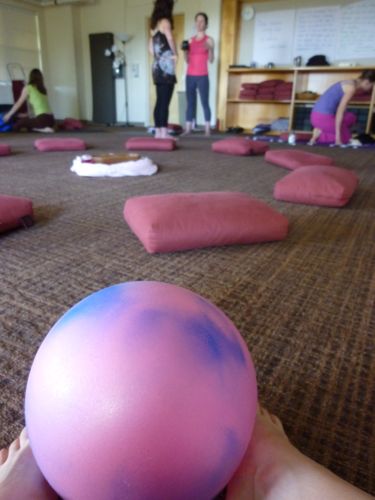
We worked with the notion of urges through movement, using John’s music as a lovely soundtrack. Some movement was primal, some playful, some done by sinking into gravity with the help of soft, pliable rubber balls.

We were all doing our own thing, exploring what felt right to us, but Bobbie reminded us to use sound, open our mouths, let the air move through our mouth like wind in a cave. We moved slowly—“Go too fast and you might miss something,” Bobbie said. “One small feeling could shift your entire being.” We ended the practice lying in savasana, our hands resting below the navel in a triangle.

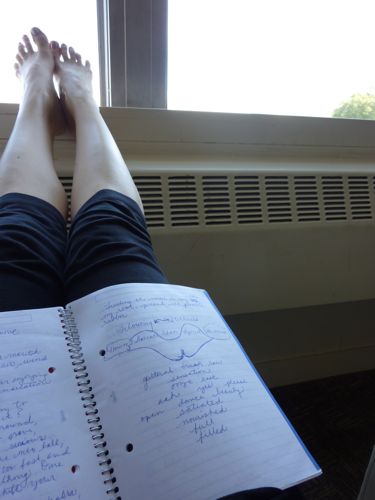
When we sat up, John continued playing the piano, and we opened our notebooks to journal. I found it very interesting that up until that point, I had been journaling in print, yet when my pen touched the paper after that particular exercise, the words flowed forth in cursive, penmanship I rarely use unless signing my name. My feminine nature was emerging through the pen!

One of things I wrote was a list of the 5Rhythms and how this program was making me focus primarily on the rhythms of Flowing and Stillness. I circled the two words and drew lines connecting them. Later, I realized I had pretty much subconsciously sketched the female reproductive system.

Playing with Sound

Saturday afternoon’s class was John-less, so we made our own music, primarily through chanting the sounds of the chakras, starting with the root: O, Ooo, Ahh, A, Eee, Mmm, and then silence. We chanted them in order and were then encouraged to mix and match the sounds, maybe moving from O to Mmmm or hovering between two and going back and forth. I worked on the sounds of the heart and throat chakras, and I soon realized that combining “E” and “A” sounded a bit like saying “Yay!” over and over again. 🙂

Re-Directing Inhalations

We also talked a bit about inhalations, because I had expressed that I often feel like I can never get a full breath and I’m puffing my chest to no avail. Bobbie suggested directing the inhalation in other directions—maybe even down!—instead of trying so hard to push it upward (“There’s enough of that in society!”). However, I did like experimenting with circular breathing, imagining the air coming up through the spine, out through the forehead, and then down the front of the body.

Pranayama & Asana

Sunday morning we did even more breath work, beginning with color pranayama, in which we breathed in a color that appealed to us then exhaled a color we wanted to expel. I breathed in orange and exhaled gray, the color (or lack of) of cubicle walls. Next up was a pituitary pranayama, in which we envisioned breathing in two slivers of ribbon through the nostrils, up to the space between the eyes and under the brain, and then exhaling in that pituitary space as well.

Well, pranayama is powerful, man, because when I eventually rose to standing, I felt like I was ten times taller, like my head was touching the ceiling and I was towering above everyone else. I had such a sense of largeness and presence. I remember once feeling this same way after a particularly intense massage, and my therapist said it was the feeling and awareness of my consciousness expanding.

From there, we moved right into a very slow but powerful asana practice, sinking into Goddess with some noise, an exalted Warrior on each side during which my back felt so free and my chest so open, a deep squat that my hip didn’t allow me to do, but Bobbie came to the rescue by stacking six blocks under my butt. I had never even thought of this modification, and I was so grateful to be supported, both by Bobbie (realizing I could use some assistance) and the blocks (I could do the pose without straining!).

Supported Bridge

Near the end of the practice, we were encouraged to do any final movement that felt right, and my body was asking for supported bridge pose. We had done this pose the day before with the support of the rubber balls, but I reached out for a yoga block this time. Even when Bobbie came around and asked if I’d rather use the ball, I firmly turned down the offer, sticking to the block. Maybe it was the height I craved, maybe the steady firmness of the prop, but either way, when I turned that brick to its highest level, it was as though the scales tipped and all emotion cascaded from my root straight down into my solar plexus, flooding my heart, and releasing through my throat and eyes. Big emotion, big tears.

This release was a moment of extreme clarity for me; it was brief, but it was a physical and emotional sensation tied to the quote that Bobbie had shared earlier: “Power is the strength and ability to see yourself through your own eyes and not through the eyes of another.”

Reflection

After our final sharing circle and goodbyes, I tried to find time to let everything from the past day and a half sink in. I felt a bit vulnerable but incredibly open, as though the program were timed just as so, waiting precisely until 10:30 a.m. Sunday morning for the big A-ha! moment to occur. One of my favorite places to reflect at Kripalu is the second-floor lounge, directly across from the Main Hall and overlooking the front lawn and the mountains.

I thought more about this concept of embodied meditation, not putting words to the sensation. I realized that recently I’ve had trouble journaling about some of my most intense dance/5Rhythms experiences; I feel absolutely exhilarated/raw/blissed out during class but then struggle (and get mad at myself) when I sit down and try to write about the experience here. Maybe I don’t want to assign words, I don’t want definitions, I don’t want the upper chakras to talk and explain and dialogue and dissect these very deep lower chakra experiences. I want to sing “Can You Feel the Love Tonight?” not “Can You Discuss the Matter of Love Tonight?” I just want to feel. Suspend the conclusion.

Shortly after that, I made my way to the Healing Arts center on the fourth floor for a reflexology appointment. If femininity is being receptive and open, then my feet are very feminine, because for me, reflexology work is like transcendental hypnosis from the toes upward. I saw colors, I saw very light and white objects in my mind’s eye (bathroom tile, steam, soap), I felt an incredibly warmth in the ball of my right foot. Fifty minutes later, when the therapist concluded and left the room, I sat up and immediately burst into tears, not sad, no emotion tied to it—just a very welcome release.

My feet had never felt so fixed and firm on the ground; it was as though electricity was buzzing from my soles straight into the earth. I looked in the mirror, and my eyes were fierce and open, dilated, the kind of wildness that I remember shining from Gurmukh Kaur Khalsa’s eyes when she visited Kripalu. Kundalini eyes. Shakti eyes.

Cleaned, massaged, stroked, and set ablaze, my feet somehow managed to carry my noodle-like legs out of the room, down four flights of stairs, and outside on the grass of the front lawn for my first steps into openness and abandon.

An interesting thing happened in 5Rhythms class last weekend: The stereo crapped out.

5Rhythms is movement meditation practice guided by—you got it—music, so you can imagine how this threw a wrench in the instructor’s plans. We were 20 minutes into a 2.5-hour long class, and now, instead of a thumping, bass-filled surround-sound, we had only the tinny whisper of music straining from the instructor’s laptop, such a small sound in comparison to the huge room we were dancing in.

Luckily, the teacher was pretty quick on his feet and miraculously found a way to teach the 5Rhythms through sound rather than music. Either he’s just really good at extemporaneous instruction or there’s a component of 5Rhythms training titled “Music Crises 101.” Either way, it worked.

For a portion of the class, we became the music, vocalizing “Flowing” sounds, so that the room became a chorus of oooohs and aaahs and sing-song laughter. We made sound together; we sang alone. I see these people dance all the time with my eyes but never before had the chance to hear their dance with my ears. Where did that deep, throaty sound come from? Was that inside you all this time?

We used clapping and stomping for Staccato, a gong to facilitate the release of Chaos, flew around the room like birds for Lyrical, and gathered close to the laptop as the subtle sounds from the speakers settled us into Stillness. At that point, the lack of music wasn’t even a factor, as sometimes silence can produce the loudest of Stillnesses for me, especially when the energy I’ve amassed from everyone else in the room is making my cells vibrate like a subwoofer cranked full volume, my pulse the underlying melody to the song that resides within.

Sometimes the energetic music we make with each other is just as powerful as the most stirring ballad. Thanks for turning a moment of Chaos into just another beautiful Wave, Richard!

“Those who dance are thought to be quite insane by those who cannot hear the music.”
~ Angela Monet

Today I am reuniting with two sacred spaces: Kripalu, and myself.

It’s no secret that Kripalu means a lot to me: I was there in 2006 for my monthlong yoga teacher training and then returned in 2008 for a Let Your Yoga Dance weekend. When I checked in during the latter program, the woman at the front desk smiled, handed me my name tag, and said, “Welcome home.”

Kripalu is home because it brings me back to my foundation, strips off all the mumbo jumbo of everyday life, and allows me some time to see what’s going on deep inside this 31-almost-32-year-old body. It’s a bit of an anthropological endeavor, taking this corporeal being, dusting it off, peeling away layers of guck and grime, and examining the raw treasure that has always resided within me.

Last time I was at Kripalu, I tried to reconstruct my prior experience there, wanting so badly to trace my old footsteps and routines, but quickly realized that who I was in 2006 was not who I was in 2008, and Kripalu itself had changed dramatically in those two years.

This time, I come in ready to breathe in the old recollections of how I was in 2006/2008, how I grew while there, and how much I’ve grown since then.

I have a new skin, a richer self, and I am ready to live in the inquiry of yoga.

Atha Yoga Nushasanam~
And now, the inquiry of yoga.

(Also, this is what I’ll be doing there.)

No, not the Lambada.

I’m talking about physical heat, dancing in a climate where your muscles relax and release the moment you step into the room, when the high temperature and humidity make your body want to speak with the same intensity as the fiery atmosphere surrounding your skin.

There’s hot yoga.

So why not hot dancing?

The “Dance From the Inside” class I attended Friday night was not intended to be of the hot variety, but because we came into the room immediately following a hot vinyasa flow class, that it became. The teacher opened up all the windows, propped open some doors, but still—the room never really cooled down until the final 15 minutes of class.

This “hot” theme is exactly what I was craving. Physically, my hips opened up without resistance; emotionally, I was able to let go and dance my own dance, despite being in a room full of people I’ve never met before. Even the bamboo floor was warm, so starting the practice on my back, rolling from side to side, was a little like floating out in the middle of the Caribbean Sea, my body following the natural rhythm of the sun-kissed waves.

The teacher’s instruction was just as warm, encouraging us to move from the inside. Rather than telling us “move like this” or “move like that,” she asked for us to respond to the music and listen to our body’s wants and desires. How do our fingers want to move to this music? Where does the body want to take us when the tempo picks up?

This theme of warmth and heat had me glowing. I felt myself connect with people in ways that I never would have allowed 2 years ago when I first started this journey of conscious movement/ecstatic dancing. I smiled. I made eye contact. At the teacher’s request, I danced “really silly” and didn’t have an ounce of self-consciousness hold me back. The heat was a reminder of all the warmth that I’ve built up along the way, and I felt myself wanting to share and pass it along to everyone I crossed paths with.

I danced with a man in jeans and a polo shirt, whose unusual choice of restrictive dance attire didn’t hold him back from letting loose. A grandmother seated in a folding chair who shared a happy foot dance with me. An 8-year-old girl who allowed me to twirl her and copied the moves I hoped she would follow. When the Bangles’ “Eternal Flame” come on—a song from my childhood that I remember playing throughout every roller rink in the late 1980s—my body opened up in ways that the 9-year-old me didn’t even know about yet back then, even though she had known that song was about something big and important, because of the way it made high school girls swoon and smile and hold their hands to their hearts.

That eternal flame was evident even outside, as the sun began its late end-of-spring descent. “Look at the sky!” someone had commanded during class, and when I approached the door, the clouds were ablaze with orange, and for a moment all of the heat and warmth and glowing of the cosmos consumed me, hypnotized me, both weakened my knees and made me stronger. I stood in the doorway and did my own dance version of a sun salutation in response to the fiery explosion of astronomy in front of me.

It made me think: What is stronger, the heat of the sun or that which resides in our human circuitry, waiting to be released when the right music plays?

Photo courtesy of Flickr user KellyCDB

Back in the fall, to commemorate my 5-year anniversary of graduating from the 200-hour Kripalu Yoga Teacher Training Program, I took on a very extensive and revealing blogging endeavor of transcribing and posting (most of) my journal notes from the experience. The posts were well received, and—judging by my WordPress site stats—I can see that they are being read by others out there interested in learning more about the Kripalu experience.

At the end of the month-long documentation, I promised I’d do a reflection post about YTT at Kripalu to summarize the pros and cons of the program. I loved my experience and wouldn’t trade it for the world, but there are certainly some things about the program to consider if you’re on the fence about where to study.

(Background: I completed the month-long, 200-hour YTT program in October-November 2006, led by Megha [Nancy Buttenheim] and Rudy Peirce.)

PROS

Exposure to a variety of teachers and styles. Our curriculum included twice-daily 90-minute yoga classes, which meant we had a lot of guest teachers who specialized in a variety of styles. Kripalu yoga can be gentle, moderate, or vigorous; we had mornings where we’d be squatting in utkatasana for a minute and others where we’d be nearly drifting off to sleep during a 6:30 a.m. yoga nidra practice. Where else does your day start with a playful and fun vinyasa class led by a grown man with pigtails and then conclude with a sensual and deep journey into asana and meditation led by a tantric master? Our classes were led by both senior and newly minted teachers, meaning we got to see where we hoped to be ourselves in the near and distant future.

Nothing to do but focus on yourself. When living in a yoga community in the mountains for a month, all of life’s everyday routines are removed: washing the dishes, feeding the cat, changing diapers, commuting to and from work, deciding what to make for breakfast/lunch/dinner, checking your e-mail, putting on makeup, changing the burned-out lightbulb. When the mundane necessities of life are no longer in the picture, the only thing remaining is…you. This can be scary but oh-so therapeutic. After a few days, the void normally filled by these little distractions fills with time for honest self-reflection. It is why every room at Kripalu contains a box of tissues: When deep issues are unearthed, they have nowhere to go but out; no running off to vacuum the living room or rearrange the condiment shelf in the refrigerator. Opportunities like this don’t happen often: Take the time away from “real life” to get to know the soul inhabiting that often-frenzied body you carry around.

It’s the yoga of life. Kripalu yoga teacher training goes beyond the asanas, the pranayama, and the meditation (all great thing, though!): You learn and apply the yoga of life, taking time to engage in conscious listening/communication, find and strengthen your voice, and practice compassion and lovingkindness. Several small group discussions in YTT went well beyond just mat-talk; people talked openly and honestly about past experiences, traumas, current struggles, and fears of the future. Everything you learn at Kripalu will follow you home and constantly remind you to live in the inquiry.

The food. It’s fresh. It’s natural. It’s chopped and diced and prepped lovingly by volunteers. Best of all, it’s there for you three times a day, along with a 24-hour tea stash. I could have my usual bowl of high-fiber cereal with walnuts and raisins and rice milk, or I could have a slice of frittata with a rosemary biscuit (or all of the above). If you’re there in the fall, THE SOUPS. A simple slice of toast with peanut butter and jelly becomes a special treat when your realize dessert is only served once or twice a week. Warning: It’s easy to go overboard, especially when you’re all vulnerable and shit. Let me eat my feelings along with this third helping of country-fried tofu, why don’t I?

Modifications a’plenty. Kripalu yoga is all about making yoga right for you. Kripalu teacher trainees are taught numerous variations on a pose, including different stances, prop usage, or just plain substitutes for certain asanas. What works for your body? Do you need a rolled-up blanket? A cushion? How about a block with a blanket and an eye pillow? I was super flexible 5 years ago and didn’t really consider limitations, but now that I have a hip thing, I am ever-so-grateful for my Kripalu training and the assurance that it is 100% completely OK to modify a pose or just not do it when something hurts. My training gave me the gift of creativity, so in my own practice I have the knowledge to play around with props or different forms of a pose when my body just doesn’t feel quite right. The “perfect pose” is the one that offers you openness and joy without pain.

Daily dance parties. Most of our daily sessions began with music thumping and bodies moving freely into the open space. Hey, if you’re going to be sitting for 3 hours straight learning about the yamas and niyamas, best to start the classes by getting the blood flowing and endorphins rushing. How I would love to start each work day with 5 minutes of booty shaking in the hallway!

Integration. After each session, we’d close with pranayama, meditation, or a round of co-listening with a partner. It was a way to take all the huge concepts we just learned and give them time to settle into our bodies, complete the download, so to speak. We crammed a lot into those 28 days, and it would have been easy to get overwhelmed. Even mini deep-breathing pauses in the middle of a class helped ground us and bring us all back to the same wavelength.

Quick turnaround. One of the main reasons I chose Kripalu was because I knew I’d be certified in a month. I was so gung ho on becoming a teacher that I was just too impatient to enroll in a program that only met one weekend a month and took 8 months to a year to complete.

International flavor. Studying yoga at a nationally renowned center attracts people from all over the country…and the world. My class included students from Hawaii, California, Florida, Ireland, Japan, Australia, and even a woman who lived just two towns over from me. The diversity at Kripalu is much greater than anything you’d get at a local YTT program, and even people’s backgrounds were simply fascinating: I mean, I shared a dorm room with a Cirque du Soleil aerialist!

CONS

An insular utopia. Yes, I mentioned above that being holed away in a retreat center allows your true self to emerge, but this can also be problematic once you try to leave the bubble. Kripalu tends to attract only kind, compassionate, mindful folks; step outside into the real world, and no one’s wearing nametags and giving you a silent Namaste when you pass them in the street. I only left the campus once or twice during my month there, and so even things like the sound of cars on the road and Christmas music piped into stores jarred my senses and made me feel very uneasy. If feasible, I suggest a day or two of re-integration, maybe getting a hotel room off-site and gently easing yourself back into reality instead of just hopping directly onto the Greyhound bus and heading straight into Manhattan.

All conditions are ideal. Ideal, not necessarily real. It’s why people get upset at shows like The Biggest Loser, where contestants live on a ranch, have world-class trainers by their side, eat only the best foods prepared by the best chefs, and work out 4 hours a day without having to worry about jobs or kids or mowing the lawn. Yeah, it’s great, but then it comes time to return home and try to apply everything you just learned in a shitstorm of deadlines, bills, morning gridlock, and insomniac toddlers. I went from doing at least 3 hours of yoga each day to maybe 1 hour three times per week…and consequently went through honest-to-god yoga withdrawal, my brain craving the biochemical reactions that daily yoga provided. Although it’s not always financially do-able, the 2-part monthlong program (split into two 12-day sessions) may be more realistic in terms of taking what you learn and applying it to real life.

Lack of post-graduation support/community. You eat, sleep, and study with a wonderful group of people for a month, share with them your deepest and darkest secrets, cry on their shoulder, massage their calves, declare that This Group is the circle of friends you’ve been seeking your whole life…and then after 28 days, *poof* Everyone boards their plane, train, bus, or car and heads home, back to Ireland, back to Australia, back across the country. Of course, technology makes it easy to stay in touch with a group, but it’s simply not the same as studying in a local yoga studio and being able to take class with a core group of mates from your YTT class. People who stay closer to home and do a local YTT have such a greater opportunity to keep that bond alive by, for example, meeting up for coffee or registering for a weekend workshop together.

Leaving your YTT teachers is also difficult, as they just don’t have the time to keep in touch with every student under their tutelage. With a local YTT, you may get to see your teachers weekly and rely on them for advice, suggestions, and support; at Kripalu, once your group of 60 graduates, the next group is waiting at the door. Kripalu teachers are generally fairly busy folks with rigid teaching/training/travel schedules and simply cannot offer the personal support you may need post-graduation.

Heavy responsibility. You’re training not just to be a yoga teacher but a Kripalu yoga teacher. The name carries a lot of weight; Kripalu has a history, a reputation, and prestige. This freaked me the hell out—people would expect me to be a Super Awesome Compassionate Yoga Teacher, but what if I couldn’t pull that off? In addition, the premise of Kripalu YTT is that you can change the world. Be the change! Spread the love! Take this knowledge we’re imparting on you and do something with it. Man, talk about pressure! I got home not knowing whether I should teach yoga, join the Peace Corps, or live in a leper colony in India. For me, I was so overwhelmed that I just sat in a relatively catatonic state for about a week afterwards, trying to process everything.

Practice-teach fail. Personally, I think this is one of the biggest downfalls of the Kripalu YTT: No opportunities to practice-teach real-world students. Many local YTTs have “practice-teach” weeks, a stretch of free or discounted classes—open to the public—where trainees can get guided experience in working with a variety of bodies, abilities, and personalities before they go solo. At Kripalu, the only students you teach are your fellow classmates…who, ahem, are already pretty adept at yoga. Try going from that to teaching a class with mixed abilities, where one woman has trouble sitting on the floor and the other is a seasoned yogi with ripped chaturanga arms. During our training, we had one opportunity to assist with a public class, but that was maybe 15 of us assisting all at once as a senior teacher led the class. We did our best to take on “beginner’s” minds for our fellow classmates during each of our three practice-teach sessions, but this is still minimal preparation for the task of leading actual beginners.

If you completed the Kripalu YTT, I’d love to hear your take!
And good luck to all the trainees headed out there this summer (::coughcoughLiberezVouscoughcough::). 🙂

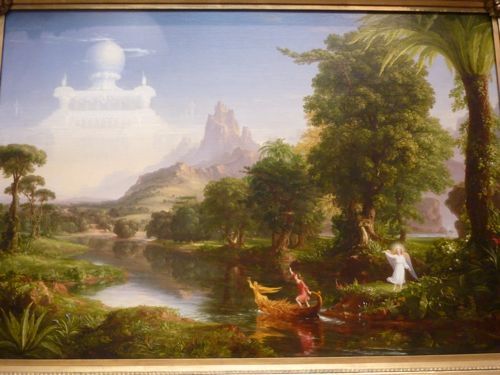
When Bryan and I decided to go to Washington, DC this past Saturday, my #1 priority was to get to the National Gallery of Art to see Thomas Cole’s The Voyage of Life. It is the four-part series of paintings that inspired Jeanne Ruddy’s Out of the Mist, Above the Real, the dance piece I saw a few weeks ago. The piece moved me greatly, and how fortunate am I that a day trip to DC allowed me the opportunity to see the original artwork behind the choreography?

Once I got that off my chest, we moseyed around the museum and admired Manet, Monet, Renior, and Degas, among others, including a visually striking photography exhibit on the circa-1984 New York City subway. Although snaking through an art museum without a guidebook or plan of action makes me a bit discombobulated (I feel like I need a trail of breadcrumbs to remind me where I’ve been), the act of turning a corner and coming face to face with something surprising, stirring, or moving is what the museum experience is all about.

I hesitate to interrupt this artistic discussion with talk of food, but I feel it is my duty to share with everyone my love for the Mitsitam Cafe in the National Museum of the American Indian. If you need to break for lunch at one of the Smithsonian museums, this is the one to do so.

The food court is broken down into stations representing the various regions of the Americas and the foods indigenous to that culture: Northern Woodlands, Mesoamerica, South America, Northwest Coast, and Great Plains. You can mix and match food items, creating one melting pot of a meal. It reminds me of World Showcase in Epcot, but without the need to walk a mile in the central Florida sun to collect your global cuisine.

Our meal, clockwise from upper left: Indian fry bread; buffalo chili; cedar-plank fire-roasted salmon with wild berry glaze; pumpkin cookies; red beets, candied apples, toasted walnuts, cherry vinaigrette; braised chard; and quesadilla with chihualua cheese, spinach, mushroom, and huitlacoche.

So much tastier than chicken fingers and fries!

We did a lot of walking, probably close to a half marathon (13 miles) by the end of the day, including a ridiculously strenuous climb up a non-working escalator in the Woodley Park-Zoo Metro station as other (sane) people watched us from the functioning one. The ascent was steep and loooong; it looked like a fun challenge at first but then just got hard. We further punished ourselves by standing in a 20-minute line at the Zoo to see a panda bear that was dead asleep and then walking through every twist and turn of the Asia exhibit hoping to catch sight of the sloth bear that was nowhere to be found.

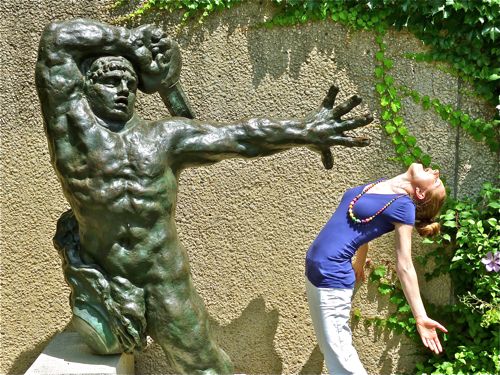
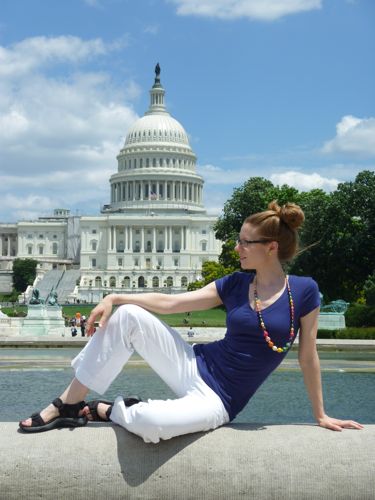
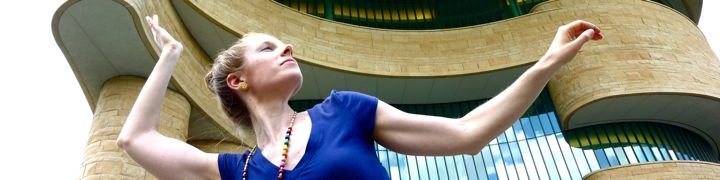
One thing I did find, though, was each of the 5Rhythms. Even when I’m trekking around the nation’s capital, my mind is never far from dancing and the rhythms that tie us all together. For example, I witnessed kites soaring high above the National Mall lawn (Flowing), a flock of Canada geese audibly pecking the grass under their webbed feet (Staccato), a group of hyper schoolchildren in matching T-shirts and hats scramble onto their tour bus (Chaos), a young girl in a cream-colored dress run with her same-colored dog up a grassy hill (Lyrical), and a group of veterans in wheelchairs being pushed slowly around the Vietnam Memorial (Stillness).

I think the practice of 5Rhythms, coupled with yoga and meditation, has helped sharpen my senses and my awareness of all the little dances taking place within the larger dance. When you look at a satellite map of a city, everything looks either gray, green, or blue. Look closer, and you see, hear, and feel the rhythms:

Flowing:
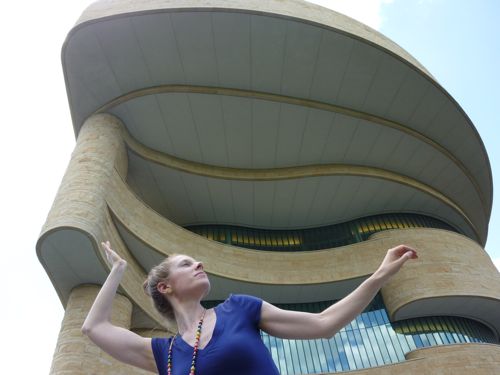
National Museum of the American Indian

Staccato:
Washington Monument

Chaos:
Hirshhorn Sculpture Garden

Lyrical:
U.S. Capitol Building

Stillness:
Vietnam Memorial

A completed Wave:
Atrium, National Museum of the American Indian

About the Author

Name: Jennifer

Location: Greater Philadelphia Area

Blog Mission:
SHARE my practice experience in conscious dance and yoga,

EXPAND my network of like-minded individuals,

FULFILL my desire to work with words in a more creative and community-building capacity;

FLOW and GROW with the world around me!

Archives

Categories

Enter your email address to subscribe to this blog and receive notifications of new posts by email.

Join 321 other subscribers

Member of:

YIOM

Yoga Inspired Online Movement

Top 100 Yoga Blogs