You are currently browsing the tag archive for the ‘5rhythms’ tag.

No one ever craves Chaos, but during a recent 5Rhythms class I discovered just how necessary it is for transformation.
We were dancing in the tail-end of the second rhythm, Staccato. My body was being tantalized by the percussive sounds, which were gradually intensifying in beats per minute, the vibrations under my feet pushing me closer and closer to Chaos. Imagine a glass of water being nudged along a table-top by a heavy bass throbbing from a cranked-up subwoofer.
The glass reaches the edge of the table.
The pulsing stops.
The glass hovers.
It does not fall.
Chaos averted.
In my case, however, I needed Chaos. I needed that glass to slip. I needed the music to take control and bring that glass tumbling off the edge. I needed spilled water, broken glass.
What the teacher had chosen to do was play the subtlest of Chaos, a repetitive drum beat that lacked a crescendo, a percussive prelude to an anticipated explosive rip-roaring rumble.
But the rumble never happened, and after a few minutes the relaxed sounds of Lyrical came through the speakers. My body wanted to scream; instead, it was requested to be subdued.
I felt robbed. I felt lost. The music that usually makes my muscles melt and my face soften had the opposite effect on me, and I could feel my body slip into the shadow of Lyrical—Distraction. Instead of integration, I disintegrated, losing grasp of everything I had built up earlier in Flowing and Staccato.
Had this happened two years ago, I would have chalked up my disappointing experience to my Type A personality’s fondness of rules, regulations, and order. I would have thought, “Well, OK, the definition of a 5Rhythms Wave is to dance equally through Flowing, Staccato, Chaos, Lyrical, and Stillness, and because the Chaos segment wasn’t really proportionate to the previous two rhythms, that is why it didn’t feel ‘right.'”
But now I know that isn’t the case. 5Rhythms isn’t a mathematical equation—it’s a practice that parallels so many facets of our lives. An honest, authentic, meaningful Lyrical is hard to find without first experiencing the Chaos that precedes it:
Double rainbows crisscrossing a gray sky after a violent summertime storm.
Lovers blissfully entwined in each other’s arms after the intensity of a chaotic climax.
A newborn baby in a mother’s arms after an excruciating, exhausting labor.
The outpouring of love, generosity, and humanity that surfaces after a natural disaster or terrorist attack.
It is easy to get caught up in our headspace and convince ourselves that a harmonious, Lyrical life can be achieved by avoiding Chaos. Maybe we can tiptoe around the edges. Stay in an amped-up Staccato until we are just miraculously pushed over or below Chaos straight into Lyrical.
And that is why this practice is so important, because the body does not lie. We can create story after story in our head about how things are supposed to feel, but when you put on music and let your body do the talking, the truth emerges. The body says, “This Lyrical doesn’t feel natural. I can’t fully take in the beauty of this moment because I am still clinging onto something I wasn’t able to let go of.”

The nature of Chaos—surrender—can be scary, no doubt. But what I learned in class that night was that the notion of living in an underdeveloped, partial, not-quite-authentic Lyrical may be even more frightening.
By the time this entry posts, I’ll be on my way to New York City in an ambitious attempt to attend Gabrielle Roth’s official memorial. As you may remember, I was incredibly fortunate to have attended what was supposed to be the 5Rhythms founder’s final workshop this past fall. She never made it to the event; rather, we danced as she died, and her bold son Jonathan and her brave husband Robert took command of the 4-day celebration of life, death, and the movement-inspired mysteries in between.
When we stepped into the studio that Thursday night in October, no one had any idea what we were walking into. Who was teaching? Was Gabrielle still alive? Would we dance? Would we mourn?
Tonight feels very similar in that whatever is to take place behind the Prince George Ballroom doors is as shrouded in mystery as the 5Rhythms practice itself. We are told that it is a memorial and “we will dance.”
So many questions remain, though! Will someone be leading the dancing, or are we to erupt in spontaneous movement when the urge arises? Will this be a walk-through memorial, with photos and mementos, albums, and videos? Will people speak? Is this more of an “open house” memorial: As people leave, more people enter?
Admittance is not guaranteed, and “we do have a finite number of people who can be in attendance at any given time,” read an email I received from the Moving Center staff. “Bearing this in mind,” it continued, “we know you will do what your heart tells you to do.”
My heart is most likely on the New Jersey Turnpike now, beating anxiously. And if I don’t dance tonight, I’ll dance tomorrow. Or, even if my fellow tribe members and I don’t make it into that ballroom, maybe I’ll still dance tonight, but in the street or a subway station or in a parking lot somewhere in Manhattan.
Because, “we’re fools whether we dance or not, so we might as well dance.” (Japanese proverb)

I love when I dance so furiously that my underwear becomes saturated—don’t know whether I peed myself.
Droplets of sweat roll down between my breasts down the fine line of hair to my navel,
Dripping drip down on the floor
Mixing with the tears that have fallen there earlier.I love the smell of my sweat when I am in ecstasy,
Dampness under my armpits that repels some and makes others dive right in.
(Stream-of-consciousness writing from the aforementioned October workshop, when 5Rhythms instructor Lori Saltzman asked us to descriptively reflect on what we love. “Be specific,” she had instructed. “Write about the smells, sensations, and sounds that come along with this love.”)
My fourth-grade teacher had a saying when she wanted her students to take her words seriously:
“That’s a requirement, not a request.”
Back then, it referred to remaining quiet during a test, putting the classroom hermit crab back in its cage, or ending the latest battle of spitball warfare. When you heard that phrase, you shut up and did what Mrs. Goettelmann said.
Lately, however, I’m hearing those words echo through my head about something greater: yoga and meditation.
And it’s not my fourth-grade teacher talking, either. It’s my aching, stiff body. My deprived lungs, which never seem to get enough oxygen. My heavy, scatterbrained, impatient mind:
“Do yoga. Meditate. This is a requirement, not a request, Jennifer.”
Yoga and meditation used to be a very integral part of my life. I had the schedules of every local yoga studio stuffed into the side pockets of my car door so I knew exactly where I could ashtanga, kundalini, or yin on any given day of the week. If I wasn’t at a studio, I was upstairs in my yoga room, following along to a podcast or simply cobbling together my own practice.
Group classes became more challenging once I hurt my hip, but I persisted, knowing my limits, modifying as necessary, simply enjoying the hour or so set aside for nothing other than focused movement and breath.
But—once a dancer, always a dancer—as soon as I discovered 5Rhythms and YogaDance and Nia and all other forms of conscious dance, my appreciation for traditional yoga and seated meditation dwindled. After all, 5Rhythms is described as “movement meditation.” I’ve never liked sitting still. I’ve always walked around on my toes. You mean I don’t have to stay perfectly poised on my little rectangular rubber mat to get a decent mind-body-soul workout? I can leap and stomp and glide and dive into dubstep and still consider that meditation?
It felt so right, too. My hip rarely ached after a 2-hour 5Rhythms class, and I usually walked away with a pretty clear mind, too. Over time, my collection of yoga mats became like old world maps, tightly rolled up and tucked away in a corner, collecting dust.

Dancing was my new yoga, my new meditation.
What I was failing to realize, though, was that the clarity and comfort attained through dancing is just simply NOT the same as that achieved through yoga and seated meditation.

Yes, there are incredibly deep meditative moments in 5Rhythms—Stillness is almost always a time of prayer and revelation for me—but it only appears after a vigorous Wave of dancing all over the room like a lunatic. Flowing, Staccato, Chaos…they shake things up. Move the gunk and junk through the trunk. It’s a relatively active process, like water boiling on the range.

Don’t get me wrong—I love the simmering, the vibrating H2O molecules, the hot and foamy water cascading over the side of the pot and sizzling on the stove top. That kind of transformation is necessary, changing from solid to liquid to vapor. The things I’ve learned through moving would have never presented themselves through tree pose or 20 minutes of alternate-nostril breathing.
But there’s a reason it was so easy for me to “leave” yoga and meditation: It’s hard! Remaining still, sinking into a pose, practicing patience and concentration is not easy. Because really, who actually wants to follow someone else’s direction about how long to stand on one foot when you could be dancing to the beat of your own drummer?
And that is precisely why yoga is so important: It forces us to pay attention. Be still. Listen.
When you stop doing that, things go haywire.
— You become irritable, complaining about the weather, work, anything and everything out of your control. Coworkers, who once you saw you as the “perpetual optimist,” are perplexed at these out-of-character sentiments.
— You become impatient, especially on the road, so much so that you need to squeeze a few drops of impatiens flower essence into your water bottle before hitting the highway so that you don’t grit your teeth to the gum line as you drive from Point A to Point B.
— You seethe when things don’t go your way, usually about stupid things, like a car pulling out of a driveway during your morning walk. (“God, it’s 6:30 a.m., why does THIS car have to leave RIGHT now and make me STOP?!”)
— You realize your flexibility in a simple seated forward bend is diminishing, that holding onto your ankles may be more reasonable than grasping for the toes.
At first, I requested myself to get back into yoga. Which at the time meant nothing more than doing a few paschimottanasanas and spinal twists after my morning walks.
Then, two things occurred that made me think of Mrs. Goettelmann, shifting the request into a requirement.
First, during a yoga/5Rhythms combo class to celebrate the winter solstice, I mentally fuh-reaked out during the yoga portion. I hadn’t done a group yoga class in months, and I was frustrated with the way my wonky hips wouldn’t let me shift from one pose into another. In the past, I would’ve found my own way to work through it without any problem, but that night I was so acutely aware of the discomfort and difficulty, and I HATED that everyone else was able to sit like little cross-legged Buddhas while I struggled to find a comfortable seated posture. I was angry and sad and basically lost all mental composure, feeling seconds away from bursting into tears and running out into the hallway.
As a result, I didn’t start the dancing portion on a very balanced note. In fact, I may have cried during almost all of Flowing.
Second, I got blood drawn last week. I take thyroid medication, so labwork is routine. A regular yoga practice has always helped me through these kinds of medical procedures, but this time no signs of yoga were evident. I had trouble taking deep breaths. I could feel my body temperature rise. I got panicky, feeling the need to escape. I kind of wanted to throw up. My sympathetic nervous system kicked into overdrive, despite having very easy veins and an experienced phlebotomist.
In short, the nickname my friend Carrol had once bestowed on me—ZenJen—is losing all meaning.
You know, I was a teacher’s pet back in elementary school, and I always listened to Mrs. Goettelmann. Now I realize it’s time to listen to a different kind of teacher: my body.
Jennifer, it’s time to do some yoga and meditate. That’s a requirement, not a request.

I had a lot of trouble getting into Christmas this year, almost as though my mental calendar was not at all in sync with the one that kept counting down to December 25. Isn’t it still September? Why is Johnny Mathis always on the radio, and why does the circular section of my Sunday newspaper weigh more than a phonebook?
Neighbors strung lights and hung wreaths; coworkers baked an abundance of cookies; family sent cards and photos. I didn’t scorn or bah-humbug; for me, it all just seemed to be participation in an event I simply didn’t “feel” this year, much like the way I care (or lack thereof) when coworkers draft their March Madness brackets or neighbors bust out nachos and beer and inflatable football players on their lawns the week leading up to the Super Bowl.
I certainly wasn’t Buddy the Elf, yet I wasn’t the Grinch or Scrooge, either. I just … was.
I followed the routine the best I could, ordering gifts online; braving Bed, Bath, & Beyond on December 23; trying at least one of every treat that made its way into my office; wearing festive red; drinking my fair share of gingerbread lattes; head-banging in the car to the Trans-Siberian Orchestra’s “Christmas Eve Sarajevo”; making my annual donation to Kripalu Center for Yoga and Health; doing my usual crappy job wrapping presents (note for next year: anything larger than the size of an iPad box will be gift-bagged); and overindulging in my dad’s traditional chocolate chip cookies.
In movement terms, the holiday season this year has felt like choreography in a year that was otherwise predominantly improvisation. I had been conscious dancing my way from spring to summer to fall; suddenly Thanksgiving happened; and then the month of December turned into one rushed preparation for the big annual jazz-tap-ballet dance recital. My heart wanted to keep dancing barefoot with my hair a wild stringy mess, but the standards of the season forced my feet into pointe shoes and slicked my hair back into a tight bun.
Life went from 5Rhythms to 5-6-7-8!
But, just as I started to feel myself slip into Black Swan territory, my clever and crafty sister Carolyn reminded me of my roots. Her Christmas gift to me this year was a collection of five gifts—

—each representing one of the 5 rhythms. (These are GREAT gift ideas for fellow dancers, by the way!)
Starting on the left is the rhythm of Flowing, a handcrafted work of womanly beauty, which itself also represents all of the rhythms. (This could have been the only thing Carolyn got me, and I would have been content.)

My sister has never even danced the 5Rhythms, but she seems to get the gist.
Next is Staccato, a book, specifically, The Book of Symbols: Reflections on Archetypal Images. The book is thick and heavy and packed with information about symbols—Boats and Feathers, Mandalas and Bridges—bam! Staccato. The practice of 5Rhythms is based heavily on archetypes of the soul, so this book is more than appropriate.
In the middle is Chaos, which Carolyn depicted via forthcoming tickets to a Philadelphia-based burlesque show. Let go, let loose—Chaos!
Carolyn’s gift of Lyrical is similar to the Flowing artwork in that it is also representative of all the rhythms. Here, she decoupaged five ceramic tiles, one for each rhythm:

Finally is the gift of Stillness, so fittingly represented by a spa gift certificate, which I already declared I’d use toward a reflexology session. What better way to close a metaphorical dance practice than with a therapeutic massage of my feet?

I got some really great gifts this year, but my sister’s was a gentle push from the frenetic feel of the holidays back into the flow. And so, even though I’m a day late, this afternoon I celebrated Christmas in the way that felt most comfortable. Barefoot and with loose, stringy hair, I danced to the sounds of the season:
Warm-Up/Flowing:
Oh Holy Night — Enya
Angels We Have Heard On High — Josh Groban, featuring Brian McKnight
The Holly and the Ivy — Medieval Babes
It’s the Most Wonderful Time of the Year — Johnny Mathis
Staccato:
Rudolph the Red-Nosed Reindeer — Chris Isaak
Carol of the Bells (Dubstep) — RawHardcore
Chaos:
Gettin’ In the Mood (For Christmas) — Brian Setzer
Christmas Eve Sarajevo — Trans-Siberian Orchestra
Lyrical:
Sleigh Ride — Leroy Anderson
Have Yourself a Merry Little Christmas — Sarah McLachlan
Stillness:
Dance of the Sugar Plum Fairy — Tchaikovsky
O’che Chiun (Silent Night) — Enya.
**Did you incorporate movement/dance/5Rhythms into your holiday this year?
Please share how you continued to flow through all the go-go-go!**
Week by week, my “blogging idea” list keeps growing. I dance furiously, take notes, ruminate, and then—just as I feel ready to transfer the experience to screen—the next event rolls along, and I am immersed in another moment of rapture. I am bursting at the seams with experiences to share (bet you didn’t know I completed a first-degree Reiki class last month!), with little down time to sink back into those moments and bring them back to life through words. And as much as my career as an editor helps me through the blogging process, it’s also a hindrance: I spend so many hours each day in front of a computer that the thought of another minute squinting at a monitor is often agonizing.
This past Sunday was supposed to be THE DAY. I had danced on Friday night and Saturday afternoon with minimal computer interaction. Apart from a morning coffee date, Sunday was wide open, and I had every intention of blogging my ass off.
(At this time, you may turn your attention to the title of this post, which indicates how well that all turned out.)
Sunday was rainy, chilly, and gray, the dictionary definition of an I’m-not-taking-off-my-pajamas kind of day. I had in fact gotten dressed that morning, but only for the coffee meetup with Carrol. Carrol is my 60-something “old lady friend” (her words, not mine!); she’s also an art therapist, and being in her presence always stirs something creative in me. A live jazz quartet accompanied our latte sipping and strata nibbling, and an exhibit by local artist Monica Joy Moran had all kinds of earthy works of mixed media popping from the walls.

“Two Sides, One Story”
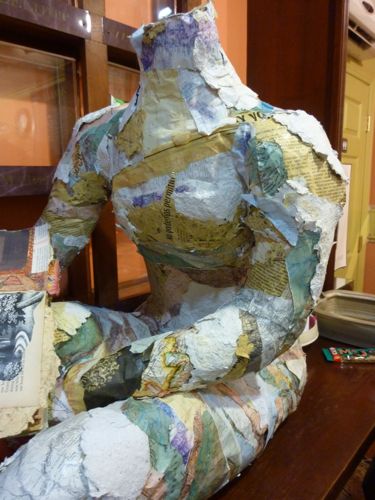
Old maps used as “skin”: Perhaps a tribute to Gabrielle Roth’s “Maps to Ecstasy”?

“The Oven Bird”
When I got home, I was inspired to flex my artistic muscle—but not through writing! I wanted to use my hands more than my brain; I wanted to create! Despite the urgency of all the writing that was waiting to be done, I wanted to express my love of movement through images rather than words.
My first endeavor was to create a get well card for the producer of my 5Rhythms tribe, who was scheduled to have arthroscopic knee surgery the following day. Knee surgery for a mover/shaker/dancer is a pretty huge deal; it deserves a special kind of card!
As barbaric as it sounds, I began by dismembering the ballerinas and dancers in an old Alonzo King Lines Ballet wall calendar. Whereas zombies mutter “Braaaaiiinsss,” I was thinking more along the lines of “Legggggssss.”
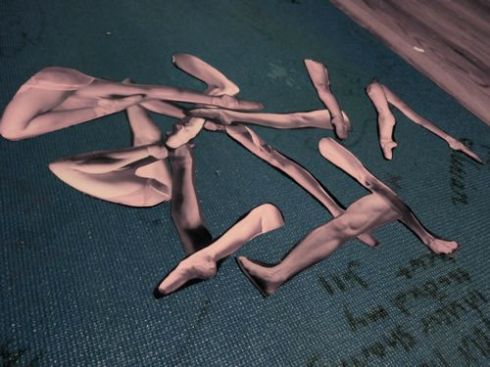
I envisioned using healthy dancer knees as part of the project; I was inspired by the work I created for my friend who had pulmonary surgery over the summer. For that project, I had cut out a bunch of words and images from magazines illustrative of “breath” and “inhalation” and shaped them into a pair of lungs. However, I quickly realized that a knee wasn’t exactly as visually striking.
Change of plans!

The notion of making an actual card I could send in the mail fell flat when I realized the size of these dancer legs. Instead, I made a temporary exhibit on a yoga mat and delivered the image via Facebook. Thank you, technology! (Also, I don’t know what the heck Rebekah would have done with a poster-sized image of random limbs.)

I was now in the zone. My little yoga room upstairs had transformed into a paper-littered art studio; Zoë Keating’s cello music played on my laptop, the vibration of her strings moving me to vibrate along with her. The assembly of legs before me was calling to be transformed.


I then realized something needed to be done with all the poor floating heads and torsos left behind on my leg-less dancers. It was time to get serious.
I became a madwoman, gathering scissors, glue, poster board, and tape, spreading them over the wooden floor of my yoga room. From the kitchen, I brought up a bowl of mixed nuts, with some Reese’s Pieces thrown in the mix for a colorful kick. A gallon jug of water to chug on, to keep me hydrated. Lit a chocolate mint-scented candle, changed my music to the buoyant strings of the Penguin Cafe Orchestra.
I was ready for both hibernation and/or creation.
Delicately, I snipped the dancers’ heads and arms from their dark background, happy to be repurposing their poses and poise. The work became a Wave: smoothing down paper and paste to the music’s tempo; gliding my finger over wet glue, feeling the stickiness with the same awareness of pressing my foot into the dance floor and feeling the gritty wood fibers; slicing paper with a razor—careful not to get too Staccato—being mindful of the Lyrical nature of the razor’s work, thin cracks forming over an icy lake.
Finally, there came Stillness:


I’m still thinking of a good name for the piece. “Tribe and True”? “Us”? “Supportive Stillness”? The intention was to depict how a 5Rhythms tribe allows room for a heart to grow while holding a sacred, contained space for such development. The dance isn’t necessarily about contact as it is connection, the feeling of being part of a greater something even when dancing by yourself.
I can be standing on the outskirts of the dance floor by myself during 5Rhythms but never feel alone. It had happened just the day before at a class led by Peter Fodera; overcome with a profound appreciation and deep gratitude for everyone dancing around me, I was compelled to stand off to the side and simply witness the unraveling around me. I felt tapped into the buzzing circuitry, lifting my hands as though placing them on one of those plasma static electricity balls. My body started to heat up, not in a “I’m dancing crazily, I’m hot” way, but rather a radiating warmth from my core outward that left a fine sheen of perspiration over the surface of my skin. A healthy 5Rhythms tribe is very much like a flourishing circulatory system; my heart beats as the surrounding veins and arteries flood it with fresh nourishment.
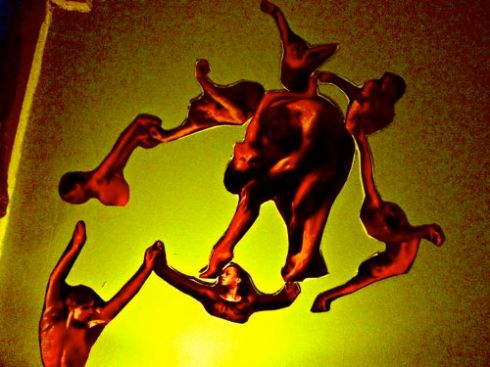
I hardly touched my keyboard that Sunday but didn’t feel as guilty as I normally do when putting off writing for another day. Artistic expression had emerged in different ways that night; old calendars found new life; and I found that cutting, pasting, and assembling can be just as meditative as shaking, whirling, and twirling.
Like most children of my generation, I grew up watching Sesame Street. I loved Big Bird, I got pissed at Oscar the Grouch, and I caught on early to the fact that the cookies Cookie Monster shoved in his mouth just broke into pieces and spewed all over the place, never really being ingested and eaten.
I really loved Sesame Street. However, there were two recurring segments that actually scared me and sent me face-first into the couch cushions so I wouldn’t have to watch: (a) the “Yip Yip” martians; and (b) the shadow puppets.
I can see being disturbed by those slack-jawed martians with their hypermobile mouths and crooked antennae. They’re weird looking and speak in jibberish. But being frightened by the shadow of someone’s arm turning into an elephant or swan? I wish I could have a conversation with my 4-year-old self and figure out what exactly about that segment made me squeal in terror and cover my eyes. Why was I afraid of shadows?
Well, apparently adults are just as easily frightened by shadows as they were 20-something years ago, because when 5Rhythms teacher Douglas Drummond announced he was leading a “Light and Shadow” workshop in my area a few weeks ago, I instantly equated it with “good vs. bad,” “happy vs. sad.” I imagined us taking these five beautiful rhythms and plunging them into darkness, exposing their menacing, scary sides. I pictured my happy-go-lucky Ronald McDonald dancing transforming into Pennywise from Stephen King’s It, laughter morphing into screams. No thank you!
This wasn’t the case, of course. The workshop was called “Light and Shadow,” not “Light and Dark.” Two very different things! As Douglas explained: “The shadow should not be looked upon as a negative, rather an integral component of the bigger picture—a play with polarity.”
The five rhythms and their respective shadows are:
Flowing / Inertia
Staccato / Rigidity
Chaos / Confusion
Lyrical / Distraction
Stillness / Numbness
This wasn’t an exploration of opposites; more like an examination of our underbellies, those angles of our bodies that are difficult to see without a mirror. After all, the opposite of Stillness would probably be something more like Chaos, not numbness. We were learning to dance with the fraternal twin of each rhythm, not its evil cousin.

It’s true, the shadows listed above may, at first, seem “bad.” But Douglas was quick to explain the benefit in each of them, starting with the concept of physical shadows themselves. Ever been in the city on a hot and sunny 100-degree day? Stepping into the shadows cast by the towering buildings can be a welcome reprieve. Alternatively, stepping out of the shadows on a 30-degree day can be just as rewarding. Neither is bad; one complements the other.
Flowing / Inertia
Regarding inertia, Douglas used the metaphor of a garden hose with a kink in the tubing. What was once freely flowing is now blocked, perhaps only a trickle of water escaping from the mouth. I was reminded of the “squeeze-and-soak” concept of twisting yoga postures, where creating restriction in one area of the body will expel staleness and allow room for fresh blood to flow in once released, much like wringing out a dirty sponge.
Movement-wise, Douglas described inertia as trying to move while wearing a heavy backpack. This was a good exercise for me because I tend to be a dramatic upper-body mover, prone to always being one arm-flail away from dislocating my hyperflexible shoulders or elbows. Instilling that sense of heaviness in my upper body created a kinesthetic awareness that I would have never allowed myself to experience; inertia was a wise old sage reminding me to be cautious with flowing.
Staccato / Rigidity
It’s only appropriate that I had just watched The Hunger Games on Netflix before working with this shadow, because, as Douglas explained, rigidity is like the tension built up in a crossbow before an arrow is shot. Without tension, there is no directness and the target will never be hit.
Someone with a staccato personality will just come right out and say what’s on her mind: “Yes!” “No!” If that person becomes rigid, the staccato is brewing inside but is just never quite fully released, the way someone’s eyes will scream Yes or No but the words are stuck in her throat.
While dancing rigidity, I was reminded of my days studying ballet—specifically pointe—when my feet were jammed into tight block-like shoes, my ankles bound with satin ribbon, and my movement consisting of a series of straight lines. But that type of dance is also an art form, and at the time it meant a lot to me. My years of rigidity taught me discipline, direction, and poise. My current barefoot and dubstep-supported staccato is stronger because of my years in tights and a tutu.
Chaos / Confusion
Even in my wildest Chaos, I am usually able to maintain a sense of proprioception; whether I’m flailing, leaping, or spinning like a whirling dervish, I still have a keen sense of body awareness that keeps me from colliding with someone else or running into a wall.
Switch that to a confused state, and I may start to lose my footing. Step on another’s foot. Even with my eyes wide open, being confused will have me running into more obstacles than an eyes-closed chaos.
I think the difference lies in the role of the brain: In Chaos, there is minimal cerebral interference. Things are wild and loose and frenetic, but the body is intelligent and is rolling with the punches, so to speak. The body knows. In confusion, however, things are still wild and loose and frenetic, but the brain keeps trying to step in and control the situation. In confusion, the mind keeps questioning “Why? Why? Why?” instead of just letting things be, regardless of how messy or weird or unattractive they are.
Confusion can also be a gift, too. While walking in a bad neighborhood at night, switching the brain on to full-power and having a slight sense of panic may clue one into something amiss and save her life.
Lyrical / Distraction
So often I compare Lyrical to dessert, the sweetness that comes after supper, a sumptuous reward for making it through the rather strenuous and hearty rhythms preceding it. Lyrical is meant to be savored one spoonful at a time: licked, nibbled, sucked.
And then there’s dessert with distraction, devouring the slice of office birthday cake because it’s sitting on your desk, hurriedly shoving forkfuls of icing into your mouth while composing an e-mail in Outlook. Or excitedly finding the last strawberry-cream-filled chocolate in the Whitman’s sampler and popping the whole thing in your mouth at once, distracted by the object itself rather than focused on the sensory pleasure of taking it in.
I acknowledge that I have a tendency to slip into distraction (also described by Douglas as “spaced out”) more than I’d like, especially at the weekly farmers’ market. There’s usually a lot going on at once—cute dogs being walked, cooking demos being presented, plump vegetables and warm apple cider doughnuts being sold—and instead of taking a deep breath and becoming one with all this goodness, I tend to separate myself from it all, viewing it in a blurry haze. It feels a bit like walking around without my glasses, viewing things out of focus.
I was surprised, then, that the embodied version of distraction was not as “blurry” as I thought it would be. My fellow classmate described becoming captivated by his hands and all of their intricate movements during this portion of class; I too had a similar experience, becoming fascinated by the glowing red exit sign above the door. So, yes, we were “distracted” by these singular objects rather than surrendering our entire body to Lyrical; however, there was a notion of pointed, meditative focus involved in this distraction, which is certainly not a “bad” thing.
It reminds me of sitting in the church pew during my friends Erik and Anna’s wedding. Everyone around me was singing a hymn, eyes glued on the lyrics; I got distracted and decided instead to glance up at the two of them sitting at the front of the church. They exchanged cute smiles and expressions of love, probably not aware that anyone was looking up from their hymnals. My distraction gave me a few seconds of witnessing something very special.
Stillness / Numbness
Stillness is being open to mystery. Numbness is shutting down: Nothing in, nothing out.
There are moments for numbness, like receiving bad news at an office meeting. When you’re sitting around a conference table with the big-wigs and learn that the company is cutting employees’ salaries, it’s professionally wise to just hear the information and process it later, since it will most likely involve expletives or crying or fist pounding. Nothing in, nothing out (until after work, and probably at the bar with your colleagues).
Numbness makes me think of the chilly Decembers when my sister and I would crawl into a freezing car after Christmas dinner at my aunt and uncle’s house, screaming at the cold leather under our butts and impatiently waiting for the engine to warm up so we could too. Sometimes—instead of carrying on with all the “Brrrrrrs” and shivering and foot stomping—it was easier to just become limp inside our winter coats and go into silent hibernation mode. Nothing in, nothing out, just lifeless bodies in the backseat until the heat kicked in.
In those ways, numbness is protective, shutting down receptivity in an effort to save face or save energy.
Dance-wise, numbness was the most difficult shadow for me to embody. It felt like a “scary” place to me; not scary like Pennywise from It but scary like Robert De Niro in Awakenings, a catatonia that shut down my ability to express what I needed to express. I remember getting stuck in a shuffling kind of foot pattern—step forward, step back, step forward, step back—when all I really wanted to do was plow ahead. I remember wanting to extend my arm out but found it paralyzed next to my torso.
It was frustrating and sad. I’m glad we weren’t partnering at the time, because I can’t imagine standing in front of someone and being completely immune and indifferent to their movement. Alternatively, it would be equally as difficult to pour my heart out through movement and get nothing in return.
Impressions
The format of Douglas’ class worked perfectly with our environment: The light-centric portion of class coincided with daylight, and by the time the shadow-centric Wave had rolled around, the sun had set and we were dancing by candlelight. Not only were we dancing with our metaphorical shadows but our literal ones, too! Many times I could only identify someone by the outline of his or body. Even in those conditions, no one clashed or collided or ran into walls. Again, shadows aren’t necessarily “bad”!
A fascinating coincidence was that our venue—a Friends school—still had its display up from Dia de los Muertos (Day of the Dead), a reminder about the importance of acknowledging and celebrating the shadow side of our physical existence on earth.
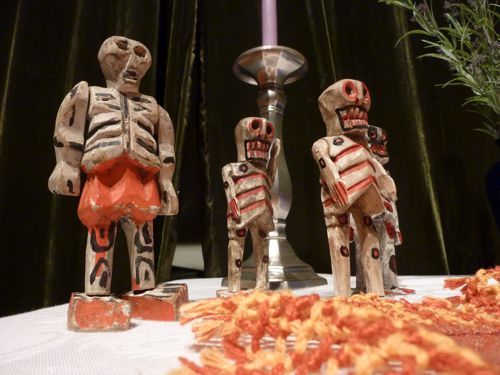

It brought me back to the 5Rhythms workshop I had done in October, the one Gabrielle Roth was supposed to lead. Our space was decorated in black and white, a celebration of living and dying and everything in-between.
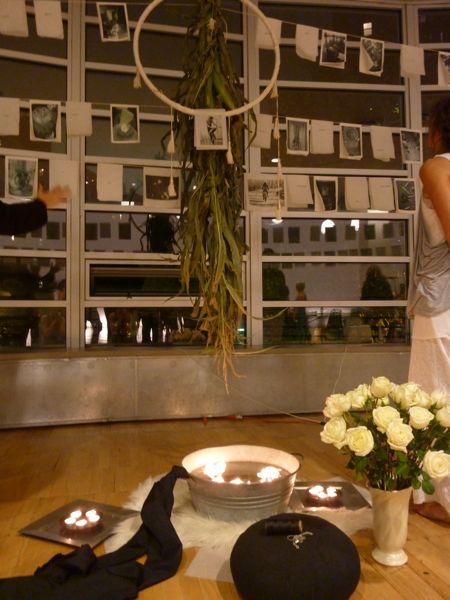
It was a poignant event, but never “dark.” Gabrielle’s son Jonathan and her husband Robert talked about the shadows, brought them to the forefront, but never thrust us into complete darkness or misery. We danced along the continuum, at times more heartbroken than others, sometimes going from crying to laughing to crying in a matter of minutes.
* * *
I don’t know what the Children’s Television Workshop was thinking when it introduced those freaky Yip-Yip martians to Sesame Street, but I have to say, those educational researchers must have been onto something with the shadow puppets. Even though I didn’t accept it at the time, I’ve come to realize that shadows aren’t bad or scary, whether we’re talking about a hand becoming a horse or Chaos becoming confusion.
Our shadows are always with us, even (and especially) on the brightest and lightest of days. It’s about time we become acquainted with our other half so we can better understand the full spectrum of our movement, and—more important—our existence.
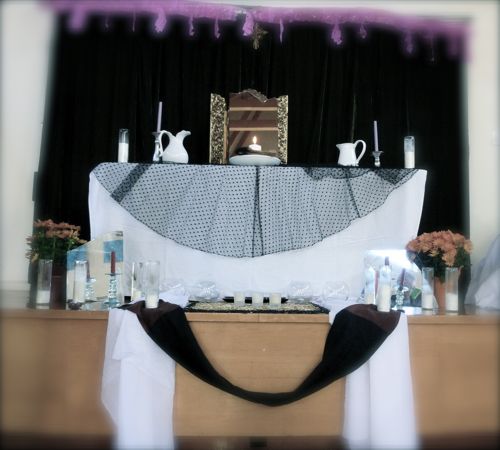
Light and Shadow installation
On the last Friday of October, I set out for my monthly 5Rhythms class in South Jersey. Fourth Fridays at Yoga for Living, as I had been doing regularly for the past two and a half years. It’s an event I mark on my calendar with exclamation points and spirals; it brings an anticipation that hits me full-force at around 3 p.m. on the day of, my feet becoming restless in my office chair, my body aching to move beyond the three gray walls that comprise my cubicle.
This time, however, something felt different.
Not even a week prior, I had been in New York City dancing in what turned out to be probably the biggest celebration of 5Rhythms of all times. Four days of moving, crying, laughing, stomping, rolling, exploring, discovering, sweating, and breathing with 150 individuals from around the world, sharing this practice with some of its most devoted dancers and talented teachers. It was such a massive group that one collective inhalation and exhalation sounded and felt like Mother Earth sighing. The energy was electric, as powerful as the speeding subways that ran under our feet, the megawatts of light that illuminated the island around us.
So, I wondered, how was I supposed to go from THAT to *this*, the quaint little 5Rhythms class in southern New Jersey, held in the basement of an office building, where the low-hanging ceiling prevents any enthusiastic leaps upward, where at most maybe a dozen or so people would show up? Where on earth would the energy come from? I had taken one of the deepest breaths of my dancing life in New York; could this 2-hour class with only a handful of other individuals sustain me, or would it feel like sucking through a straw?
The doubt lingered with me as I descended into the basement. But then, as I entered of softly lit, womb-like dancing space, my eyes made contact with my teacher, Richard, and then moved across the room to the altar in the corner, a framed photo of Gabrielle Roth surrounded by flickering votive candles, an illustration of a commanding black bird perched at foot-level.
Instantly, all of my hesitations evaporated. No, dancing won’t be a problem, I thought. And with that, I spread my wings and allowed the raven inside of me to take flight.
* * *
In these funky, frenetic times, we need our feet on the ground, our instincts intact and our intuition in full force. Being true to the signs and signals that come from within is our survival art, not to mention a way to move with integrity in a world in flux.
So began the description of “Slow Moving with Chaos,” the workshop I had emphatically penned on my calendar back in the summer, when word had begun to spread that 5Rhythms founder Gabrielle Roth—who rarely made public appearances anymore due to her ailing health—would be teaching a 4-day workshop in New York City. For the longest time, there were no concrete details about the event, only dates and the fact that Gabrielle and her son Jonathan Horan would be facilitating. I checked The Moving Center’s website almost every week, waiting. TBA. TBA. TBA, all through the summer.
As a planner and stickler for details, it killed me that I didn’t have all of the 5Ws right away; nonetheless, I was going to New York, come what may. As you may be able guess from this blog, 5Rhythms is a HUGE part of my life, beginning in 2009 when I read Gabrielle’s Sweat Your Prayers. Everything I have ever felt about dancing was reinforced in that book, and it opened my eyes to a form of movement that so perfectly follows the natural rhythms of the human persona and natural world. The book is very much like a bible to me, a work that I can re-visit over and over again, sentences and paragraphs touching me in new ways with each reading as my own practice expands. The pages are dog-eared; notes are scribbled in the margin.
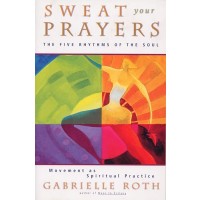
Gabrielle’s words, her oceans of prose from which five lighthouses guide weary sailors—Flowing, Staccato, Chaos, Lyrical, Stillness—had become my mantras. The wisdom she had imparted on her teacher trainees, who then passed this kinesthetic knowledge down to students like myself, was changing my life, day by day, Wave by Wave, rhythm by rhythm.
I needed to meet this woman.
As soon all the details about the workshop were released, my check was in the mail.
* * *
Hello Dancing Loved Ones,
Over the last few weeks Gabrielle has been moving into stillness. Robert [Gabrielle’s husband] and I [Jonathan] have been deeply moved by the love and support pouring in from around the world. We appreciate each and every message and have been watching her smile when we share.
We have now entered a time when we need to focus our energy on Gabrielle. We would like to ask that you all please understand that we can no longer respond to the outpouring of beautiful words via phone and the email individually. Gabrielle has asked to take refuge in stillness and solitude, and as her family, we need to honor that.
This was the e-mail I received from The Moving Center only a few days before the workshop was scheduled to begin. Gabrielle was dying, yet people from all over the world were actively on their way to New York by planes, trains, and taxi cabs to meet her.
The news rocked the dancing community by surprise. Online, prayers and songs of stillness were shared via a Facebook page set up in Gabrielle’s honor. The outpouring of love was overwhelming.
Yet, no one ever said the workshop was called off or postponed. How could we dance Chaos when our teacher was in her final breaths of Stillness? Who would lead us as Gabrielle lay in bed with her son by her side? So many questions, but with a heavy heart and an open mind about what the next 4 days would hold, I set off to the city.
* * *
Day 1, Manhattan, Lower East Side. The mood in the lobby of the Paul Taylor Dance Company studio on Thursday night was a heavy happiness; fellow dancers excited to see each other but unsure if smiling was appropriate at this time. The doors to the main studio were still closed, so many mysteries lying just a few feet away. When they finally opened, I walked into a sacred space of Sanskrit chanting, ethereal white lights glowing on the floor and ceiling, the installation at the front of the room a black-and-white homage to Gabrielle, a clothesline strung from wall to wall, decorated with images and words representative of her work. A vase of flowers, candles floating in a bowl of water.

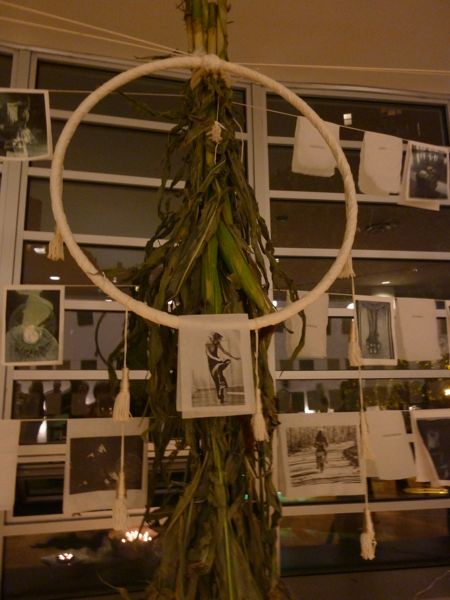


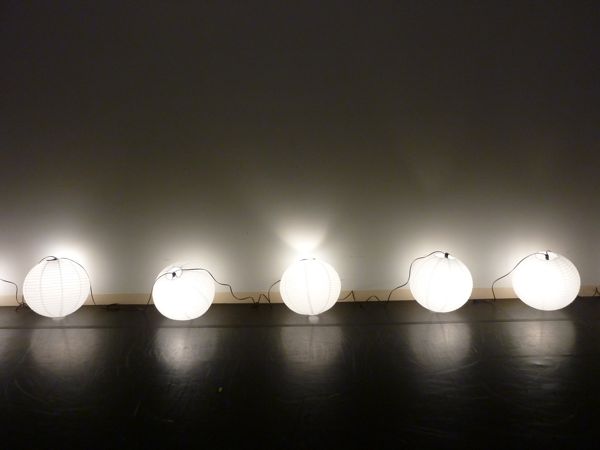
It was like walking into a church, a Buddhist temple, a funeral home. Heads bowed, utmost reverence. Still, we were unsure of what we were actually walking into. Was this a vigil? A memorial? A wake?

Instead of asking the questions, we danced them. There was no introductory speech or Hello, How Are Yous? Thanks to the last-minute help of NYC teacher Tammy Burstein, music played, and everyone instinctively knew it was time to warm up and flow. As we moved to Staccato and then to Chaos, it was clear that everyone here knew this language, despite the international flavor of the crowd. Just moments ago, I had been in the women’s changing room, surrounded by a flurry of accents and conversations in German, Spanish, and French. On the dance floor, there was no such thing as a linguistic barrier. Different tongues, same language.
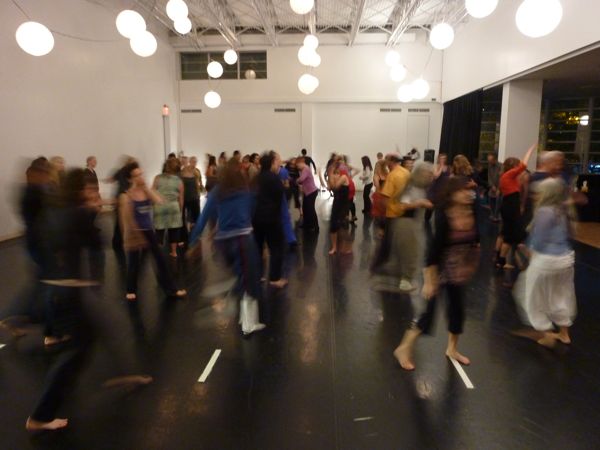
The center of the room is like a concert pit—crowded, hot, a throbbing powerhouse of either ecstasy or anxiety, depending on one’s tolerance for lack of oxygen. I am simultaneously thrilled to be moving with so many bodies but also terrified. How can I have so many people around me but feel so alone? I feel like I’m dancing in the middle of Times Square. It’s not until Tammy instructs us to walk around the room, meet the eyes of those you pass, and then brush hands with those you pass that the anxiety dissipates. The emotional and physical contact with others grounds me; I realize then how much I have grown in my past 2.5 years of doing the 5Rhythms, having gone from being reluctant at the notion of having to share my movement to needing it to be nourished.
After Lyrical, our Stillness is sitting, ears and hearts open as Robert, Gabrielle’s husband, comes to the front of the room to update us on her condition. Somewhere in an apartment in the city, Gabrielle is dying. She is in good care, Robert assures us, and her face continues to light up whenever her son Jonathan enters the room. Never a quitter, Gabrielle had exclaimed, “I gotta do that f**king workshop!” only 3 days beforehand, Robert said. This was supposed to be her retirement party, the last hurrah.
After wiping tears from his eyes, Robert took his usual place behind the tom drum and led us through another Wave, the percussion hitting me deep and creating an easy entrance into movement. We end the evening chanting Om Namah Shivaya, Gabrielle’s favorite mantra, heading out into the night with uncertainty lumped in our throats.
* * *
Over the next 3 days, we stepped into the studio each afternoon not knowing whether Gabrielle was still with us. Robert was present for most of the program, and much to our surprise, Jonathan showed up halfway through Friday’s session and remained through our final moments on Sunday.
I remember seeing Jonathan walk into the studio as we were in the middle of a Wave; I had never met him in person before but knew his face. The magnitude of his presence hit me in the gut, adding fuel to my movement. I think we had all accepted the fact that our two leaders would not be present for the workshop, and so for Jonathan to show up—and facilitate—100-some people as his mother lay dying was truly a gift.
“The Raven still lives!” Jonathan exclaimed as we gathered around him that afternoon, a collective sigh among our group. From there, he spoke candidly about living, dying, and love, his face crumpling at times, beaming at others.
He was genuinely human, a man in the throes of living with dying, talking from his heart, speaking through his body, reminding us to pay attention to the signals we get from our body as we dance. “What are you going to do with that information?!” he prodded. How can we become our own teachers? “Jonny won’t always be here to tell you to move your hips!” he reminded.
He demonstrated a stilted version of the 5Rhythms, acting out each rhythm without intention, without heart. It was a humorous but sad pantomime, a visual reminder of the two-dimensional world we often find ourselves trapped in.
“Yeah, you can say ‘I love you,’” he said in a nasal voice. “I love you [pointing to someone], I love you [pointing to someone else], I love you!” he demonstrated, charming, but no depth to his words. And then Jonathan stood tall, took a long inhalation, and bowed forward, gesturing gracefully toward the group. “I L O V E you,” he expressed, the emotion palpable. The difference in presentation was profound, and several of us gasped or awww‘ed or sighed as his words hit our heart. Without intention and passion, our words and actions are like yoga poses held without breath, going through the motions without actually being in our bodies.
“And why do restaurant servers always ask if I’m still ‘working’ on my meal?” he questioned. “No, I’m enjoying it,” he said. “My dinner isn’t a job. It’s not work. I’m loving this food.”
* * *
Food and love went very much hand in hand during the workshop. After so much dancing and sweating, our 20- to 60-minute snack breaks were a welcome reprieve, the peanut butter-filled pretzels and gluten-free ginger snaps the crew provided tasting like food of the gods. The difference between the final dance pre-break and the first dance post-break is like night and day. Nourished, hydrated, and rested with time to pee, talk, and reboot, our movement carries a new quality, wilted flowers sprouting back to life after a rainfall. I feel reborn.

* * *
Our breaks are essential. The physical act of dancing is exhausting, but so is all the emotional baggage that comes along with the practice.
I find myself against the back wall during an exercise in exploring centeredness versus uncenteredness, a dance I will not forget for a long time. I never intended to dance with that wall for so long, but I closed my eyes and fell into one of the most powerful releases of movement my body has ever endured, the wall being tender, the wall being a punching bag, the wall being a window, the wall being just a boring old wall. Somewhere in the depths of my brain, a little voice tried to pry me away from the wall, to interact with the rest of the group, to open my eyes, but I resisted the temptation to escape; my body was giving me so much information, and as violent as it looked, it needed this freedom and time to get out.
My body surprised me again when Jonathan instructed us to dance our dance of power…and then put the brakes on that and had us switch to powerlessness. Things must have been cooking in my body, because within seconds something came to the surface out of nowhere, a sudden reminder of a time of powerlessness in my life, leaving me squirming on the ground, wailing.
And then there are all the interactions with others, sometimes brief, sometimes extended moments of giving, receiving, and sharing. Engaging in unlikely partnerships, touching the hair of someone you originally were unsure of, placing trust in another to lift you off the ground. Wordless dances that speak volumes, kinetic conversations with others that stay stored in your muscles (the heart being the biggest).
* * *
Why, when we introduce ourselves to others, California-based 5Rhythms teacher Lori Saltzman posed, are we always so quick to talk about “the bad stuff”? Why do we think sharing our traumas, inadequacies, and limitations is so appealing?
What if we celebrated the things we love? she asked.
So, after dancing one of the wildest, loudest, longest periods of Chaos, Lori told us to stop. The room went from frenetic drumming and screaming to silence. We got in groups of four. Paper and pens were passed out.
Use this energy built up from Chaos to reflect on what you love, Lori instructed. And be descriptive, she added. Don’t just say you “love dancing.” Write about the smells, sensations, and sounds that come along with this love. Be specific.
It was serious work. We went to town with those pens, writing furiously. People wrote about books, nature, pets, children, spouses, lovers, friends, mentors. We knew we’d eventually have to share them with our group; that was a given. But that wasn’t the most challenging part of the exercise.
Now, Lori said, after you’ve read your list to your group, end it by saying the following: “And when the time comes, may I say goodbye with grace.”
Tears began to pool in our eyes before we even started speaking; of all the dancing we did over those few days, this was by far the hardest exercise requested.
But it was also the central theme of this emotional roller coaster of a workshop, wasn’t it? All of us had gathered to celebrate the joy that Gabrielle had brought to our lives, our love for her, whether personal or indirect. We had come to “Slow Dance with Chaos,” and now the time had come for us to say goodbye with grace.
* * *
Of course I am sad to have never met Gabrielle in person, and I was very much looking forward to doing so at this workshop, but the poignancy of what occurred in its place is just as moving. The entire event was deeply emotional, essentially turning into a vigil/memorial/life celebration. 5Rhythms teachers from across the country stepped in to help, and I feel so fortunate to have witnessed such devotion.
I stood among people like myself who had never met Gabrielle; people who did one or two workshops with her; people with strong, spiritual connections to her; newly certified teachers who had only recently studied with her; teachers who have followed her dancing path ever since Gabrielle embarked on it herself.
Being among those people with such deep ties to the practice, those so close to Gabrielle, was a phenomenon to witness. Because I didn’t have those strong associations, I found it difficult to mourn the way others were, but I didn’t want to force myself to feel a specific emotion where there was none. I accepted being neutral, a conscious witness, taking in the tears around me without getting overly empathetic. I saw the pain and loss in Tammy, Lucia Horan, and Douglas Drummond’s dances; I heard Jonathan’s voice crack; I felt the sorrow and fear that erupted from Robert’s drumming during Chaos.
I had never met Gabrielle, but being with those closest to her during these moments of vulnerability provided me a glimpse into her spirit; through their exhalations of anguish, I sucked in the air they had shared with their mentor, mother, master, Mama G.
We ended the program by again chanting Om Namah Shivaya and “decorating” blank paper tags with our prayers, whispers, sweat, kisses, breath, and love and hanging them on the medicine wheel at the front of the room.
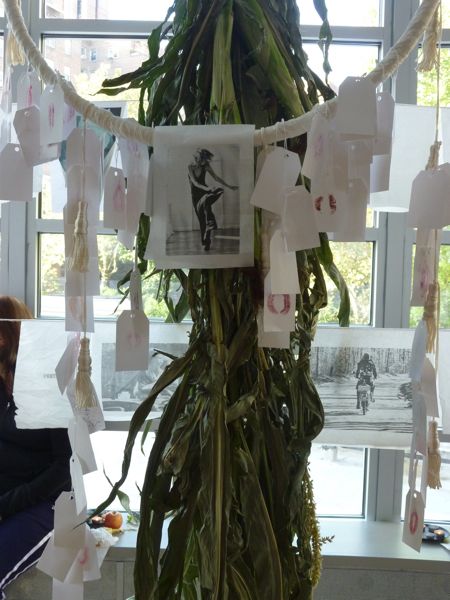
Gabrielle died the following evening at the age of 71.

* * *
Back to the little South Jersey yoga studio—where this story all began—I’m staring at the framed photo of Gabrielle, suddenly remembering why I’m here. No, it’s not New York, and no, there isn’t an international contingent of 100 people around me, but those aren’t reasons to dance.
We dance because we can, the way classmate Michelle so eloquently commented: “I will continue to move as long as my body allows me to, what it allows me to.”
Her words echoed what Jonathan had told us about his mother’s last movements, the way Gabrielle had danced to songs of stillness with her hands during her final days, because that was the only part of her body she could move.
If that spirit can remain with someone through her dying days, then it can sure as hell ignite movement in a healthy 30-something with nothing but a diagnosis of self-doubt.
My experience in New York was a time to memorialize, pay tribute, bow my head, clasp my hands, hold my heart. Now it was time to celebrate Gabrielle’s spirit, pay it forward, lift my head high, and open my hands and heart wide to new connections.

As much as I love to dance, there are in fact days (usually when I forget to drink my afternoon coffee) that I’m just not quite sure my limbs, torso, muscle, and bones are going to sync with my brain and produce some kind of coordinated movement. When I head off to a 5Rhythms or YogaDance class with a dull brain, I fear that even the most rockin’ tunes won’t get the engine going and I’ll end up wasting 2 hours sputtering in the driveway.
Most of the time, however, my inner Henry emerges.
Who is Henry, you ask?
Henry is that glorious moment when inertia suddenly switches to reaction. Henry is eyes lighting up. Henry is fingers snapping. Henry is the reminder that you can feel.
Henry also happens to be the poster child man for the nonprofit organization Music & Memory, whose goal is to bring the therapeutic benefits of personalized music to long-term care (LTC) settings nationally and globally. You may remember Henry from his spin around the social media circuit earlier this year, his wide-eyed and animated face plastered all over Facebook and Reddit video posts: “Man In Nursing Home Reacts To Hearing Music From His Era”:
What I recently found out was that Henry is just one of hundreds of older adults profoundly touched by the gift of music, and one of several featured in the up-and-coming documentary Alive Inside: The Story of Music & Memory. I had the privilege of attending an advanced screening of this documentary at my alma mater, coordinated by the Dean (who also happens to be a fellow blogger!) of my old stomping grounds, the College of Communication & Creative Arts. Both the executive director of Music & Memory, Dan Cohen, and the film’s producer/director, Michael Rossato-Bennett, were present to discuss their project.
Cohen, armed with volumes of evidence-based research on the connections between music, mind, and memory (including testimony from the renowned Oliver Sacks), is on a mission: to help all LTC residents and individuals with Alzheimer’s disease/related dementias reconnect with their joys, dreams, and passions of yesteryear using digital music players as the key to unlocking these deeply rooted memories.
The idea is simple and straightforward: Talk with LTC residents and their family members about what kind of music the residents enjoyed growing up; compile these songs in a personalized iPod playlist; place a pair of headphones on the resident’s ears; press Play.
Of course, the individuals featured in the documentary were ones with the most transformational reactions: Henry, described by his caregiver as “inert and unresponsive” suddenly began signing Cab Calloway, talking about his childhood, and waxing about love and God; Denise, who had been using a walker every day for the past two years, stood up, pushed it aside, and began dancing with the researcher; and Joe, a former performer, started singing like a Broadway star, his clearly trained voice stunning the other residents and staff. He cried afterward, stating that he was so happy to find that connection again.
Cohen pointed out that not everyone has the same reaction—for some residents, the response isn’t instantaneous; for others, it takes several attempts to narrow down just the right music that will spark something in their brains. Sometimes there is no change at all. Nevertheless, he said, there’s never been an adverse reaction to listening to some music. The video clip of Henry, in fact, was filmed 4 years ago. Today, Cohen said, Henry still has his music protocol. He’s declining physically yet remaining stable cognitively. Had it not been for the music, both domains instead of one would have most likely been on a downward slope.
This effect of music on the mind is nothing new, nor is the notion of bringing it into the lives of nursing home residents. The genius of Cohen’s vision, however, is (a) personalization and (b) high-quality stereophonic audio. With today’s technology, volunteers can easily create customized playlists for residents, adding and eliminating songs with the click of a mouse. This is one key difference in Cohen’s program versus, say, playing a record of Count Basie in the nursing home living room. Not everyone is going to appreciate Count Basie, and his music may not fire the neurons of someone who prefers bluegrass or the Beach Boys. The Music & Memory program also strives to personalize not just the music but a resident’s schedule as well. Maybe Jane likes to wake up to Broadway showtunes but functions better at bedtime with a soothing melody. With this program, residents’ music is tailored to their personal preferences, mood, and time of day.
In addition, the use of crystal-clear digital sound and the iPod headphones are crucial in a nursing home, where auditory distractions are commonplace. This way, residents get a “direct infusion of music,” said Cohen. Also, in the case of Alzheimer’s disease, one’s ability to filter out background noise diminishes, he pointed out. A stereo sitting on a nightstand may be useless for someone who is going to be distracted by a ticking clock or voices in the hallway.
While this is all very inspiring work, one of the challenges Cohen faces is convincing nursing home CEOs and potential donors that it is worth the money. It can be disheartening when facilities and insurance companies will pay millions of dollars for a treasure chest of antidepressant/antipsychotic drugs but can’t find value in spending $40 per person for a program that will rejuvenate hearts and souls, something no drug on the market can do. It is the lazy/ignorant route to point at patients slumped in the corner and claim that they are withdrawn and unresponsive, so if drugs can’t help them, how can an hour of Elvis?
As editor of two gerontological nursing publications for the past 5 years, I guess you could say I have a soft spot in my heart for the older adult population, and yes, that is partially why I attended the screening; however, I was more interested in witnessing just how magical music can be. Nearly everyone featured in the documentary had some kind of physical response to the music—tapping their feet, swaying, gesturing their arms like a conductor—a testament to how deeply music is stored and can be felt in our bodies. One woman—bedridden and catatonic—began rocking back and forth when the headphones were placed on her ears.
It’s reactions like this that make me even more appreciative of not only Cohen’s work but that of movement-based therapeutic modalities such as Let Your Yoga Dance (which has a separate teacher training for those who wish to work with special populations, including older adults), the 5Rhythms Reach Out for elders, and Wu Tao Dance for the dementia population. When the older adults in Cohen’s Music & Memory program start ditching their walkers and wheelchairs, these groups will be prepared to add safe movement to that oh-so-magic music.
Have you found your inner Henry yet? Put on some music and see if it does to you what it does to Henry:
“It gives me the feeling of love, of romance. I figure right now the world needs to come into music, singing. You’ve got beautiful music here.”

Sometimes the most inspiring component of a 5Rhythms class is not the music or the environment or the people but rather the guidance or encouragement the instructor shares mid-dance via microphone, a phrase that touches you just the right way, a combination of nouns, verbs, or adjectives composed and delivered in such a manner that words become energy in mere milliseconds.
For example, during Amara Pagano’s workshop last month, a simple, emphatic “There you go” would sometimes launch me from minimally energized to borderline explosive.
However, one phrase I never imagined would (a) ever be uttered during class, and (b) be such a catalyst for me is the following, courtesy of Douglas Drummond:
“Bust out your inner blacksmith.”
Now, I have imagined myself to take on several identifies and forms during a 5Rhythms class—a high priestess, a tiger, a lady in red, a collection of vibrating atoms—but never a dirty-faced dude wearing safety goggles and a leather apron, forging iron over an open flame.
But the command made sense at the time, as me and about 15 other dancers were in the middle of Douglas’ “Embodying the Elemental” workshop, and our Staccato—the element of fire—was getting hotter by the minute. We had just dug up the earth with our feet (my metaphor for Flowing; we were on a wooden floor the whole time), and now the music was picking up tempo and busting some bass, and it was our duty to transform this collection of dirt-speckled minerals with the fire churning from our bellies.

Even though I was physically dancing inside a church auditorium in Pennsylvania and a primary school in New Jersey, the two-day experience ended up being a journey into the center of the earth and on edge of the cosmos. Each class consisted of two standard Waves, but we approached each rhythm as an element:
Flowing: Earth
Staccato: Fire
Chaos: Water
Lyrical: Air/Wind
Stillness: Ether

The same elements are represented by prayer flags, like those hanging in the kitchen.
Connecting the 5Rhythms with the natural world brought a new level of understanding to this often complex dance. As much as I loved Amara’s Fire of Love workshop, associating the dance with heavy-duty and abstract concepts such as fear, love, and loss brought a certain degree of difficulty to the process. But water, sand, wind…how tangible these objects are, how primal.
We all know how pliable earth feels under our toes and how the threat of fire causes us to jump and react. Douglas acknowledged that everyone has had an experience with these elements, some positive and others not so much. While it is easy to associate earth with a flourishing garden or sandy beach, Douglas is from New Zealand, an area on fault lines where the constant threat of seismic activity makes this element a bit frightening. And yes, how refreshing it is to open the windows on a spring day and allow the breeze to rustle your curtains, but this same element of air and wind can also take the shape of a funnel cloud and wipe out entire towns.
At first I was perplexed about the element of water representing Chaos—Isn’t water always associated with flowing?—but the more it was explained, the more it made sense. Water is temperamental, unpredictable. I mean, heck, water can freeze, water can boil, water can turn to a solid or evaporate into steam. A heavy rainfall can turn into a flash flood in a matter of minutes, and a steady flow of water underground can turn into this the moment its container breaks:

Water main break in Center City, Philadelphia, the same day as the workshop.
To be able to actually visualize the rhythms was something relatively new to me. I loved Douglas’ example of how dancing in Staccato requires being aware of your environment: If you’re standing in tightly packed group, are you going to bust out a raging bonfire that’s going to burn others around you, or can you achieve the same heat with a simple and sharp strike of a match?
I’ll tell you, it was hard at times not to let Staccato become the blazing bonfire. Douglas’ playlist was heavy on the dubstep/psy-trance/electronica, music I seldom listen to but when I do—WATCH OUT! That genre already has that little electric “buzz” built it; my veins and arteries basically became live wires. And I love the brief moments of pause/suspension in the music—it reminded me of trick candles being blown out and then coming back to life, stopping for a breath (…) and then launching right back into the movement (!!!).
By the time Stillness rolled around, my mind was definitely in the ether; I was in a whole new dimension. Maybe it’s because I had just played with fire and water and been electrocuted, that the Four Winds had just resuscitated me with their breath of life, but during Stillness I hovered in a state of acute awareness and deep meditation, a bit scared by this near-possession but allowing it to move through me, because as Douglas had stated earlier, the element of ether is the deepest mystery, the enigmatic.
In Tibetan Buddhism, ether is defined as the regions of space beyond the earth’s atmosphere; the heavens. For me, Stillness is like looking in a mirror and seeing nothing but knowing and feeling that something is there. It is vibrating wildly like the smallest speck of matter, moments away from bursting and expanding into a vast universe, the Big Bang of my consciousness. It is also ending class with my limbs feeling like magnets being drawn down into the earth’s magma, barely able to rise from the floor and shuffle over to the center of the room for the final sharing circle.
And just as we have to share this planet, Douglas also gave us plenty of time to share our thoughts with each other. In pairs, we answered the question, “In the element of ___ (fill in the blank with the given element), I feel ___.” Douglas emphasized that this was an exercise in conscious listening—while the speaker spoke, the listener was simply to listen—no nodding in agreement, frowning, prompting the speaker in any way. Doing both workshops, what a gift it was to hear 10 different descriptions of these elements. I don’t recall everything that I stated, but I do remember snippets:
In the element of earth, I feel sludge, resistance.
In the element of fire, I feel electricity.
In the element of water, I feel like I am submerged, having no oxygen but hearing every little breath and sound my body makes.
In the element of air, I feel like a dolphin coming to the surface, the breath that connects me with the rest of the world.
In the element of ether, I feel a spiritual hypnosis, grasping for something that is always just out of reach, the beauty you feel but cannot see.
Honor and respect these elements, Douglas reminded us. They were here long before us and will exist well beyond our lifetime. Recognize their beauty, acknowledge their power, and feel the rhythms they hum, crackle, churn, whisper, and vibrate.
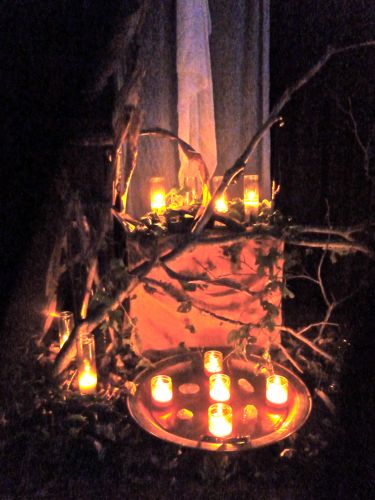
Element-inspired installation, Day 2.
I’ve sat down at my computer so many times over the past week in an attempt to document the three-day “Fire of Love” 5Rhythms workshop with Amara Pagano I attended in late September, and each time my fingers try to translate movement into words, I get discouraged. The hard, clickety-clack sensation of my metallic keyboard feels so unnatural and sterile, a device more fit for writing about a tap-dancing or clogging class, not about a program created to explore the inner workings of the body’s most fragile organ.

Opening night installation
“I wish I were a ballet blogger,” I say. “It would be so much easier.”
If I blogged strictly about ballet, I’d write about combinations we learned, steps that challenged me, the way I wobbled during my fouette turns or how I think my grand jete needs more height. I wouldn’t have to write about the experience of delving deep into the next level of 5Rhythms after Waves—Heartbeat—an act akin to going out for a run with a twisted ankle. I’ve already gleaned so much about myself during Waves practice, have faced questions that only present themselves through movement. My dance has already transitioned from mind to body to heart; dear god, did I really need to take it a step further?
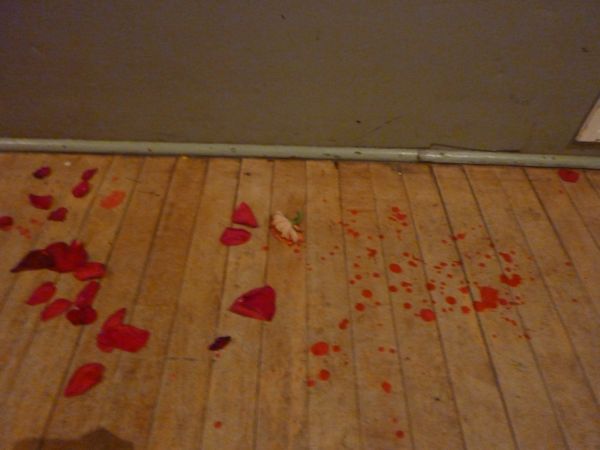
Love is messy
If I blogged strictly about ballet, I’d describe the teacher by how tightly her hair was pulled back, the commands she barked, the feedback she offered on my lines and execution. I wouldn’t have to write about the way Amara Pagano could speak without uttering a word, how her fluid body conveyed more information than any encyclopedia, how her eyes connected with each and every student. I wouldn’t have to explain that when I danced because Amara said so, I was dancing for myself, not because I was trying to impress a superior. I threw myself into the movement because Amara was serious about self-realization; she didn’t care about appearance or rhythm or lines—all she pressed us for was authenticity and the courage to “let it go.”
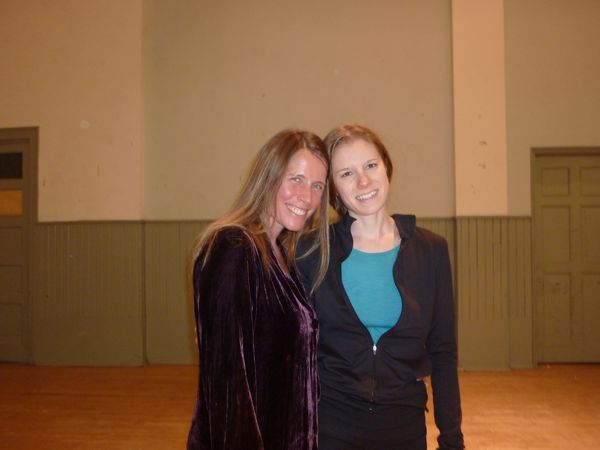
Amara Pagano and me
If I blogged strictly about ballet, I’d post pictures of my bloodied toes, the result of being packed too tightly into pointe shoes. I wouldn’t have to explain how the purplish-brown bruise on my elbow was from throwing myself into a dance depicting grief, how the skin on the top of my foot was torn after dragging my lower body across the floor, my arms propelling my lifeless legs behind me in an exercise exploring our fear.

A ballet blogger’s description of “center work” would involve small jumps, turns, combinations of 8, 16, 24, and 32. I wouldn’t have to write about a group exercise in which we were told to trust no one but ourselves, to move as though you are suspicious of everyone. I wouldn’t have to describe how fear built up so intensely that when Amara told us to switch the fear to excitement, the outburst exploding from my body was manic, a throaty laughter I didn’t even recognize, wild, wicked, and somewhat lascivious. Back and forth we went—fear, excitement, fear, excitement—continuing the dichotomies with a partner, screaming, baring teeth, grinding pelvises, alternating from witches to whores, criminals to cat-nipped kittens. A ballet blogger wouldn’t have to explain how such “center work” pushed us into the concept of fearlessness, finding the euphoric midpoint between fear and excitement.
“I wish I were a language instruction blogger,” I say. “It would be so much easier.”
If I blogged strictly about language, every day I’d present a new word and translate it into Italian or Swahili, maybe use it in a sentence as well. I wouldn’t have to write about the surprise I felt after hearing a French-Canadian accent emerge from the mouth of a young woman with whom I engaged in an intense responder/revealer partner dance. Our movement was such a rich conversation of fear, empathy, support, and encouragement; I never once thought of her as a “foreigner.” If I blogged about nouns and adjectives, I wouldn’t have to write about how dance is a universal language; when one dances fear, you will understand it and respond to it, no matter what country you’re from or what accent you carry. I wouldn’t have to explain how when one dances love, it translates both as a whisper in the ear and a scream in your face—so subtle and personal, yet so loud and clear and public.

If I blogged about language, I’d describe how X means Y, how A means B, clear definitions for words, proper ways of constructing sentences. I wouldn’t have to write about the language of love, defined by Amara as awareness, being available. I wouldn’t have to write about allowing a partner to touch me, being instructed to just take in the touch, be receptive, before moving and responding to the touch. I wouldn’t have to go into detail about using the floor as a partner and then returning to my human partner to extend this “conversation,” or the disappointment I experienced when my partner’s movement felt tired and distant.
If I were a language instruction blogger, my post on pronouns would discuss nosotros versus vosotros, tu versus Usted, you, me, I, we. I wouldn’t have to write about the difficulties of retaining my “I” movement when dancing with a partner, the pitfalls of too quickly abandoning “I” for “you,” the connection that develops when the right amount of “I” (authentic movement) and “you” (a partner’s movement) equals “we” (a dance of revelation, response, and mutuality). If I were a language blogger, “we” would be just a two-letter word, not a concept involving a group of people ending a three-day workshop as an interconnected mass, limbs linked, hands touching, someone’s cheek resting atop my thigh, my fingers running through a woman’s saturated hair, a circuit of energy looping through our intertwined arms and legs, a current so strong that I swear I could feel the pulse of even those I wasn’t physically touching.

“I wish I were a dream blogger,” I say. “It would be so much easier.”
If I blogged strictly about dreams, I’d describe and interpret the fantastical images that play through my brain at night. I wouldn’t have to write about the stirring visions I experience on the dance floor, like when I closed my eyes and saw not just my classmates’ faces but felt their movement talk through my body, as though everyone had been squeezed into me and I into them, until we were simply a giant concoction of universal movement, no skin, bones, or muscle separating us. I wouldn’t have to write about how that experience felt like I was serving as a kind of medium for my classmates’ stories, experiencing not just their dance but the emotion behind it as well. I wouldn’t have to describe how the experience comforted me, a metaphorical experience for the realization I am not alone, that even after just a few hours of being introduced to these people, they now live inside of me.

“I wish I were a fashion blogger,” I say. “It would be so much easier.”
If I blogged strictly about fashion, a post about evening wear would discuss necklines and fabrics and hems. I wouldn’t have to write about how a little red dress serving as our installation’s centerpiece was the catalyst for my dance of fearlessness. I wouldn’t have to explain that, after dancing out “fear” across the floor—my movements heavy, reluctant, dragging, having to tug at my pant leg to propel me forward—I had no idea how I was going to follow Amara’s instruction to turn around and return down the floor with fearlessness. The resistance was overwhelming, and I stopped at the floor’s edge with no idea of how I was going to turn around and face fear in the eyes. I couldn’t. I was stuck. Expletives ran through my head, and I felt like a failure as my dancemates’ grimaces turned to smiles. If I were a fashion blogger, I wouldn’t have to explain how I stood against the auditorium stage in a panic, looked up, and saw that red dress before me—that was my cue. I want to be that lady in red, a voice inside of me said. I will wear that dress. Like that—BOOM!—fearlessness! I whipped around and returned down the floor in seconds with intensity, boldness, espresso in my cup. My speed down the floor wasn’t an attempt to evade the exercise but rather was me listening to the authentic voice that boomed forth. This fearlessness didn’t want to waste time, it wanted action. NOW.

If I were a fashion blogger, I’d write about which celebrity looks best in that little red dress. I wouldn’t have to write about metaphorically wearing that dress myself for the rest of the workshop, embracing fearlessness, stepping forward and dancing with someone who intimidated the hell out of me, being surprised at how much I gave myself to her, observing my emotions shift from fear to excitement to fearlessness in a cycle. I loved it, I hated it, I was scared, I was joyful. I was.
If I were a fashion blogger, the little red dress would be just a little red dress, not a symbol of sensuality and womanhood. I wouldn’t have to write about the way it touched me to my core, how when I observed two women in the throes of a throbbing, shaking voodoo dance, I stood beside them with my palms open, soaking up their energy, a gnawing, gripping, pounding desire to be in their bodies, feel the way that red dress enveloped their flesh, share their rawness, maturity, and wisdom.
“I wish I were anything but an overly sensitive dance/movement meditation blogger,” I say. “It would be so much easier.”
Wouldn’t it? But I am, and so I dance, and so I feel, and so I write.





 Flowtation Devices